
 By Pat Kelly
 You got chickens so you'd know exactly what goes into your food. Clean eggs, from your yard, from birds you raised.
Then the weeds showed up. And now you're staring at a sprayer wondering if you're about to undo the whole point.
You're not overthinking this. Over 13 million American households keep backyard flocks now — that number hit a record in 2025 when egg prices crossed $4 a dozen. Ninety-five percent of those flock owners keep chickens for the same reason you do: eggs for the family.
So the question matters. Here's what the peer-reviewed research actually says — and what most lawn care sites won't tell you.
Is Weed Killer Safe for Chickens?
Depends entirely on the type. And that's where most advice falls apart — forums tell you to "wait a few days" without explaining why some herbicides are genuinely dangerous to poultry and others aren't.
The difference comes down to one word: translocating.
Translocating herbicides — the most common type on store shelves — get absorbed into the plant. They travel through stems, leaves, and roots. They persist inside the plant tissue for days or weeks. When your chicken eats that plant, she eats the chemical with it.
Contact herbicides work on the surface. They dehydrate the plant tissue they touch without entering the plant's circulatory system. Once dry, there's no chemical inside the plant to ingest.
That distinction is everything when your birds eat every green thing in the yard.
Can Herbicides Get Into Your Chicken Eggs?
Yes. And the research is specific.
A 2021 study published in Scientific Reports (Nature) analyzed eggs from hens exposed to glyphosate through feed. Glyphosate concentration in egg yolks reached 223 ng/g in exposed hens — compared to 0.26 ng/g in controls. That's an 858-fold increase.
A 2025 review in the World's Poultry Science Journal confirmed it: glyphosate residues were found in eggs, the herbicide caused lipid damage in embryo brains, and it reduced embryonic development in exposed flocks.
A separate 2025 study from Greece detected six different pesticide residues in backyard egg samples — including herbicide metabolites — even from non-commercial home flocks.
You started keeping chickens to get away from this. If you're spraying translocating herbicides on the ground where your flock forages, the chemicals end up where you'd expect — on your breakfast table.
Three Ways Your Flock Gets Exposed
Most guides focus on whether a product will "kill your birds." That's the wrong bar. Acute poisoning from herbicides is rare. The real damage is slower and hits three targets.
1. Direct Ingestion — Your Birds Eat Treated Plants
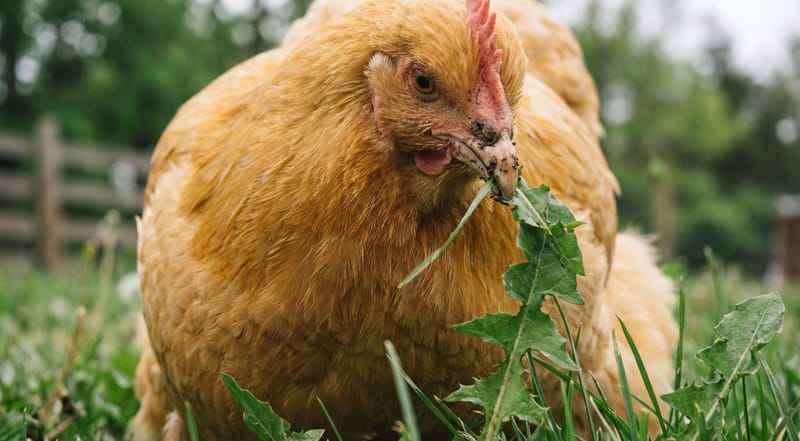
Chickens don't walk across your lawn like a dog. They eat it. Every weed, every blade of grass, every bug. A 2022 study in PLOS ONE found that chronic glyphosate ingestion disrupted cecal microbiota in hens — the gut bacteria that drive immune function and nutrient absorption. A 2023 study in Veterinary Research Communications documented elevated white blood cell counts and disrupted immune markers — the first time this was shown in meat-type poultry.
2. Egg Contamination — It Ends Up in the Yolk
The herbicide your chicken ingests doesn't just stay in the bird. It transfers to the eggs. Your family eats those eggs. The 858x concentration increase isn't theoretical. It's measured, published, and peer-reviewed.
3. The Killer Compost — Your Manure Poisons Your Garden
You compost your coop bedding. Chicken manure is garden gold. But certain persistent herbicides — particularly aminopyralid, found in pasture products — survive animal digestion completely intact. They pass through into the manure and contaminate your vegetable garden at concentrations as low as 1–3 parts per billion. Tomatoes, peppers, beans, and lettuce are destroyed. NC State Extension documents this extensively. The phenomenon is so common it has a name: "killer compost."
How Long After Spraying Is It Safe for Chickens?
This is the most-asked question on every chicken forum. And the answer everyone gives — "wait until it dries" or "keep them off for a few days" — misses the point.
With translocating herbicides, the chemical is inside the plant. It doesn't matter if the surface is dry. Your chicken eats the leaf, she eats the chemical. A dry surface with a translocating herbicide underneath is no safer than a wet one.
With contact-based herbicides, the product works on the surface and doesn't enter the plant's vascular system. Once it's dry, the active work is done on the tissue it touched. There's nothing stored inside the plant for the bird to ingest later.
So the honest answer: it depends entirely on the type of herbicide. "Wait until it dries" is only meaningful if the product is contact-based. If it's a translocating product, drying time is irrelevant — the chemical persists inside the plant regardless.
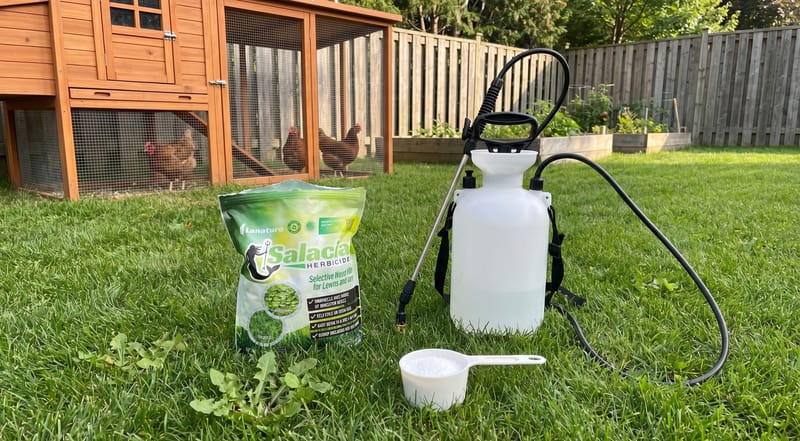
For a contact-based product like Salacia, let the treated area dry before allowing chickens back. Not because of safety concerns — but because birds pecking at wet foliage can wipe the product off the weed before it finishes working. You want the product on the weed, not in a chicken's crop. Spray in the morning before you open the coop.
Ready to Take Back Your Lawn?
Salacia™ is the first OMRI-certified selective organic herbicide — kills weeds, not grass. Choose your lawn size:
What About Ducks?
Everything above applies to ducks — but ducks add a fourth exposure route: water.
Herbicide runoff collects in puddles, drainage ditches, and low spots in your yard. Your ducks swim in it, drink from it, bathe in it. Chickens might drink from a puddle occasionally. Ducks live in them.
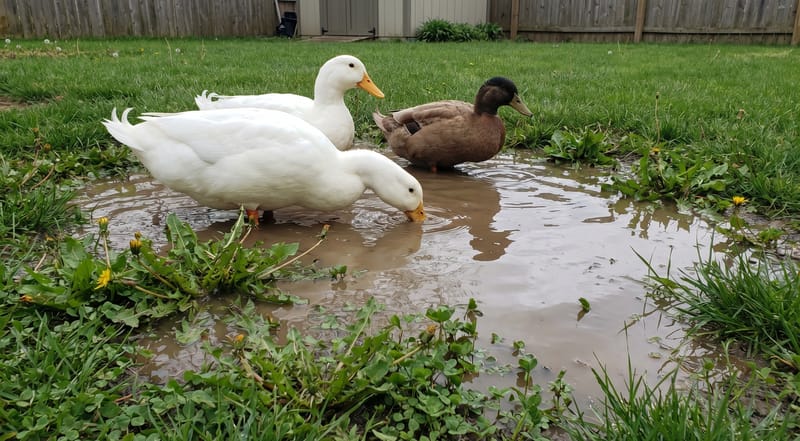
Waterfowl are bioaccumulators — they concentrate environmental toxins through water, aquatic insects, and contaminated vegetation at higher rates than land-foraging birds. Foxglove is so toxic to waterfowl that ducks have died from drinking water that ran off a potted plant — not the plant itself, just the water that touched it.
If you keep ducks, the herbicide you choose needs to be contact-based (no absorbed residues leaching into water) and non-persistent (breaks down on the surface, doesn't accumulate in runoff).
What Actually Makes an Herbicide Chicken-Safe
Now you know the risks. Here's the checklist — and why Salacia Organic Weed Control exists.
Contact-Based, Not Translocating
Salacia works through rapid osmotic dehydration — it dehydrates the plant tissue it touches on contact. It does not enter the plant's vascular system. No absorbed residues means nothing for your birds to ingest through treated vegetation, nothing to transfer to eggs, and nothing to survive in manure.
OMRI Certified Organic
OMRI certification means the product has been independently reviewed and approved for organic use. OMRI-listed products can be used on land where livestock graze with no mandatory withdrawal period.
Selective — The Part Nobody Mentions
Most organic herbicides are non-selective. They burn everything — weeds and grass alike. But your chickens need that grass. They forage on it. It holds the soil together in their run. Bare dirt becomes mud. Mud becomes parasites.
Salacia is the first OMRI-certified selective organic herbicide. Hybrisal Technology gives you two modes from one bag: selective rate (3 cups per gallon) controls broadleaf weeds while preserving your grass. Non-selective rate (4 cups per gallon) for driveways, coop perimeters, and fence lines.
Your flock keeps their forage. You lose the weeds.
Salacia is designed to be selective, but temporary paling or yellowing on lawn grass is possible depending on irrigation, lawn health, application rate, and conditions. Test a small area first.
Already using Salacia around dogs? Same product works for your flock. See our guides for dogs and horse pastures.
How to Spray Around Your Flock
Timing
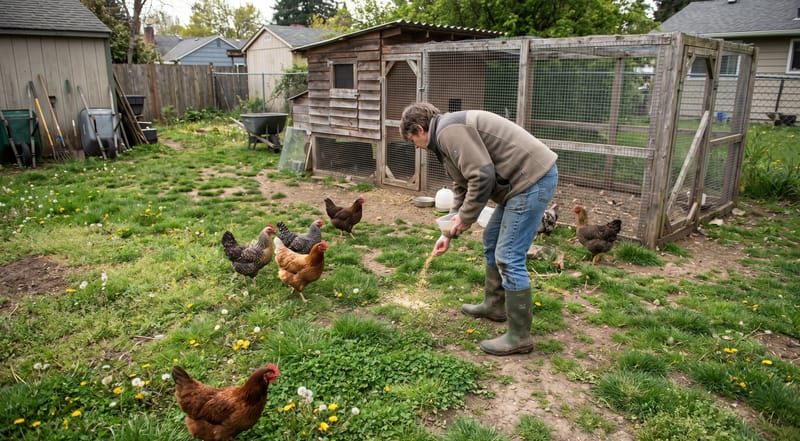
Spray early morning before opening the coop. The treated area dries while your birds are still inside.
Full Coverage
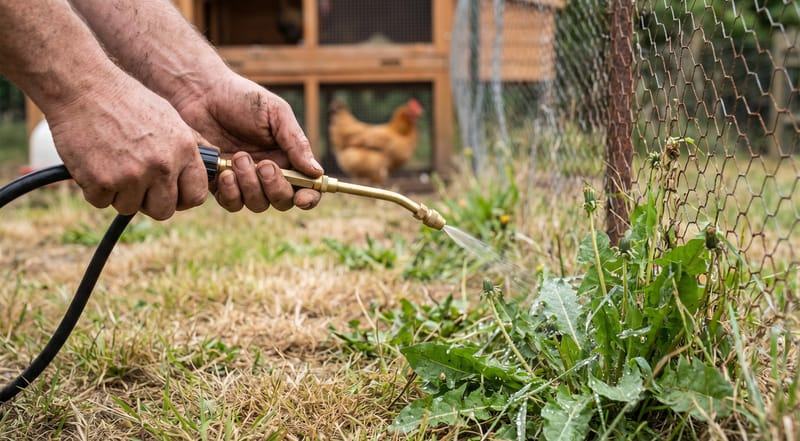
Salacia works on contact. If it doesn't touch the weed, it doesn't work. Spray thoroughly — tops of leaves, undersides, stems, crown, and the soil around the base. Wet to the point of runoff. Not misting. Drenching. Your results are directly proportional to your coverage.
Section Your Yard
Treat half, let the flock use the other half. Rotate next week. Birds stay on untreated ground while the weeds die back.
Weeds Worth Targeting
Your chickens eat some weeds voluntarily — clover, dandelion, chickweed, purslane. That's free forage. The weeds worth treating are the ones they avoid: dock, thistle (spiny and dangerous near bare feet), and nettle. Use Salacia's selective rate to remove these from your lawn while keeping the grass intact.
A few plants are genuinely toxic to poultry — pokeweed, nightshade, and foxglove among them. Free-range birds with plenty of forage typically avoid these, but if they're growing near your coop or run, pull them by hand to eliminate the risk entirely.
For treatment techniques, mixing rates, and results on 46 weeds, see the Weed Control Guide.
Not sure what's growing in your yard?
Upload a photo to Sal — instant weed ID plus a treatment plan tailored to your lawn.
Explore the Weed Control Guide →Comparing your options?
Our full breakdown of what to look for — and what to avoid — is in the organic weed killer guide. Four criteria, real comparison, no marketing fluff. If keeping your grass is the worry, see the best weed killer that won't kill grass.

Lawn
Advisor
Not sure which weed you're looking at? Show Sal.
Sal is Lanaturo's lawn-care expert. He doesn't just name the weed — he builds your exact treatment plan and checks whether today is the right day to spray.
Ready to Take Back Your Lawn?
Salacia™ is the first OMRI-certified selective organic herbicide — kills weeds, not grass. Choose your lawn size:
You left the grocery store for a reason.
Clean eggs. Healthy birds. A yard you actually trust. That's not a dream — it's what happens when your weed control was built for the way you live.
This article is for informational purposes. Always read and follow product label directions. Salacia is labeled Pet Friendly. It is not a veterinary product. Consult a poultry veterinarian for specific flock health concerns.