 By Pat Kelly
 Five facts about glyphosate as of 2026:
- Over 192,000 lawsuits filed in U.S. courts against the manufacturer of the world's most-used herbicide.
- More than $10 billion already paid out to resolve cancer claims, with another $7.25 billion class settlement heading to a final approval hearing on July 9, 2026 — covering more than 40,000 additional claimants.
- The World Health Organization's cancer agency classified glyphosate as Group 2A, "probably carcinogenic to humans," in March 2015.
- 32 countries have banned or significantly restricted glyphosate, including full national bans in Austria, Luxembourg, and Vietnam.
- The manufacturer pulled its glyphosate-based residential products from the US consumer market in 2023, stating the decision was made "to manage litigation risk."
More homeowners are walking away from glyphosate-based herbicides. The reasons vary — some are driven by the ongoing litigation, others by concern for their pets and families, and many simply want an OMRI-certified organic alternative that actually works. Whatever the reason, the search for a glyphosate-free weed killer that delivers real results has never been more urgent.
The problem? Most alternatives don't work. Or they kill everything — grass included. This guide breaks down what's actually available, what performs, and why the first selective organic herbicide changes the equation entirely.
Why Homeowners Are Going Glyphosate-Free
The shift away from glyphosate isn't speculation — it's measurable. In March 2015, the World Health Organization's International Agency for Research on Cancer (IARC) classified glyphosate as "probably carcinogenic to humans" (Group 2A). Since then, more than 192,000 lawsuits have been filed in U.S. courts alleging links between glyphosate exposure and non-Hodgkin lymphoma. The manufacturer has paid over $10 billion in settlements and jury verdicts to resolve those claims, and a fresh $7.25 billion class settlement received preliminary court approval in February 2026 with a final approval hearing scheduled for July 9, 2026 covering an additional 40,000+ claimants.
In 2022, a federal appeals court ordered the EPA to revisit its safety assessment of glyphosate, finding the agency's previous review inadequate. That reassessment remains pending as of 2026.
Meanwhile, the manufacturer itself removed glyphosate from its residential lawn-and-garden products in the United States in 2023 — a decision the company publicly stated was made "to manage litigation risk and not because of any safety concerns." Replacement formulas now sit on retail shelves under the same brand labels, built on different active ingredients. Homeowners noticed.
But awareness alone doesn't solve the problem. You still have weeds. You still need something that works. And that's where the alternatives landscape gets frustrating.
The Problem With Most Alternatives
Search for "glyphosate-free weed killer" and you'll find three categories of products. Each has a fundamental limitation.
Non-Selective Organic Sprays
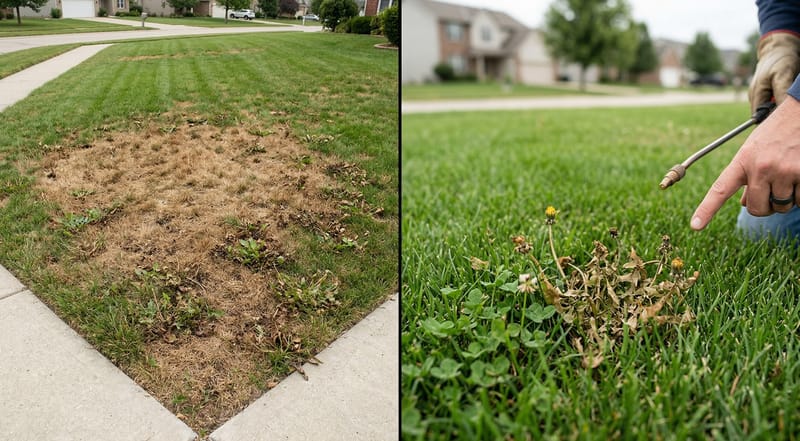
Most organic herbicides on the market are non-selective burn-down formulas. They use contact-burn chemistry to damage plant tissue on the surface. The problem: they kill everything they touch. Spray a dandelion in your lawn with one of these products and you'll kill the dandelion — along with a circle of grass around it. They can't distinguish between what you want to keep and what you want to kill.
They're also surface-only. The weed browns on top, but the root system stays alive. Two weeks later, it's back. For homeowners with lawns, these products create more problems than they solve.
Iron-Based Products
Iron HEDTA herbicides are selective — they target broadleaf weeds without killing grass. But they're contact-only, meaning they burn foliage on the surface while the root system stays alive. Multiple applications at 3–4 week intervals are typically needed, and results vary significantly by species and maturity.
Synthetic Alternatives (Triclopyr, 2,4-D, Dicamba)
These are effective. They're also synthetic chemical herbicides with their own environmental and health concerns. Dicamba is notorious for drift damage to neighboring properties. 2,4-D is restricted in many municipalities. If you're moving away from glyphosate because of health or environmental concerns, swapping it for another synthetic chemical misses the point.
Until recently, those were your options: organics that can't select, iron products that only handle dandelions, or synthetics with the same concerns that made you leave glyphosate in the first place.
Why Glyphosate-Based Herbicides Can't Protect Your Lawn
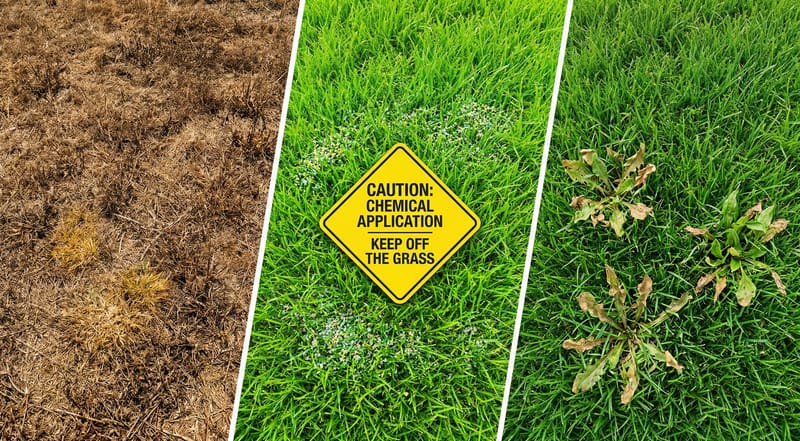
Here's something most people don't realize: glyphosate is permanently locked in non-selective mode. It kills every plant it contacts — weeds, grass, flowers, shrubs. One mode, one outcome. There is no "lawn-safe" rate for glyphosate. There never has been.
That's why glyphosate-based products are labeled for driveways, fence lines, and patios — areas where you want total vegetation kill. Using them on or near a lawn is a gamble with guaranteed collateral damage.
This matters because most homeowners need two things: a way to kill weeds IN their lawn without killing the grass, and a way to kill tough vegetation like poison ivy on fence lines and driveways. Glyphosate can only do the second. For the first, it's useless — or destructive.
The question isn't just "what replaces glyphosate?" It's "what does what glyphosate never could?" A selective weed killer that targets broadleaf weeds while leaving grass untouched — and does it organically.
What a Selective Organic Herbicide Changes
Salacia is the first OMRI-certified selective organic herbicide. Before Salacia, no organic product could selectively kill weeds while preserving grass. Every organic herbicide was non-selective — it burned everything. That's not a marketing claim. It's the state of the market that existed for decades until Hybrisal Technology changed it.
Hybrisal means dual-action from one bag:
- Selective mode (3 cups per gallon): Targets broadleaf weeds — clover, ground ivy, wild violet, dandelion, chickweed, and dozens more — while grass is designed to stay intact. Always test a small area first; temporary paling or yellowing is possible depending on lawn health, irrigation, and conditions.
- Non-selective mode (4 cups per gallon): Total weed control for driveways, fence lines, patios, and tough targets like poison ivy. Same bag.
One product replaces what used to require two separate purchases — a lawn herbicide and a total-kill herbicide. And it does both without glyphosate, without synthetic chemicals, and with OMRI certification for organic use.
The mechanism is physical, not chemical: rapid osmotic dehydration of plant tissues on contact. No absorption into the plant's vascular system. No soil contamination. No chemical residue moving through roots into groundwater. The product works where it lands — and only where it lands.
Ready to Take Back Your Lawn?
Salacia™ is the first OMRI-certified selective organic herbicide — kills weeds, not grass. Choose your lawn size:
Poison Ivy Without Glyphosate
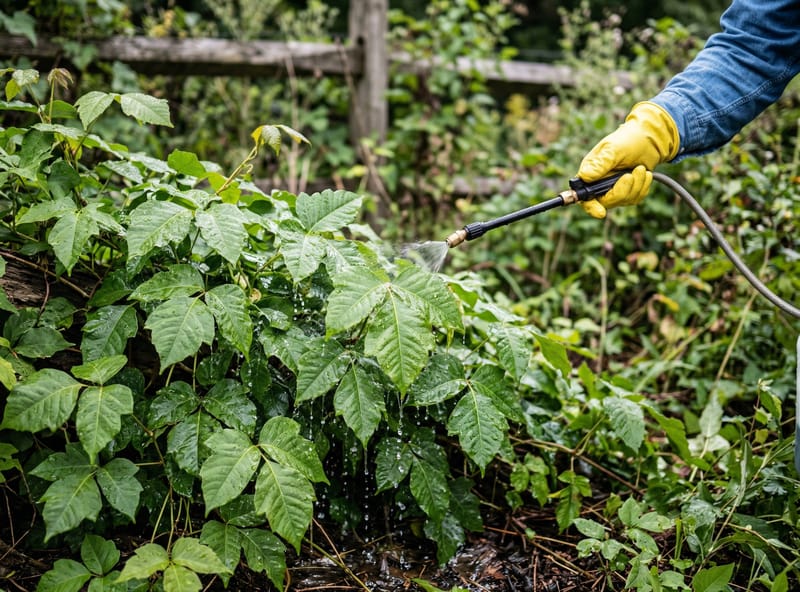
Poison ivy is the weed that sends most people reaching for the strongest chemical they can find. For decades, the standard advice from extension services has been: use a glyphosate-based or triclopyr-based herbicide. Those are effective — but they're also non-selective, meaning they'll kill everything around the poison ivy, and they carry the same concerns that are pushing homeowners away from synthetic chemicals in the first place.
Salacia handles poison ivy at the non-selective rate (4 cups per gallon) with heavy, thorough application. Drench every leaf surface — front and back — every stem, every vine, and the soil area around the base until heavy runoff. Poison ivy is persistent, so expect three or more applications as new growth emerges. Persistence is the key to full control.
Critical safety note: Always wear full protective clothing when treating poison ivy — long sleeves, pants, chemical-resistant gloves, and eye protection. All parts of the plant contain urushiol oil, which causes severe allergic reactions. Never burn poison ivy — the smoke carries urushiol.
For the complete treatment protocol, application photos, and seasonal timing, see our full organic poison ivy control guide.
Over 150 US Communities (and 32 Countries) Have Already Decided
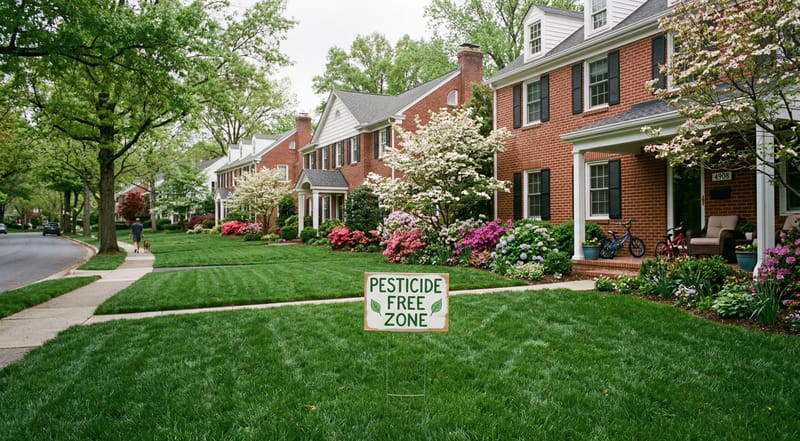
The shift away from synthetic pesticides isn't just a consumer trend — it's becoming law. Over 150 US communities have adopted organic-first or pesticide-restriction policies for lawns, parks, and public spaces.
Montgomery County, Maryland is one of the most significant examples. In 2015, the county passed Bill 52-14, which bans the use of conventional pesticides on private lawns, playgrounds, and childcare facilities. Over one million residents are affected. The city of Rockville adopted the same restrictions in 2022.
Under Montgomery County's law, only three categories of products are allowed on lawns:
- OMRI-Listed products — certified for organic use
- Products approved by the EPA in its lowest-toxicity registration category — classified by the agency as low-impact for residential use
- Iron HEDTA products — contact-based broadleaf herbicides
Salacia meets the criteria for the first two categories. It is both OMRI Listed and approved under the EPA's lowest-toxicity registration — meaning it qualifies as an allowed product under Montgomery County's pesticide restrictions.
Montgomery County isn't alone. South Portland, Ogunquit, and Hallowell in Maine have all banned synthetic pesticides on private property. Connecticut has prohibited pesticides at K-8 schools and daycares statewide, with a neonicotinoid turfgrass ban taking effect in 2027. Portland, Oregon, and communities across New York and Massachusetts have adopted organic-first policies for public spaces.
Internationally, the picture is even sharper. 32 countries have banned or significantly restricted glyphosate as of 2026. Austria became the first EU country to enact a full national ban in 2019; Luxembourg followed in 2020; Vietnam's ban took effect the same year. France, the Netherlands, Belgium, Germany, and others have implemented partial bans restricting glyphosate use in residential, school, and public-space contexts. In 2018, the Punjab state government in India banned all glyphosate-based formulations. The six Gulf Cooperation Council nations (Bahrain, UAE, Saudi Arabia, Oman, Qatar, Kuwait) collectively banned glyphosate back in 2016.
The pattern is clear: more communities and more national governments are moving in this direction, not fewer. Homeowners in these jurisdictions aren't choosing between effective weed control and compliance — but only if they have access to products that are both organic-certified and actually work on lawns.
For a deeper look at the environmental impact of conventional herbicides — including how they end up in drinking water supplies across North America — we've covered the data extensively.
What the Agencies Disagree About
Here's the counterpoint we won't bury, because the homeowner reading this deserves the whole picture.
The U.S. Environmental Protection Agency has consistently maintained that glyphosate, when used according to label directions, is "not likely to be carcinogenic to humans." That position differs from the World Health Organization's International Agency for Research on Cancer's 2015 finding of "probably carcinogenic to humans" (Group 2A). Two regulatory bodies, two methodologies, two conclusions. The disagreement is real and ongoing, and the federal appeals court's 2022 order requiring the EPA to reassess its position has not yet been resolved.
The American legal system has produced a third data point. Juries — after hearing both sides argue in court — have repeatedly found in favor of plaintiffs alleging that glyphosate exposure contributed to non-Hodgkin lymphoma. Over $10 billion has been paid out in settlements and jury verdicts. The manufacturer chose to remove its glyphosate-based residential products from the U.S. consumer market in 2023, publicly stating the decision was about "managing litigation risk."
The reader doesn't have to resolve the EPA-versus-WHO disagreement to make a buying decision. The simpler question is this: when two major regulatory bodies disagree, when American juries have consistently sided with cancer plaintiffs, when 32 countries have decided the risk is unacceptable, and when an OMRI-certified organic alternative now exists that handles both of glyphosate's residential jobs from a single bag — what's the case for keeping the older chemistry around the family lawn?
What Changed in Court in 2026
Two events this year effectively closed the courtroom chapter — without resolving the science. In February 2026, glyphosate’s primary manufacturer proposed a settlement of roughly $7.25 billion to resolve current and future U.S. cancer claims — on top of the more than $10 billion already paid — and a court granted it preliminary approval in March. Then, on June 25, 2026, the U.S. Supreme Court ruled 7-2 that federal pesticide law preempts state failure-to-warn claims: no state court can hold a manufacturer liable for not adding cancer warnings beyond the EPA-approved label. You can read the Supreme Court decision and the case background at Cornell’s Legal Information Institute.
The practical translation for a homeowner: the warning on a glyphosate label is now whatever the EPA approves — no state court can require more. Whether that label tells you enough is exactly the EPA-versus-WHO disagreement above, and that disagreement remains unresolved. After 2026, moving your lawn off glyphosate is a decision no court or label change is going to make for you.
Five Criteria for Picking a Glyphosate Alternative
If you're standing in a garden center or scrolling Amazon trying to pick a replacement, here's the short list of buying criteria. Salacia hits all five. Most products hit two or three.
1. Selective + non-selective from one bag. The selective-vs-non-selective question is the most important one and the one most reviews miss. If the product kills grass, it isn't a lawn product. If it only kills grass-side weeds and not driveway weeds, you still need a second product. Insist on dual-action.
2. Independent organic certification. "Natural" is a marketing word with no legal definition. OMRI Listed means an independent third party reviewed the ingredients against the standards used in certified organic agriculture. Look for the OMRI seal — accept no other.
3. Caution-grade signal word, not Danger. EPA labels are required to carry one of three signal words ranked by hazard: Caution (lowest), Warning, Danger (highest). The signal word is on the front of every label. Several "natural" weed killers carry Warning or Danger ratings because of dermal toxicity, despite being marketed as safer alternatives. Caution is the floor for a product you're spraying where kids and pets walk.
4. Pet Friendly and residue-free. For households with dogs, cats, chickens, or kids who play barefoot, no persistent soil residue matters. Contact-action products that break down without accumulation are the safer architecture; translocating synthetics tend to persist longer in soil, compost, and runoff.
5. Works on the hard weeds. Poison ivy, established perennial roots, waxy invasives. If an alternative can't handle the weeds glyphosate was supposed to handle, it isn't actually an alternative — it's a downgrade. Verify with named-weed-specific protocols, not vague "kills weeds" promises.
How Salacia Works
Salacia is a granular concentrate that you mix with water and apply with a pump sprayer. The mechanism is physical dehydration — not chemical absorption through the plant's vascular system. When the solution contacts plant tissue, it triggers rapid osmotic water loss. The weed dehydrates from the outside in. Results are visible within hours.
For best results, full coverage is everything. Salacia works on contact — if the product doesn't touch it, it doesn't kill it. That means drenching the entire weed: leaf tops, undersides, stems, crown, and the soil area around the base. Not misting. Not lightly spraying. Thorough, drenching application until runoff. Your results are directly proportional to your coverage.
Mixing rates:
- Lawn-safe (selective): 3 cups per gallon of water. Targets broadleaf weeds, grass is designed to stay intact.
- Total control (non-selective): 4 cups per gallon. For driveways, fence lines, poison ivy, and areas where you want complete weed elimination.
Application tips:
- Mow first — shorter grass means better spray contact with weed foliage
- Apply on calm mornings between 60–80°F
- No watering for 24 hours after application
- For mat-forming weeds like clover and ground ivy, get under the leaf cover — the hidden growth underneath is what regrows if you only treat the surface
- One 25 lb bag makes 25 gallons of spray solution, covering up to 10,000 sq ft
Pet Friendly: Salacia carries a Pet Friendly label. Let the treated area dry before allowing pets back — not because of safety concerns, but because animals may be attracted to lick it, which could affect results on the weeds. Always follow label directions.
Homeowners across the country are getting results. For the full list of weeds Salacia controls — with treatment techniques, mixing rates, and before-and-after photos for each — see the Weed Control Guide.
Not sure what's in your lawn?
Our Weed Control Guide covers 46 weeds with before-and-after photos, mixing rates, treatment techniques, and full guides.
Explore the Weed Control Guide →Keep reading: where glyphosate has been banned or restricted.
Ready to choose a product?
Once the selective principle clicks, the practical question is which product to trust on a real lawn. Our ranked answer: the best weed killer that won't kill grass.

Lanaturo
Intelligence
Not sure which weed you're looking at? Show Sal.
Sal is the lawn-care brain behind Lanaturo Intelligence. He doesn't just name the weed — he builds your exact treatment plan and checks whether today is the right day to spray.
Ready to Take Back Your Lawn?
Salacia™ is the first OMRI-certified selective organic herbicide — kills weeds, not grass. Choose your lawn size:
The market didn't have this option before.
For decades, going organic meant giving up selective weed control. It meant burning your lawn to kill a dandelion. It meant choosing between your principles and your turf. That trade-off is over. The first selective organic herbicide exists, and it works.
Salacia is an OMRI-Listed organic herbicide approved by the EPA under its lowest-toxicity registration. Results depend on application technique, coverage, environmental conditions, and weed species. Always read and follow label directions. Test a small area before full-lawn application. Temporary paling or yellowing of grass is possible. References to regulatory classifications, court proceedings, and municipal legislation reflect publicly available information and do not constitute legal or health advice.