
 By Pat Kelly
 Horse pasture weed control is a problem with no good answers — until now. Toxic weeds like alsike clover, buttercup, and thistle threaten your horses every day they graze. The standard solution is a synthetic broadleaf herbicide that forces you to pull horses off pasture for days or weeks while chemicals break down. If you have limited acreage, rotating horses off treated fields is not realistic. If you have concerns about chemical residues in the forage your horses eat every day, the trade-off feels unacceptable.
On the organic side, the options have been even worse. Every organic herbicide available until recently was non-selective — it kills everything it touches, including the forage grass your horses depend on. You cannot burn down your pasture to kill a few weeds.
There is now a third option: an OMRI-certified organic contact herbicide that works through physical dehydration rather than chemical poisoning, with a selective mode that targets broadleaf weeds while preserving grass. One product. Two mixing rates. The first time this has existed in an organic herbicide. Here is what horse owners need to know.
Why Pasture Weeds Are More Than a Nuisance
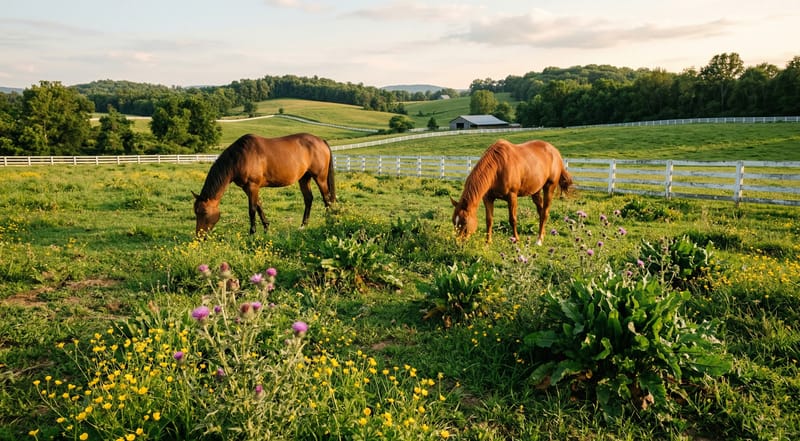
Pasture weeds are not just unsightly — several species are genuinely dangerous to horses. Unlike dogs or cats that can be kept off a treated lawn for an afternoon, horses graze continuously. They eat what grows in front of them. That makes toxic pasture weeds an ongoing health risk, not a seasonal inconvenience.
Alsike clover is one of the most dangerous pasture weeds for horses. It causes photosensitization and liver damage — a condition sometimes called "big liver syndrome." Horses that graze on alsike clover-infested pastures can develop skin lesions, jaundice, and progressive liver failure. Michigan State University Extension identifies alsike clover as a significant threat in horse pastures across the northern United States.
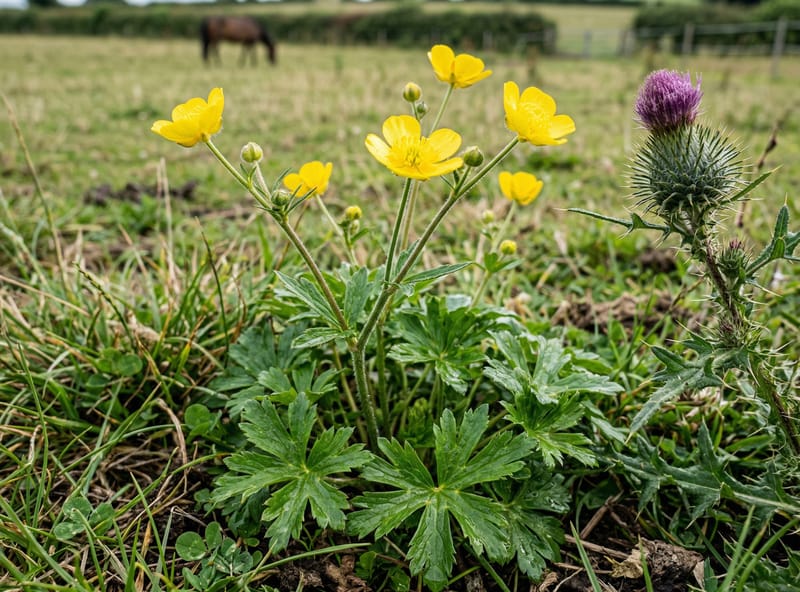
Buttercup contains protoanemonin, a bitter toxic oil released when the plant is crushed or chewed. It causes mouth and digestive tract blistering, excessive salivation, colic, and diarrhea in horses. Horses typically avoid buttercup when other forage is available, but in overgrazed or weed-dense pastures, they may have no choice.
Thistle displaces quality forage and creates physical hazards — spines can injure mouths, legs, and hooves. Dense thistle stands effectively render sections of pasture unusable.
Poison ivy is less common in open pasture but thrives along fence lines, tree lines, and pasture edges. Urushiol oil can transfer to tack, handlers, and equipment.
Ragweed is a prolific allergen producer that aggressively displaces forage grasses, reducing the nutritional quality and carrying capacity of your pasture.
Nightshade species contain solanine and related alkaloids that are toxic to horses even in small quantities. While nightshade control is beyond the scope of any single herbicide, awareness is critical — if you spot nightshade in your pasture, remove it immediately and consult your veterinarian.
The takeaway: pasture weed control is not cosmetic. It is a horse health issue. The question is how to address it without creating a different set of problems.
Why Horse Owners Distrust Synthetic Herbicides
The conventional answer to pasture weeds is a 2,4-D-based broadleaf herbicide. These products work — they kill broadleaf weeds and spare grass. But they come with restrictions that make them impractical for many horse operations.
Grazing restrictions. Many 2,4-D-based pasture herbicides carry label precautions about grazing after application. While some labels technically show a zero-day grazing restriction, most veterinarians and extension services recommend keeping horses off treated pasture as a precaution — and the practical reality of withered, herbicide-coated weeds in a grazing area makes immediate re-entry inadvisable. If you have one pasture and no rotation options, that means boarding your horses elsewhere or confining them — neither of which is simple or cheap.
Aminopyralid persistence. Some persistent broadleaf herbicides used in pasture management contain aminopyralid, a compound so stable it survives composting and can contaminate hay. Horses fed hay from aminopyralid-treated fields show no ill effects, but if that manure is composted and used in gardens, it destroys broadleaf crops. This has caused widespread contamination incidents and eroded trust in synthetic pasture herbicides.
Limited acreage reality. Commercial ranches can rotate livestock across thousands of acres. Most private horse owners have 5 to 50 acres — often less. Pulling horses off pasture for two weeks is not a scheduling inconvenience; it is a logistics problem that many owners simply cannot solve.
The other "organic" alternative? Non-selective burn-down sprays that kill everything — weeds and forage grass alike. That is not weed control. That is pasture destruction. Horse owners need something that removes the weeds and keeps the grass. Until recently, no organic product could do that.
How Organic Contact Herbicide Works in Pastures
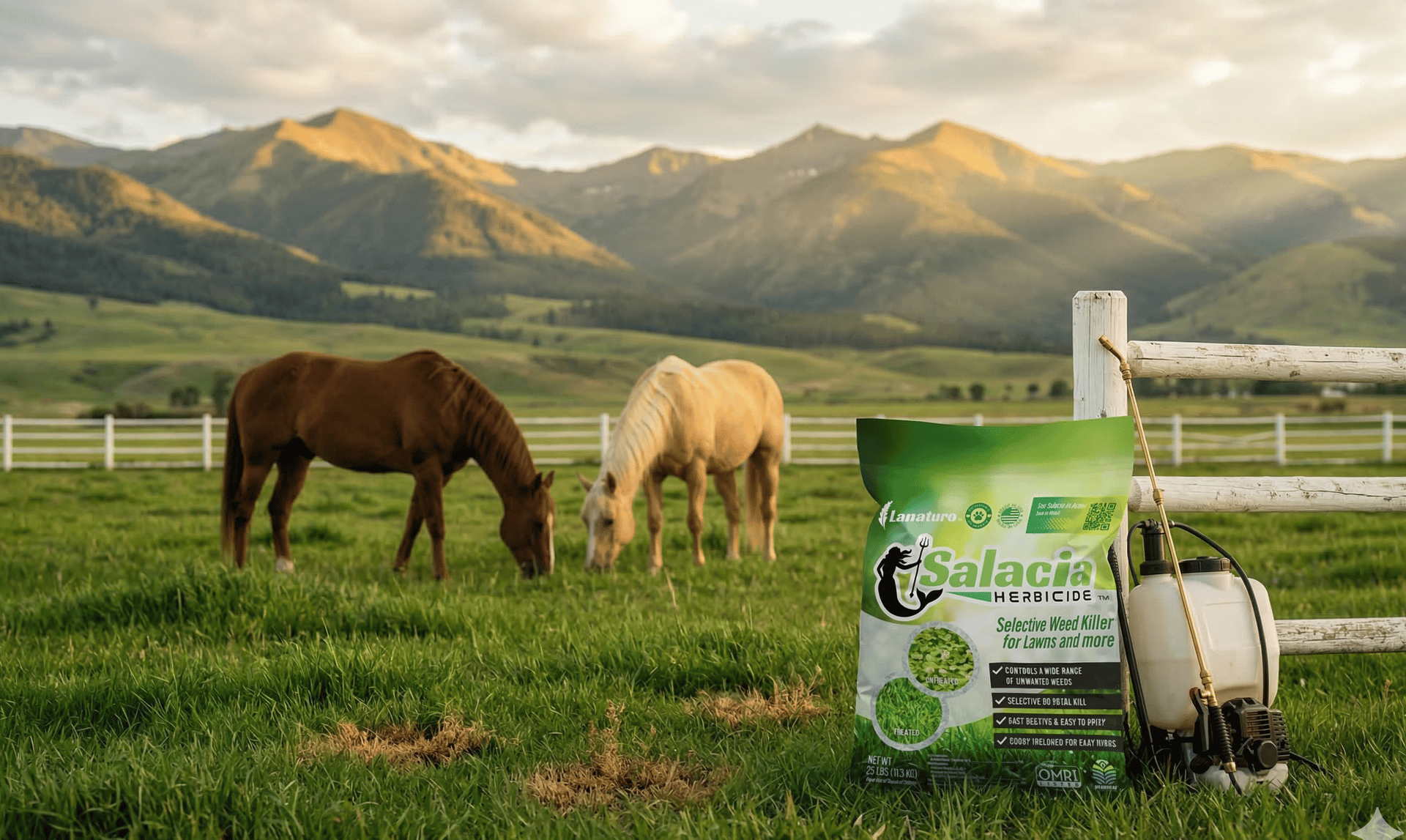
Salacia is the first OMRI-certified selective organic herbicide — a product category that did not exist before it. It works through rapid osmotic dehydration on contact: the solution draws moisture out of weed leaf and stem tissues, causing cell collapse within hours. It is non-systemic — it does not enter the plant's vascular system, does not translocate through roots, and does not persist in soil or groundwater.
For horse pastures, this matters for three reasons:
- OMRI certified organic. Verified by the Organic Materials Review Institute — the same body that certifies products for organic farming. Not "natural." Not "eco-friendly." Certified.
- Pet Friendly. The label carries the Pet Friendly mark. The mechanism is physical dehydration, not chemical poisoning.
- Contact-based, non-systemic. It works where it lands. No soil absorption, no groundwater migration, no residue buildup in forage.
Hybrisal Technology: Why This Post Exists
Here is the real breakthrough for horse owners — and the reason this product changes the conversation about pasture weed control.
Most horse owners need two types of weed control: a selective herbicide for the pasture itself (kill the weeds, keep the grass your horses eat) and a non-selective burner for fence lines, barn perimeters, thistle patches, and poison ivy colonies (kill everything). That has always meant buying two separate products.
Hybrisal Technology means one bag handles both.
- Selective mode — 3 cups per gallon: Targets broadleaf weeds while preserving forage grass. Use this across grazing areas to eliminate clover, buttercup, ragweed, and other broadleaf invaders without destroying the pasture your horses depend on.
- Non-selective mode — 4 cups per gallon: Total vegetation control. Use this on fence lines, thistle stands, poison ivy colonies, barn perimeters, and anywhere you want complete weed elimination.
One bag. Two herbicides. The first time this has existed in an organic product. You are not buying two bottles, two formulations, two application schedules. You are adjusting one mixing rate.
The label carries the Pet Friendly mark and uses an OMRI-certified organic contact mechanism. Horse owners considering pasture application should review the full product label and consult their veterinarian for guidance specific to their operation.
For a deeper explanation of how selective and non-selective modes work, see our guide on selective vs. non-selective herbicide. For the full evidence on organic herbicide effectiveness, see is organic weed killer safe for pets.
Pasture Weed Treatment Guide
Each weed requires a specific approach. The following treatment protocols are based on verified field data for each species.
Clover
Rate: Selective — 3 cups per gallon
Clover forms dense mats in pastures. Surface spraying is not enough — get under the canopy and wet the stems, undersides of leaves, and soil area around the base. The hidden growth underneath is what regenerates if you only treat the top. Clover is among the most responsive weeds to treatment; full coverage is the difference between one application and three. 1-2 applications typical; new growth from seed bank is normal — retreat as it appears.
Buttercup
Rate: Selective — 3 cups per gallon
Creeping buttercup spreads via stolons (above-ground runners) that root at each node. Trace the runners and spray all leaves, stems, stolons, and the soil area around each rooting point. Get under the leaf canopy for full coverage. Every runner and rooting point needs treatment — missing connected plants allows the network to regenerate. Wear gloves; buttercup sap can cause mild skin irritation. 1-2 applications typical.
Thistle
Rate: Non-selective — 4 cups per gallon (precision targeted)
Thistle requires the non-selective rate for effective control. In pasture areas, apply precisely to thistle foliage, stems, and crown — do not blanket spray surrounding grass. Full coverage on all leaf surfaces and drench the crown area. Thistles can regrow from root fragments, so persistence matters — 1-3 applications depending on maturity. Wear protective gloves and clothing due to sharp spines.
Poison Ivy
Rate: Non-selective — 4 cups per gallon
Apply very generously to all leaves (front and back), stems, and vines. Drench until runoff. Poison ivy is extremely persistent — 3+ applications typical, and treatment may span multiple seasons. Critical safety: wear full protective clothing — long sleeves, pants, chemical-resistant gloves, and eye protection. Urushiol oil causes severe allergic reactions. Do not burn poison ivy — smoke carries urushiol and can cause severe respiratory reactions. Wash all equipment and clothing thoroughly after use.
Ragweed
Rate: Selective — 3 cups per gallon
Apply generously to all foliage, stems, and the crown area until runoff. Ragweed can grow tall in pastures — make sure to get full coverage on all leaf surfaces and stems. Treat before it flowers to prevent pollen release. 1-2 applications typical. Annual weed — new plants may emerge from seeds throughout the growing season.
Ground Ivy
Rate: Selective — 3 cups per gallon
Ground ivy (creeping charlie) forms dense, spreading mats. Get under the canopy — lift mat edges if needed and spray stems, undersides of leaves, and the soil area beneath. The hidden runners underneath drive regrowth if you only treat the surface. Ground ivy is one of the most persistent weeds; 2-3 applications are typical. Full coverage is absolutely critical — canopy, stems, undersides, soil area.
Ready to Take Back Your Lawn?
Salacia™ is the first OMRI-listed organic herbicide with true selective action — kills weeds, not grass. Choose your lawn size:
Applying in a Pasture: What to Know
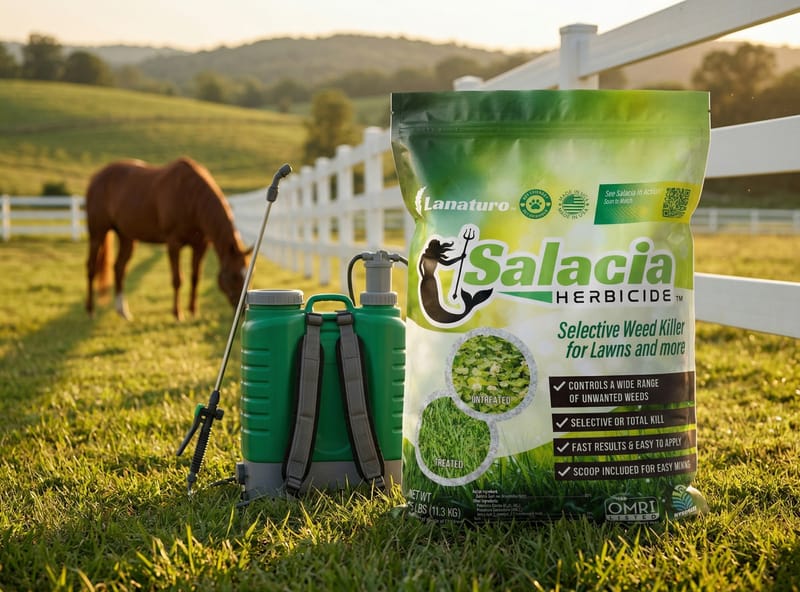
Pasture application differs from lawn care. Here is how to get the best results in a horse pasture environment.
A Note on Horses and Salt Attraction
Every horse owner knows the salt block. Horses are naturally drawn to salt — they seek it out, lick it, and will travel across a pasture to find it. This matters for herbicide application because Salacia uses naturally derived ingredients that horses may find attractive.
This is not a toxicity concern. The product is OMRI certified organic, Pet Friendly, and built entirely from naturally derived ingredients with animal safety in mind. But if horses lick treated weeds before the product has dried and done its work, it reduces effectiveness on the weeds — the product gets consumed instead of dehydrating the plant.
The practical takeaway: Let the treated area dry completely before allowing horses back into that section of pasture. This is about protecting your weed control results, not about protecting your horses from harmful chemicals. There are no harmful chemicals to protect them from — that is the entire point of using an OMRI-certified organic contact herbicide.
- Spot-treat weed colonies. Do not broadcast across the entire pasture. Identify weed-dense areas, fence lines, and trouble spots. Target those zones with the appropriate mixing rate — selective (3 cups/gal) for broadleaf weeds in grazing areas, non-selective (4 cups/gal) for fence lines, thistle stands, and poison ivy colonies.
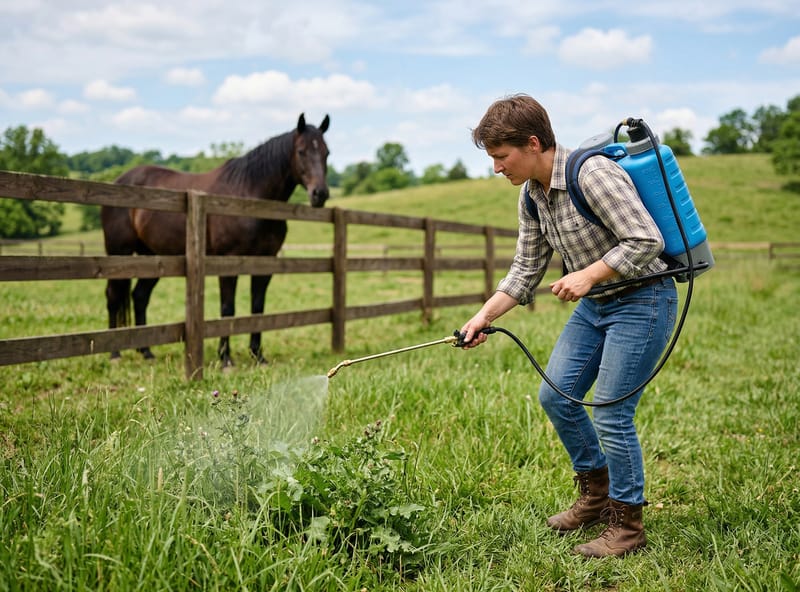
- Equipment. A backpack sprayer works for small pastures and spot treatments. For larger acreage, an ATV-mounted or tow-behind sprayer covers ground efficiently. Any pump sprayer that delivers consistent pressure will work.
- Mow tall weeds first. Cutting tall weeds before treatment exposes more leaf surface for spray contact. This improves coverage and reduces product waste.
- Apply in the right conditions. Temperature between 60°F and 80°F. Calm morning with minimal wind. Dry foliage — no dew, no recent rain.
- Full coverage is everything. This is a contact herbicide — if the product does not touch the weed, it does not kill the weed. Thoroughly wet the entire plant: top of leaves, undersides, stems, crown, and the soil area at the base. For mat-forming weeds like clover, get under the canopy. Light misting is not enough — drench to the point of runoff.
- Horse re-entry. Let the treated area dry completely before allowing horses back. As every horse owner knows, horses are naturally attracted to salt — they will seek out and lick treated areas if given access too soon. This is not a safety issue (the product is built from naturally derived, OMRI-certified ingredients), but it will reduce effectiveness on the weeds. Dry time depends on weather and sun exposure.
- Test a small area first. Always test before treating large sections. This confirms the right spray volume for your conditions and ensures no unexpected effects on your specific forage grass.
Where Pasture Weeds Hit Hardest
Horse country is weed country. Texas — the number one state for both horse ownership and Salacia sales — deals with year-round weed pressure from clover, thistle, and ragweed. Georgia, South Carolina, and Virginia face aggressive warm-season broadleaf invasions from spring through fall. Kentucky and Pennsylvania horse operations battle cool-season weeds like ground ivy, buttercup, and wild violet that thrive in the same conditions as their pasture grasses.
Spring is the prime treatment window across all regions. Weeds are actively growing, temperatures are in the ideal 60-80°F range, and treating early prevents seed set — reducing next year's weed pressure. In southern states, a second fall treatment window targets late-season germination.
Your Pasture Weed Control Advisor
Not sure what is growing in your pasture? Lanaturo Intelligence — the green chat icon on every page of this site — is your on-demand weed control expert. Upload a photo of any pasture weed, and it will identify the species, tell you the exact mixing rate and treatment technique, calculate how much product you need for your acreage, and check your local weather to give you a live Application Score for your zip code.
We do not just sell a bag — we give you the complete system. The product and the expertise to use it right.

Intelligence
Not Sure About Your Situation? Ask Lanaturo Intelligence.
Snap a photo of your weeds, get an instant species ID, check real-time application conditions for your location, and receive a tailored treatment plan.
Ready to Take Back Your Lawn?
Salacia™ is the first OMRI-listed organic herbicide with true selective action — kills weeds, not grass. Choose your lawn size:
Your horses deserve a pasture free of toxic weeds — without the chemical trade-offs.
Toxic weeds are a health risk. Synthetic herbicides force weeks off pasture. One OMRI-certified organic bag handles both — selective in the grazing areas, non-selective along the fence lines. That product exists now. And it comes with an AI co-pilot that turns you into the expert.
Salacia is designed to be selective, but results may vary depending on weed type, lawn health, application rate, and environmental conditions. Always test a small area first. See product label for complete instructions. Effectiveness is not guaranteed. Some weeds may require multiple applications.