 By Pat Kelly
Search for "best organic weed killer" — or "natural weed killer" or "non-toxic weed killer" — and you will find the same thing repeated across dozens of listicles: a lineup of burn-down sprays that kill everything they touch. Weeds, grass, clover, your prize garden bed — gone. These products are marketed as organic alternatives, and technically they are. But they solve one problem by creating another.
If you have a lawn — actual turf grass you want to keep — most organic weed killers are useless. They are non-selective. They cannot tell the difference between a dandelion and your Kentucky bluegrass. So you either spray and accept the dead patches, or you go back to the synthetic chemicals you were trying to avoid in the first place.
That is the trap most homeowners are stuck in. This guide is about getting out of it.
 We will break down what an organic weed killer actually needs to do, why the current market mostly fails, and how one product — the first OMRI-certified selective organic herbicide — changes the equation entirely.
What makes an organic weed killer the best in 2026?
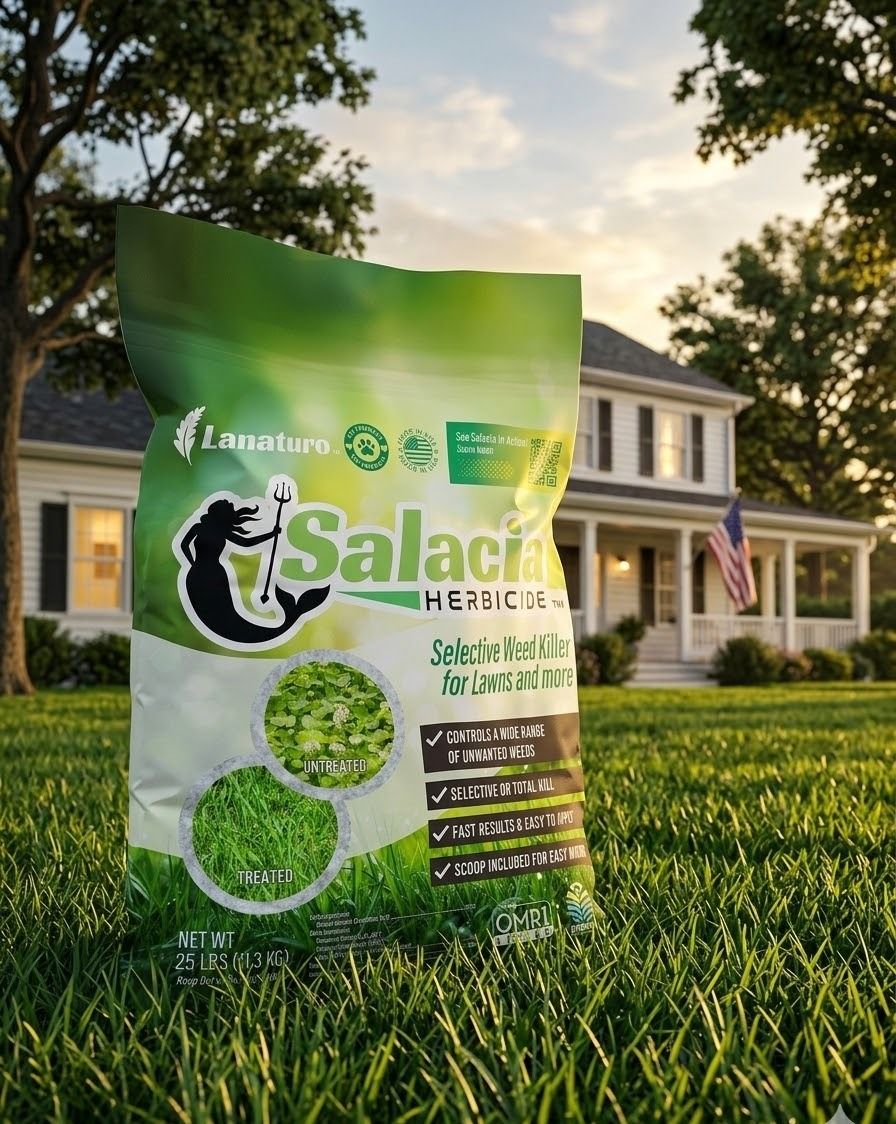
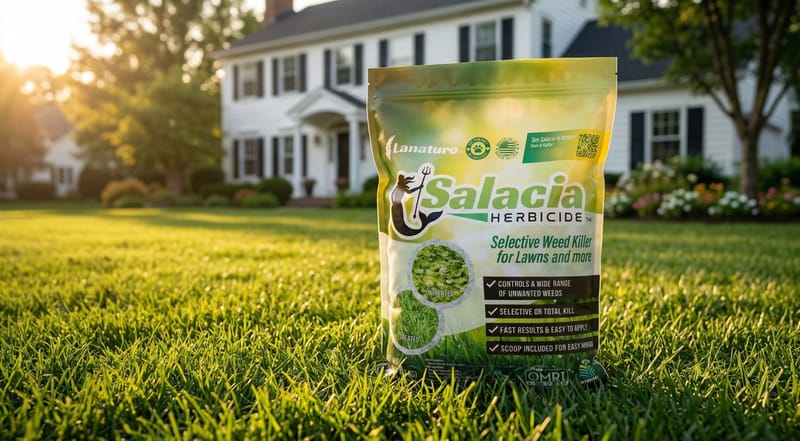
The short answer: the best organic weed killer for lawns is a selective one — OMRI certified, designed to kill broadleaf weeds while sparing grass, with a verified dehydration mechanism. Salacia is the first OMRI-certified selective organic herbicide: selective at 3 cups per gallon for lawns, non-selective at 4 cups for driveways and patios.
The answer is not the product with the biggest "natural" label. It is the product that meets four criteria most organic herbicides cannot meet at the same time.
One — true selectivity. The product spares lawn grass at its label rate while killing the broadleaf weeds — dandelion, clover, ground ivy, wild violet, chickweed, oxalis. Most organic herbicides are non-selective contact burners that kill weeds and grass alike. A selective product is a different category of formulation entirely.
Two — Pet Friendly and household-safe. The active and inert ingredients have long safe-use histories, no chronic-exposure concern from residue, and no multi-hour re-entry intervals that keep the family off the lawn for half a day after application.
Three — a verified mechanism, not a marketing one. The product works through a documented biological pathway — rapid osmotic dehydration, in our case — not "natural energy" or pseudo-science that cannot withstand scrutiny.
Four — independent organic certification. OMRI Listed, not self-declared "natural." OMRI evaluates ingredient compliance with USDA organic standards. Self-declared organic claims are unregulated.
Only one product on the market meets all four — Salacia, the first OMRI-certified selective organic herbicide. That is not a slogan; it is the structural reason the category needed a new entrant. The rest of this guide walks through why every other category falls short and what selective organic actually looks like in practice.
The Problem With Most Organic Weed Killers
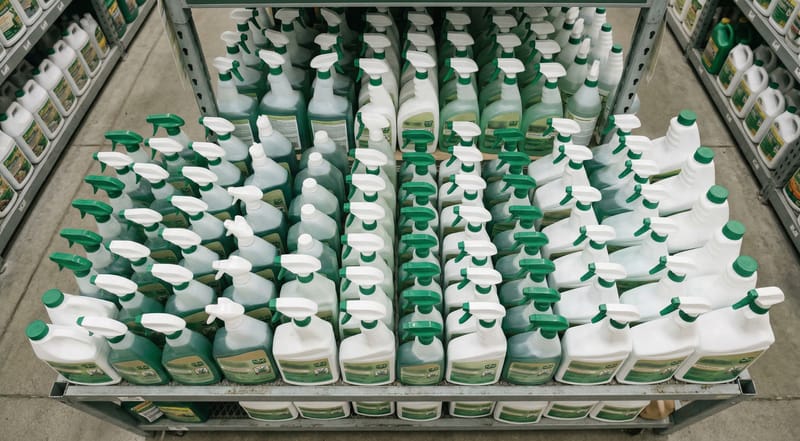
Walk into any garden center and you will see shelves of organic weed killers. Green labels. "Natural" in big letters. Friendly-looking packaging. Pick any of them up, read the fine print, and you will find the same limitation: non-selective.
Non-selective means the product kills all vegetation it contacts. Spray it on a dandelion growing in your lawn and it will kill the dandelion. It will also kill every blade of grass the spray touches. You are left with a brown dead spot where a weed used to be — which is not exactly the result you were looking for.
This is not a flaw in how the products are applied. It is a fundamental limitation of the technology. Most organic herbicides on the market are burn-down sprays — they destroy all plant tissue on contact through surface damage. They have no mechanism for targeting weeds while sparing grass. They simply cannot do it.
The result? Homeowners who care about organic lawn care face an impossible choice:
- Use an organic product that kills their grass along with the weeds
- Use a synthetic chemical that spares the grass but introduces compounds linked to environmental and health concerns
- Pull weeds by hand — which works until your entire front yard is 40% clover
For years, there was no fourth option. Now there is.
Natural vs. Organic — What's the Difference?
These two words get used interchangeably on weed killer labels, but they do not mean the same thing — and the difference matters when you are choosing a product for your lawn.
"Natural" = Unregulated
There is no legal standard for calling a weed killer "natural." Any manufacturer can print it on a label. It sounds good. It means nothing verifiable. A product labeled "natural weed killer" could contain any combination of compounds — there is no third-party audit, no ingredient review, no accountability.
"Organic" + OMRI = Verified
OMRI certification means the Organic Materials Review Institute has independently audited every ingredient and confirmed it meets organic standards. It is not a marketing claim — it is a verifiable, third-party credential you can check at omri.org.
When you search for "best natural weed killer," most of what you will find are products with the word "natural" on the label and nothing to back it up. The bar should be higher. OMRI certification is that bar.
Salacia bridges both worlds: it is made from naturally derived ingredients and it carries OMRI certification — meaning you get the natural composition you want with the independent verification to prove it. That combination is rare. In the selective herbicide category, it is unique.
Is there a natural herbicide that kills broadleaf weeds but spares grass?
Yes. Salacia is an OMRI Listed organic herbicide made for exactly this: at its selective rate it takes down broadleaf weeds such as dandelion, clover and creeping charlie and is designed to spare the lawn grass. Mixed stronger, the same bag becomes a non-selective spray for driveways and fence lines.
Most natural weed sprays cannot make that distinction. Acetic acid (horticultural vinegar), pelargonic acid and d-limonene sprays are non-selective burn-downs: they scorch whatever green tissue they touch, grass included, and the roots of established perennial weeds often survive to regrow. That is why natural products have been the answer for driveways and fence lines, not for a lawn you want to keep.
Salacia closes that gap. At the selective rate it takes the whole weed down, root system included, through crown collapse. Measured, not assumed: in Lanaturo's field trials, 65 species were tested at 28 field sites and every perennial lawn grass survived the selective rate while mortality concentrated in broadleaf species.
What the Best Organic Weed Killer Actually Needs to Do
Forget marketing claims for a moment. If you are looking for the best organic weed killer for your lawn, here is the objective checklist — the criteria that separate a genuinely effective product from a glorified burn-down spray.
1. OMRI Certified
Not just "natural" on the label — verified organic by the Organic Materials Review Institute. OMRI certification means an independent third party has audited every ingredient. Anything less is marketing.
2. Selective Action
Kills broadleaf weeds. Spares grass. This is where 99% of organic weed killers fail. If the product cannot distinguish between a weed and your lawn, it is not a lawn herbicide — it is a vegetation killer.
3. Dual-Action Capability
The ideal product works as a selective herbicide for lawns AND a non-selective herbicide for driveways, patios, and fence lines — depending on how you mix it. One product, two modes.
4. Real Mechanism of Action
Works through rapid osmotic dehydration — not just surface burn that weeds recover from in a week. The product should dehydrate weed tissue completely, disrupting the plant at a cellular level.
5. Guidance and Support
A bottle with instructions is not enough. The best product comes with real-time guidance: weed identification, weather-optimized application timing, coverage calculators, and tailored treatment plans.
That is the bar. Five criteria. Most organic weed killers meet one — maybe two. The question is whether anything meets all five.
Why Everything Else Falls Short
Let us be direct about what is available on the market right now and why each category fails the checklist above.
Non-Selective Burn-Down Sprays
This is the largest category of organic herbicides. They use concentrated natural compounds to burn plant tissue on contact. The problem: they burn everything. Weeds, grass, flowers — no discrimination. Apply one of these to your lawn and you will replace your weed problem with a dead-grass problem.
They also tend to provide only surface-level damage. The foliage browns and dies, but the root system often survives. Two weeks later, the weed is back. You have killed your grass permanently while only temporarily inconveniencing the weed. That is a bad trade.
For a deeper analysis of why selectivity matters: Does Organic Weed Killer Work?
DIY Methods
The internet is full of homemade weed-killing recipes. They are non-selective, inconsistent, and can damage soil biology when used repeatedly. There is no calibration, no selectivity, and no quality control. Professional results require professional-grade products.
The Core Problem
Every other organic option on the market sells you a bottle with instructions. That is the entire value proposition: a container of liquid and a label. No guidance on application timing. No weed identification. No weather optimization. No follow-up support. You are on your own.
They sell you a bottle. We give you a complete weed control platform.
Organic Herbicides Compared by Active Ingredient
The clearest way to compare the organic herbicides available in the US market is by active-ingredient class and application type. Four categories cover essentially everything on the shelf — and only one of them is selective.
The bottom line: contact burn-down sprays kill everything they touch, and DIY mixes are inconsistent. And certification is the dividing line most comparisons skip: "natural" is a marketing word, not a certification. Salacia is the only OMRI-certified organic herbicide with true selective action — a dual-mode granular concentrate that treats lawns at the selective rate or, mixed stronger, delivers total vegetation control.
Selective: Partially — mainly very young broadleaf weeds
Depth of kill: Cosmetic burn and leaf curl; regrowth is common because roots are typically unaffected
Best use: Spot-treating small, immature weeds
The catch: Repeat applications add up; can stain concrete and pavers
Non-Selective Contact Burn-Down Sprays
OMRI certified organic: Some are — but most rely on unregulated "natural" claims. Always check the product at omri.org.
Selective: No — kills weeds and grass alike
Depth of kill: Surface damage only; root systems usually survive
Best use: Driveways, gravel, fence lines — never lawns
The catch: A dead brown spot where the weed used to be
Homemade / DIY Methods
OMRI certified organic: No — homemade mixes carry no certification of any kind.
Selective: No
Depth of kill: Inconsistent surface burn
Best use: Not recommended for lawns
The catch: No calibration, no quality control; repeated use can damage soil biology
Salacia — Dual-Mode Selective Granular (Naturally Derived)
OMRI certified organic: Yes — OMRI Listed, and the first with selective action. Verify it at omri.org.
Selective: Yes — designed to spare grass at the 3-cups-per-gallon lawn rate (always test a small area first)
Depth of kill: Full-plant dehydration through rapid osmotic dehydration — not surface burn
Best use: Lawns at the selective rate; driveways and patios at the non-selective rate (4 cups per gallon)
The catch: Contact-based — results are directly proportional to your coverage
That last row is the honest one: Salacia works on contact, so thorough application is your job. Everything else — the selectivity, the mechanism, the OMRI certification — is built into the bag.
Salacia: A Category of One
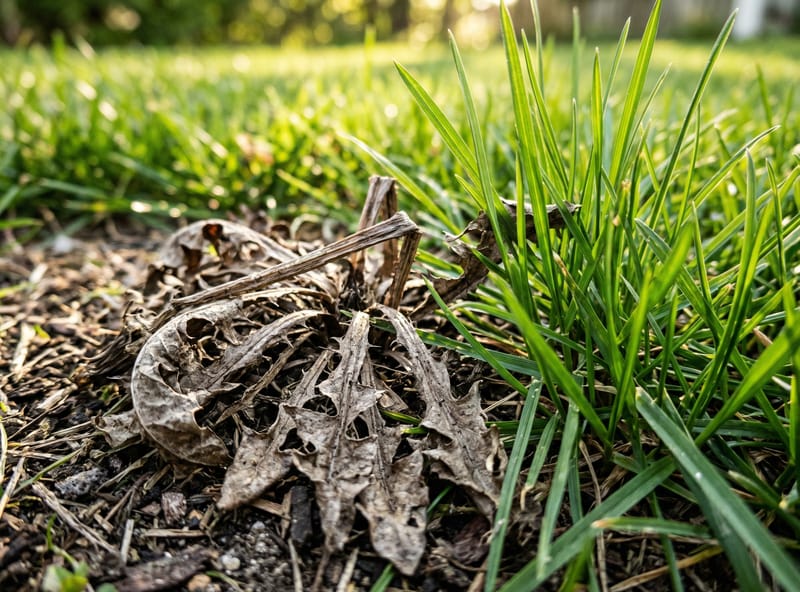
Here is where the conversation shifts — because Salacia by Lanaturo is not a better version of what already exists. It is something that did not exist before: a naturally derived, non-toxic weed killer with real selective action.
Salacia is the first OMRI-certified selective organic herbicide. Read that again: the first. Before Salacia, no organic weed killer could selectively target broadleaf weeds while preserving grass. You had to choose between organic and selective. Now you do not.
Hybrisal Technology: Two Herbicides in One
Salacia uses proprietary Hybrisal Technology — a dual-action system that no other product, organic or synthetic, replicates:
- Selective mode (3 cups per gallon): Targets and dehydrates broadleaf weeds — dandelions, clover, ground ivy, wild violet, thistle, bindweed, and more — while preserving lawn grass. Salacia is designed to be selective, but always test a small area first — temporary paling or yellowing is possible depending on lawn health and conditions. This is your lawn treatment mode.
- Non-selective mode (4 cups per gallon): Total vegetation control for driveways, patios, fence lines, gravel beds, and any area where you want nothing growing. Same product, higher concentration. Working around ornamental plantings instead of turf? See our dedicated guide to the best weed killer for flower beds.
One bag. Two herbicides. No other product on the market — organic or synthetic — offers this dual-action capability from a single formula.
Related: Going chemical-free entirely? Our complete buyer's guide to a glyphosate-free weed killer walks through the regulatory landscape, EPA-vs-WHO disagreement, and how the dual-action capability replaces a three-product stack.
How It Works: Rapid Osmotic Dehydration
Unlike burn-down sprays that scorch the surface of plant tissue, Salacia works through rapid osmotic dehydration. The naturally derived formula draws moisture out of broadleaf weed cells at the cellular level. The weed does not just brown on the surface — it dehydrates completely. This is a physical mechanism, not a chemical poison. It is dehydration, not toxicity.
For the full science: How Does Selective Weed Killer Work? A Simple Guide
How the classes behave, side by side
Set against the alternatives by behaviour rather than by ingredient, the gap is easier to see.
| DIY burn-down sprays | Synthetic selective | Salacia | |
|---|---|---|---|
| Spares the lawn | No — burns whatever it touches, grass included | Yes | Yes — test a small area first |
| OMRI-certified organic | Some products | No | Yes |
| What the kill looks like | Fast top-burn, roots regrow | Slow wilt over weeks as the plant carries it inward | Rapid dehydration of whatever the spray touches |
| Selective and total-kill from one bag | No | No | Yes — the mixing rate decides which job it does |
What the field trials measured
Across 65 species tested at 28 field sites, every perennial lawn grass survived treatment while mortality concentrated in broadleaf species — which is the combination the organic shelf has otherwise been missing. Test a small area first.
Which Lawn Weed Killers Perform Best Environmentally?
Judge by evidence, not the word "natural": OMRI Listed status, no glyphosate, 2,4-D or dicamba, and soil data after use. Salacia is the first OMRI-certified selective organic herbicide; in field trials chloride stayed below the 1,250 ppm threshold and 21 native species recolonized treated ground, and because it spares the grass you spray less lawn.
Cool weather is where organic options usually stall. In trials at 45–55°F this one still delivered control, extending the usable season at both ends of the year.
On the question every organic buyer asks about salt and soil: chloride measured 608–811 ppm after treatment in those field trials, below the 1,250 ppm threshold, and washed out with rainfall. Twenty-one native plant species recolonized the treated ground without any reseeding. Across a three-year programme of field trials at 30 sites, repeat treatment took poison ivy from 67.9% stem mortality after a single pass to 99.9% after four.
Non-Toxic Weed Control — How It Actually Works
When people search for a "non-toxic weed killer," what they really want to know is: can I control weeds without introducing synthetic chemicals into my lawn, my soil, and my family's environment? The answer is yes — but only if the mechanism is right.
Most products marketed as non-toxic are burn-down sprays. They scorch the surface of plant tissue, but the roots survive. Two weeks later, the weed is back and you are spraying again. That is not weed control — it is a cosmetic treatment.
Salacia takes a fundamentally different approach. The mechanism is physical, not chemical:
- Rapid osmotic dehydration — the naturally derived formula draws moisture out of broadleaf weed cells at a cellular level. The weed does not just brown on the surface. It dehydrates completely.
- No synthetic residue — because the mechanism is physical dehydration rather than chemical poisoning, there are no synthetic compounds left behind in your soil or lawn.
- Independently verified — Salacia is OMRI certified organic, meaning an independent third party has audited every ingredient against organic standards. Verification you can check at omri.org, not a self-declared claim.
Combine that with the Pet Friendly label and selective action that is designed to spare grass, and you have a non-toxic weed control solution that actually delivers lasting results — not just surface-level damage that grows back in a week.
The Numbers
2-in-1
Selective + Total Control
Thousands
of Verified Customers
10,000
Sq Ft per 25lb Bag
17+
Target Weed Species
Pet Friendly
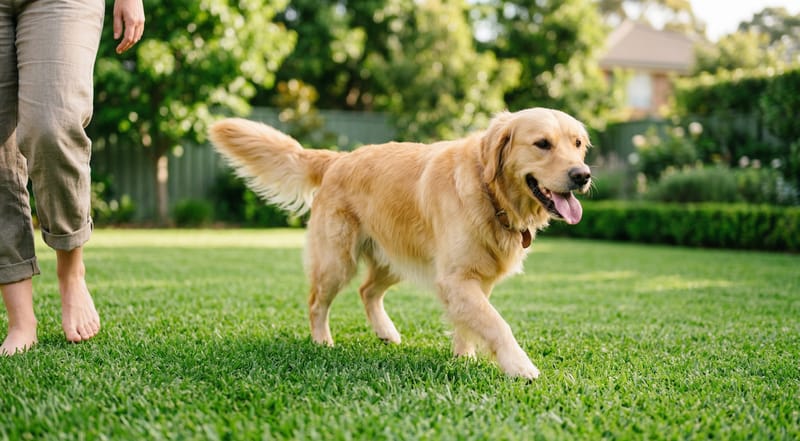
Salacia carries a Pet Friendly label — and it means something. Because the product works through a non-toxic physical dehydration mechanism rather than synthetic chemical action, there is no synthetic residue left in your lawn. Let the treated area dry before allowing pets back — not because of safety concerns, but because animals may be attracted to lick it, which could affect results on the weeds.
For the full breakdown on pet considerations: Is Organic Weed Killer Safe for Pets? What You Need to Know
Target Weeds
Salacia is proven effective on the broadleaf weeds homeowners fight most: dandelions, clover, chickweed, creeping charlie (ground ivy), wild violet, thistle, bindweed, purslane, knotweed, henbit, prostrate spurge, common lespedeza, purple deadnettle, oxalis, wild strawberry, and poison ivy. Full weed-by-weed data and before/after evidence is available in the Lanaturo Weed Control Guide.
Ready to Take Back Your Lawn?
Salacia™ is the first OMRI-certified selective organic herbicide — kills weeds, not grass. Choose your lawn size:
Sal: The Co-Pilot
Here is where Salacia becomes something more than a product. Because we did not just build the best organic weed killer — we built Sal, the lawn advisor that makes you the expert.
We do not just give you the fighter jet. We give you the co-pilot that makes you the expert in seconds.
Weed Identification From a Photo
Not sure what weed is invading your lawn? Take a photo. Sal identifies the species, confirms whether Salacia targets it, and gives you the exact treatment protocol. No botany degree required. No guessing.
Live Application Score
Application timing matters more than most people realize. Sal pulls real-time weather data for your location and generates a live Application Score — telling you whether now is a good time to apply, or whether you should wait for better conditions. Temperature, wind speed, precipitation forecast — all factored in automatically.
Coverage Calculator
How much product do you need? Enter your lawn size and Sal calculates exactly how much Salacia to buy and how much to mix per gallon. No over-buying, no under-applying.
Tailored Treatment Plans
Different weeds at different growth stages require different approaches. Sal generates a treatment plan specific to your weeds, your lawn size, your climate zone, and the current growing conditions. It is personalized weed control guidance — the kind that used to require hiring a lawn care professional.
No other weed control brand — organic or otherwise — offers anything remotely close to this level of support. The rest of the market gives you a bottle. Lanaturo gives you a platform.
How to Apply for Best Results
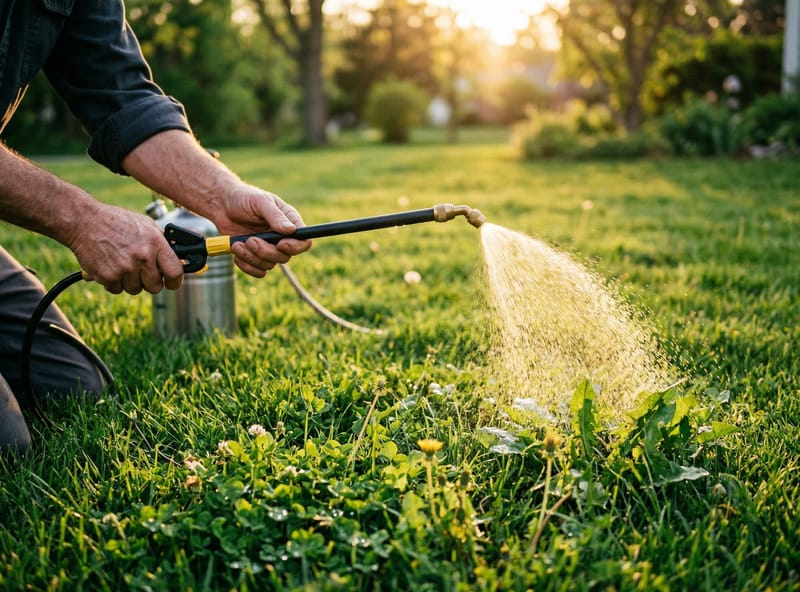
Salacia is straightforward to apply, but a few best practices make a significant difference in results. Here is the quick-start version — for the complete guide, read Best Practices for Timing and Application.
- Mow first. Cut your lawn before applying. This exposes more weed foliage to the spray and reduces the grass canopy that can block coverage.
- Check the temperature. Best results occur between 60 and 80 degrees Fahrenheit. Apply on a calm morning before wind picks up.
- Mix at the right rate. Selective (lawn use): 3 cups per gallon. Non-selective (driveways, patios): 4 cups per gallon. Salacia is designed to be selective, but we always recommend testing a small area first — temporary paling or yellowing on lawn grass is possible depending on irrigation, general lawn health, application rate, and environmental conditions. The dry granular formula is what makes the two rates possible — you control the concentration, not the bottle.
- Full coverage is everything. Salacia works on contact — if the product doesn't touch it, it doesn't kill it. Spray the canopy (top of leaves), undersides, stems, crown, and the soil area around the base of each weed. You want foliage dripping to the point of runoff. Light misting across the lawn is NOT enough. Your results are directly proportional to your coverage.
- Do not water for 24 hours. Give the product time to work. Avoid irrigating or allowing sprinklers to run on treated areas for at least 24 hours after application.
Coverage at a Glance
One 25lb bag of Salacia makes approximately 25 gallons of mixed solution — enough to treat up to 10,000 square feet at the selective rate. For most residential lawns, one bag covers a full-season treatment program of two to three applications.
For more on killing weeds organically without killing grass, including lawn-specific strategies and seasonal timing, read our full walkthrough.
Keep reading: the growing list of glyphosate bans.
Treating weeds in a lawn?
This guide ranks organic herbicides overall. If the job is specifically weeds growing in turf you intend to keep, go to the lawn-focused ranking: the best weed killer that won't kill grass.

Lawn
Advisor
Not sure which weed you're looking at? Show Sal.
Sal is Lanaturo's lawn-care expert. He doesn't just name the weed — he builds your exact treatment plan and checks whether today is the right day to spray.
Ready to Take Back Your Lawn?
Salacia™ is the first OMRI-certified selective organic herbicide — kills weeds, not grass. Choose your lawn size:
Your lawn is not a compromise. Stop treating it like one.
For years, "organic" meant accepting dead grass along with dead weeds. That era is over. The first OMRI-certified selective organic herbicide exists — and it comes with a co-pilot.
Salacia is OMRI Listed for organic use and made from naturally derived ingredients. Always follow label directions for best results. Performance may vary based on weed maturity, environmental conditions, and application method.