
 By Pat Kelly
 What Is the Best Granular Weed Killer for Lawns?
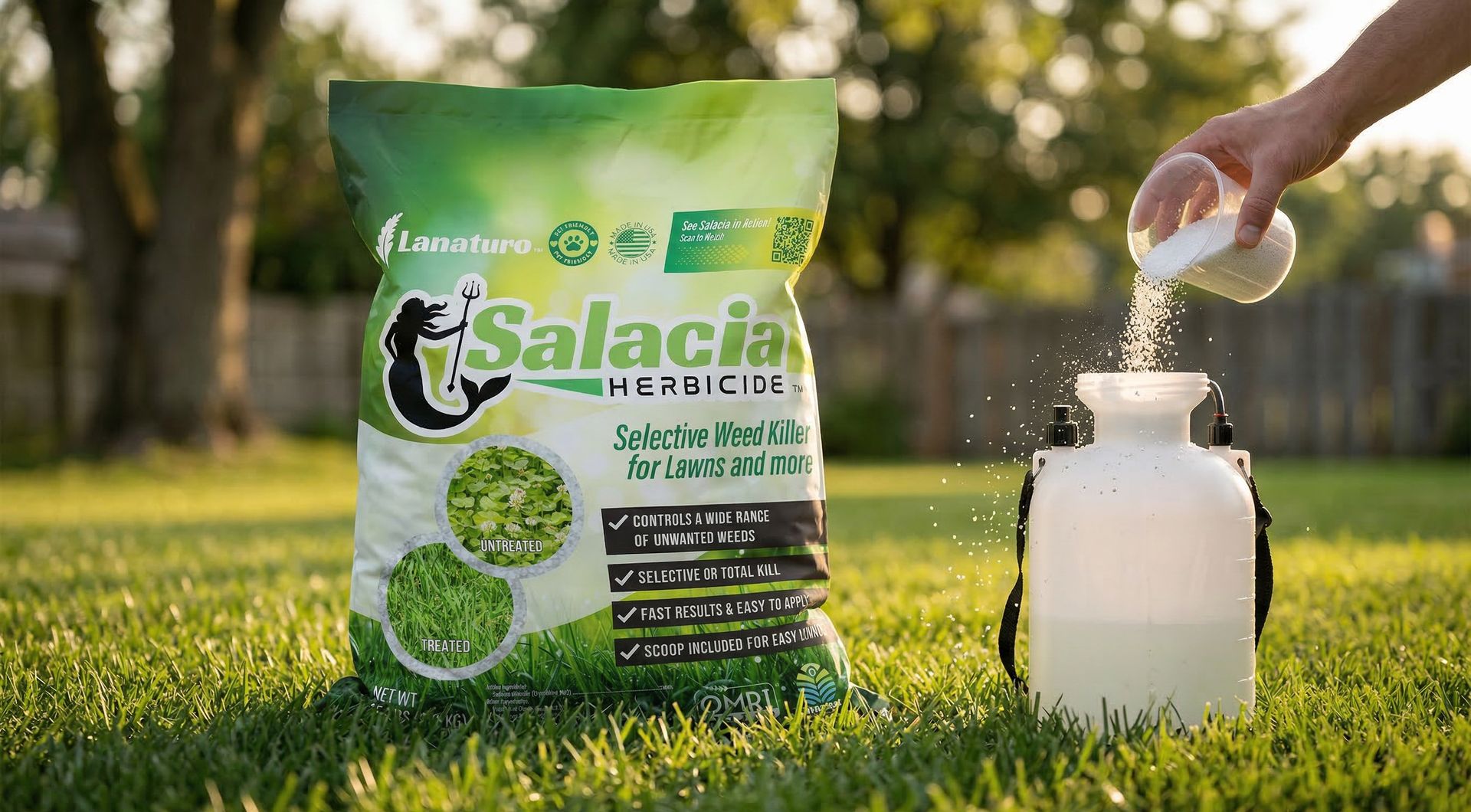
The short answer: there is no organic "spread-and-forget" granular that kills established weeds. The granular weed killer that actually works on a lawn is a water-soluble organic granular you dissolve and spray. Salacia is the first OMRI-certified selective organic herbicide — a granular concentrate that is selective at 3 cups per gallon for lawns, non-selective at 4 heaping cups for driveways, and labeled Pet Friendly.
4.7
Star Rating
2,712
Verified Reviews
10,000
Sq Ft per 25lb Bag
2-in-1
Selective + Total Control
Ready to Take Back Your Lawn?
Salacia™ is the first OMRI-certified selective organic herbicide — kills weeds, not grass. Choose your lawn size:
Search for "granular weed killer" and you are picturing something simple: a bag of dry product, a broadcast spreader, ten minutes of walking your lawn, and dead weeds by next week. That is exactly what synthetic weed-and-feed products deliver — along with 2,4-D, dicamba, and a list of chemicals you may not want near your family, pets, or soil.
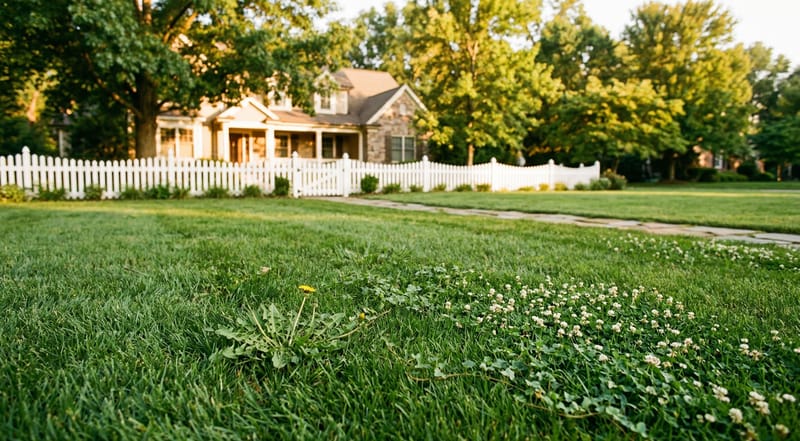
On the organic side, the options are bleak. The most commonly recommended organic granular is a pre-emergent — it attempts to prevent weed seeds from germinating and does absolutely nothing to the dandelions, clover, and ground ivy already growing in your lawn. Multiple university studies have found its effectiveness ranges from modest to nonexistent.
But there is a third category most people do not know exists: a water-soluble organic granular that you dissolve and spray. It kills existing weeds through contact. It is OMRI certified organic. It is selective — designed to target broadleaf weeds while preserving your grass. And it is Pet Friendly. Here is why it changes the conversation about granular weed control.
What Is a Granular Weed Killer?
A granular weed killer is any herbicide that starts as a dry, solid form — pellets, granules, or powder — rather than a ready-to-spray liquid. Homeowners tend to prefer granulars because they feel more manageable: no mixing, no sprayer, no protective equipment. Just load, spread, and go.
But "granular" only describes the physical form, not how the product works. Some granulars are designed to be broadcast dry onto the lawn, where they dissolve slowly with moisture. Others are designed to be dissolved in water first and applied as a spray solution. The difference matters enormously — because the method of application determines whether the product can target specific weeds or whether it treats everything it touches.
Most people searching for a granular weed killer want the first type: something they can spread and forget. That product exists in the synthetic world. In the organic world, it barely exists at all — and when it does, the results are disappointing. Understanding why requires looking at how each type actually works.
The Three Types of Granular Weed Killers
1. Synthetic Weed-and-Feed Granulars
These are the dominant products in the category. They combine a broadleaf herbicide — typically 2,4-D, dicamba, or mecoprop — with a nitrogen fertilizer. You spread them with a broadcast or drop spreader, the granules stick to wet weed leaves, and the chemical is absorbed into the plant and transported throughout its tissues. They are effective at killing broadleaf weeds. They are also loaded with chemicals that have been linked to health and environmental concerns, which is why many homeowners are searching for alternatives in the first place.
2. Organic Pre-Emergent Granulars
The most widely recommended organic granular product is a pre-emergent. It works by inhibiting root development in germinating seeds. The critical limitation: it does nothing to weeds that are already established. If you have dandelions in your lawn right now, a pre-emergent granular will not kill them. It can only attempt to prevent new weed seeds from sprouting — and even that effect is inconsistent, as we will see below.
3. Water-Soluble Organic Granulars
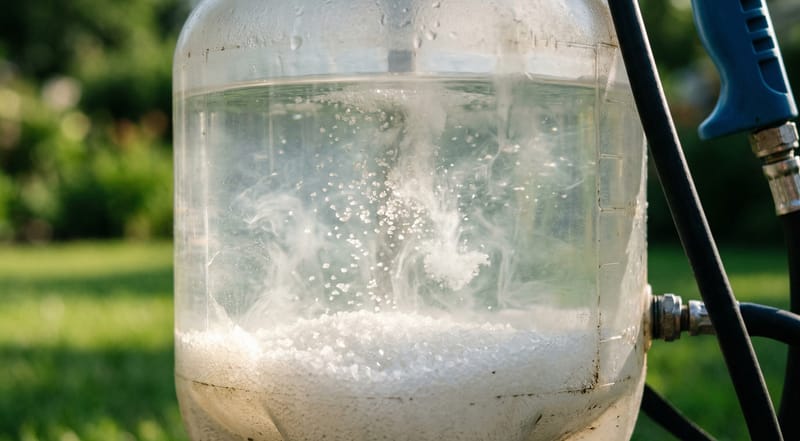
This is the category most people do not know about. A water-soluble granular dissolves completely in water and is applied as a spray — giving you the precision and coverage of a liquid herbicide with the shelf stability and concentrated value of a dry product. Instead of spreading granules across your entire lawn and hoping for the best, you mix a targeted solution and apply it directly to the weeds you want to eliminate. This is where the first OMRI-certified selective organic herbicide lives.
Why Synthetic Granular Herbicides Are a Problem
Synthetic granular weed-and-feed products work. That is not the debate. The debate is whether the trade-offs are worth it.
The active ingredients in most synthetic granulars — 2,4-D, dicamba, and related compounds — are absorbed through leaves and transported internally throughout the plant. They are also transported through soil, into groundwater, and across property lines via drift. The U.S. Geological Survey has documented widespread pesticide contamination in streams and groundwater across North America.
For pet owners, the concern is more immediate. Dogs and cats walk on treated lawns, lick their paws, and ingest residues. Multiple peer-reviewed studies have investigated the relationship between lawn chemical exposure and canine health risks. If you are reading this article, there is a good chance you are already aware of these concerns — and looking for something that actually works without the chemical baggage. For a deeper look at the documented risks, see our guide on the hidden costs of synthetic herbicides.
Why Organic Pre-Emergent Granulars Disappoint
If you have searched for an organic alternative to synthetic granulars, you have almost certainly encountered the same recommendation: an organic pre-emergent granular product. It is promoted on gardening blogs, extension websites, and organic lawn care forums as the natural answer. Here is what the university research actually says.
It only prevents seeds — it does not kill existing weeds. A pre-emergent inhibits root formation in germinating seeds. If you already have mature dandelions, clover, ground ivy, or wild violet in your lawn, a pre-emergent granular will have zero effect on them. Most homeowners searching for a "granular weed killer" want to kill weeds that are already there. A pre-emergent does not do this.
University results are mixed at best. Researchers at Oregon State University tested the most popular organic pre-emergent granular over two years and found it "did not control any weeds in any trials under any circumstances." The University of Maryland Extension does not recommend it for weed control in lawns, citing unreliable, poor control. Even the university that originally discovered the pre-emergent effect found only 60% effectiveness in year one under ideal conditions — with 80% not reached until year two and 90% not until year three of continuous application.
Heavy application rates are required. Effective application demands 20 pounds per 1,000 square feet — a rate most residential broadcast spreaders cannot achieve. Under-application is one of the primary reasons for poor results.
It is non-selective as a pre-emergent. The product inhibits germination of all seeds — including grass seed. If you are overseeding bare patches, repairing damage, or establishing new turf, you cannot use a pre-emergent granular at the same time.
It can fertilize the weeds it fails to prevent. Organic pre-emergent granulars are high in nitrogen (roughly 10-0-0). If the pre-emergent effect fails — and it often does — the nitrogen feeds the very weeds you were trying to stop. You end up with bigger, healthier dandelions.
The bottom line: there is no effective organic "spread and forget" granular weed killer for established weeds. If you need to kill weeds that are already growing in your lawn, a pre-emergent is not the answer.
Water-Soluble Granular: The Third Option
This is where most articles end — with a shrug and a suggestion to pull weeds by hand. But there is a third category of granular weed killer that solves the problems above.
Salacia is a water-soluble organic granular herbicide. You dissolve it in water and apply with a pump sprayer, backpack sprayer, or any conventional spray equipment. It is the first OMRI-certified selective organic herbicide — a product category that did not exist before it.
Here is why it matters for anyone searching for a granular weed killer:
- It kills existing weeds. Salacia is a post-emergent contact herbicide. It works through rapid osmotic dehydration — drawing moisture out of weed tissues on contact. It kills the weeds already growing in your lawn, not just future seeds.
- It is selective. At the lawn-safe mixing rate, Salacia targets broadleaf weeds while preserving grass. Temporary paling or slight yellowing is possible depending on lawn health and conditions, which is why testing a small area first is always recommended. But the selective action is real — designed to kill the weeds and spare the turf.
- It is OMRI certified organic. Not "natural." Not "eco-friendly." OMRI Listed — verified by the Organic Materials Review Institute, the same body that certifies products for organic farming.
- It is Pet Friendly. The label carries the Pet Friendly mark. The mechanism is dehydration, not poisoning. Let the treated area dry before allowing pets back — not because of toxicity, but because animals may lick it, which could affect results on the weeds.
- Dual-action through Hybrisal Technology. One bag, two modes. At the selective rate (3 cups per gallon), it is lawn-safe. At the non-selective rate (4 cups per gallon), it provides total vegetation control for driveways, gravel, fence lines, and hardscapes. Two herbicides in one product.
You Are Not Paying to Ship Water
Every ready-to-spray liquid herbicide on the shelf is mostly water. You are paying retail price — and freight costs — for something that comes out of your garden hose for free. Salacia ships as a concentrated dry granular. You add your own water at home. One 25-pound bag makes 25 gallons of spray solution — up to 10,000 square feet of coverage. That is up to 10 times cheaper per gallon of mixed spray than liquid alternatives. We believe in shipping the professional-grade material, not the water you already have.
The Granular Form Is the Feature
Here is what most people miss: the granular form is not a limitation — it is what makes Hybrisal Technology possible. Because you are mixing the solution yourself, you control the concentration. Mix 3 cups per gallon for selective lawn applications — weeds die, grass stays. Mix 4 cups per gallon for non-selective total vegetation control on driveways, gravel, and fence lines. One bag, two herbicides. A pre-mixed liquid locks you into a single concentration. A water-soluble granular gives you professional-grade flexibility that no bottled product can match.
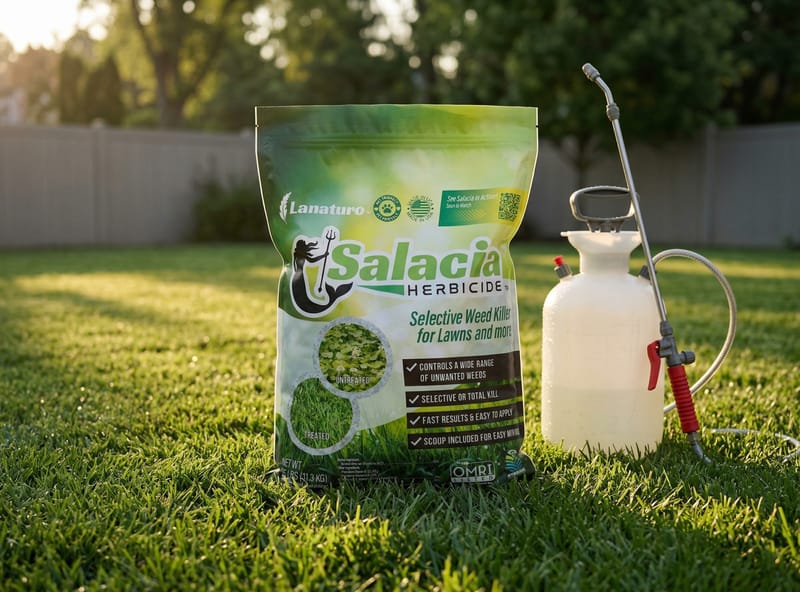
Yes, it requires mixing and spraying — you cannot broadcast it dry like a synthetic weed-and-feed. But that trade-off is exactly what makes it effective. Spraying gives you precision: you apply directly to the weeds you want to kill, with full coverage of leaves, stems, and crowns. That targeted approach is why it works where spread-and-forget granulars do not. And you are ready to spray in minutes — fill, mix, go.
Related: The Best Selective Weed Killer — And the First That Does Both →
The Granular Questions People Actually Ask
Most of the confusion in this category comes from one word doing two jobs. "Granular" describes the form a product is sold in — dry rather than pre-mixed. It does not tell you how the product is applied. Two granular products can work in completely different ways, and almost every comparison online treats them as one thing.
Are granular weed killers more effective than liquid sprays?
That comparison is not really form against form — it is coverage against coverage. A dry granule broadcast over a lawn has to land on a weed and then dissolve there, which depends on dew or watering and leaves plenty of leaf surface untouched. A liquid goes exactly where you aim it. A water-soluble granular gets both: you buy it dry, dissolve it in water, and spray it, so the coverage is a liquid's while the product on your shelf is not mostly water.
This is worth being blunt about, because people ask us constantly whether they can simply scatter it. You cannot broadcast Salacia dry and expect it to work. It dissolves in water and is sprayed onto the plant. What it kills is what the spray physically touches — that is the whole mechanism, and it is why coverage decides the outcome rather than quantity.
Is there a granular post-emergent weed killer?
Yes, and it matters which one you have. Most granular products sold for lawns are pre-emergent: they aim to stop seeds germinating and do nothing to a weed already standing in your grass. Salacia is post-emergent — it treats the weeds that are there now. If your lawn already has dandelions in it, a pre-emergent is the wrong tool no matter how good it is.
The reverse is true too, and we would rather say it than sell past it: Salacia does not prevent next season's weeds from germinating. What suppresses future weeds is dense turf closing the open ground they need, which is a growing job rather than a spraying one.
Does granular weed killer work on broadleaf weeds?
Broadleaf weeds are exactly what the selective rate is for. Salacia is the first OMRI-certified selective organic herbicide, made by Lanaturo, and at 1 lb (about 3 cups) per gallon it targets broadleaf weeds while being designed to spare grass. Temporary paling or yellowing of nearby turf is possible and recovers. Always test a small area of your lawn first.
Grassy weeds are a different question with a less comfortable answer, and it depends on the specific weed rather than on the category — some can be treated selectively and some cannot be removed from a living lawn at all. Every weed in our database has its own card in the weed control guide, including the ones we cannot control.
Is there a granular weed and grass killer?
Same bag, different mix. At the non-selective rate of 1.5 lb (about 4 cups) per gallon it clears whatever the spray drenches, grass included — which is what you want on a driveway, a gravel edge, or ground you intend to strip and start over. That rate is the ceiling; there is no stronger third mix. A stubborn weed needs more thorough coverage and another pass later, never a heavier scoop.
The rate is the decision, not the product. One bag does the selective job and the clearing job, and the only thing that changes between them is how much powder goes into the gallon.
How to Apply Granular Weed Killer the Right Way
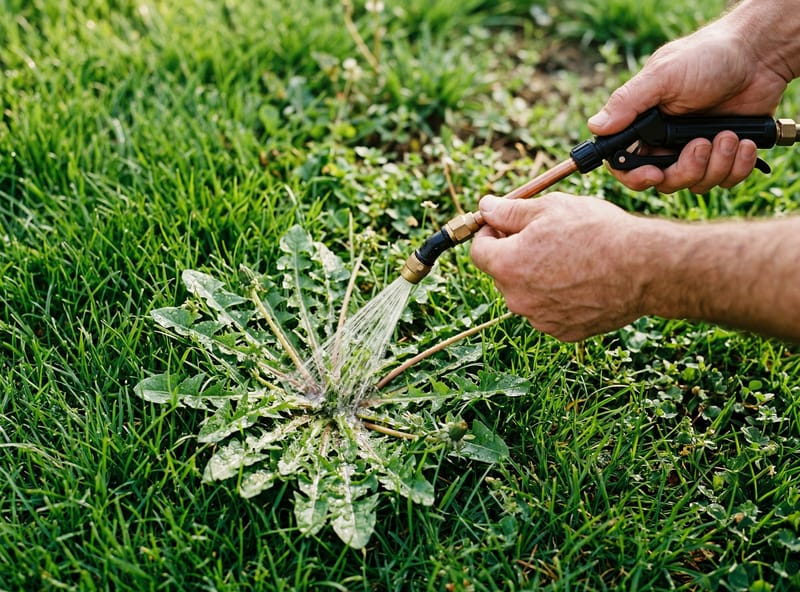
If you are using a water-soluble granular like Salacia, proper application makes the difference between good results and great results.
- Mow first. Cut the grass before applying. This exposes the weeds and improves spray contact with weed surfaces.
- Mix correctly. For selective lawn applications: 3 cups (1 lb) per gallon of water. For non-selective total control: 4 cups (1.5 lb) per gallon. Fill your sprayer halfway, add granules gradually, then top off and mix until fully dissolved.
- Apply in the right conditions. Temperature between 60°F and 80°F. Calm morning with minimal wind. Dry lawn — no dew, no recent rain.
- Full coverage is everything. This is the single most important factor. Salacia works on contact — if the product does not touch it, it does not kill it. Thoroughly wet the entire weed: top of leaves, undersides, stems, crown, and the soil area at the base. For mat-forming weeds like clover or ground ivy, get under the canopy where hidden growth lives. Light misting is not enough — drench to the point of runoff.
- Leave it alone. After application, avoid mowing or watering the lawn for at least 24 to 48 hours. This gives the product time to fully penetrate and take effect.
- Reapply if needed. Stubborn patches or dense weed growth may require a second application 2 to 4 days after the first. Most weeds respond to a single treatment, but persistent species like ground ivy or wild violet may need follow-up.
Always test a small area first before treating your full lawn. This helps you confirm the right spray volume for your conditions and ensures no unexpected effects on your specific turf type.
Your results are directly proportional to your coverage. The product does its job — but only where it lands.
What Weeds Can an Organic Granular Herbicide Control?
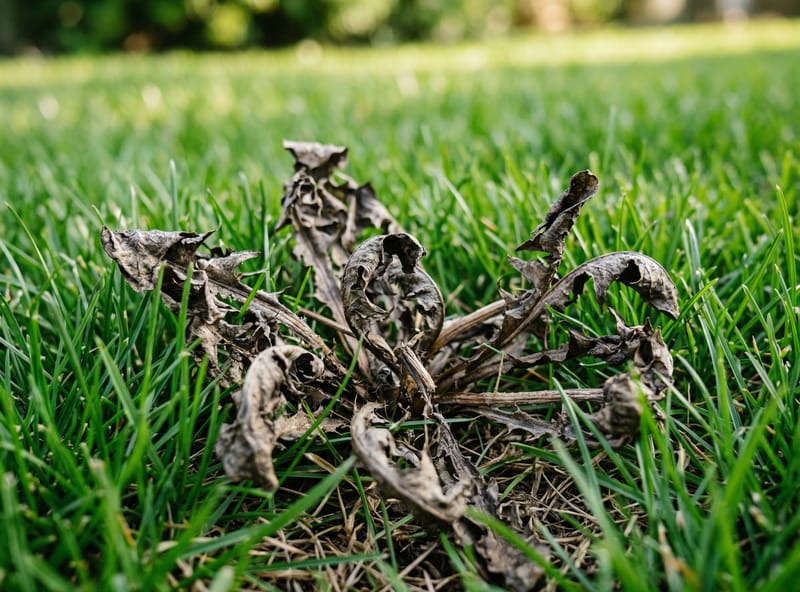
At the selective (lawn-safe) rate, Salacia effectively controls a wide range of common broadleaf lawn weeds, including:
- Dandelion
- Clover (white and red)
- Ground ivy (creeping charlie)
- Wild violet
- Chickweed
- Henbit
- Prostrate spurge
- Bindweed
- Prostrate knotweed
- Oxalis (wood sorrel)
- Wild strawberry
- Purple deadnettle
- Purslane
- Common lespedeza
- Creeping buttercup
At the non-selective rate, it controls tougher species including poison ivy, thistles, and bindweed vines. For a full breakdown with treatment techniques for each species, see the Weed Control Guide.
For more on whether organic weed killers actually work — including before-and-after results — we have a full evidence guide.
Your Lawn Care Co-Pilot
Not sure what is growing in your lawn? Not sure whether to use the selective or non-selective rate? Lanaturo Intelligence — the green chat icon on every page of this site — is your on-demand weed control expert. Upload a photo, and it will identify the weed, tell you exactly how to treat it, calculate how much product you need, and even check your local weather to give you a live Application Score for your zip code.
We do not just sell a bag — we give you the complete system. The product and the expertise to use it right.
Comparing your options?
Our full breakdown of what to look for — and what to avoid — is in the selective organic weed killer. Four criteria, real comparison, no marketing fluff. If keeping your grass is the worry, see the best weed killer that won't kill grass.

Lanaturo
Intelligence
Not sure which weed you're looking at? Show Sal.
Sal is the lawn-care brain behind Lanaturo Intelligence. He doesn't just name the weed — he builds your exact treatment plan and checks whether today is the right day to spray.
Ready to Take Back Your Lawn?
Salacia™ is the first OMRI-certified selective organic herbicide — kills weeds, not grass. Choose your lawn size:
The spread-and-forget organic granular does not exist.
But a mix-and-spray organic granular that actually kills weeds, preserves your grass, and carries OMRI certification? That exists. And it's trusted by thousands of customers who found it the same way you did — by searching for something better.
Salacia is designed to be selective, but results may vary depending on weed type, lawn health, application rate, and environmental conditions. Always test a small area first. See product label for complete instructions. Effectiveness is not guaranteed. Some weeds may require multiple applications.