
 By Pat Kelly
 The direct answer: to kill poison ivy organically, soak every reachable part of the plant — leaves (front and back), stems, and vines — with Salacia at the non-selective rate (4 cups per gallon), heavy volume until runoff. Plan on 2–3 applications per season; established patches may need touch-ups in future seasons. Wear protective clothing: urushiol, the plant's oil, is the hazard — and never burn poison ivy.
Poison ivy (Toxicodendron radicans) is the most feared plant in American yards — and for good reason. Its oil, urushiol, triggers severe allergic reactions in up to 85% of the population. The numbers are staggering: more than 10 million Americans suffer poison ivy rashes every year, generating an estimated 43,000 emergency department visits annually. The itching, blistering, and swelling can persist for weeks — and severe cases require prescription steroids, medical follow-ups, and lost workdays.
For decades, the only options were synthetic chemicals that persist in soil for weeks or months, or giving up and surrendering entire sections of your property. Homeowners with children and pets face an impossible choice: tolerate the poison ivy, or contaminate the ground where your family plays.
That choice no longer exists. Salacia by Lanaturo delivers 99% control on poison ivy through contact-based dehydration — with zero compromise on efficacy. It controls poison ivy like the synthetic products do, without the soil contamination, without the groundwater risk, without the toxic residue. No synthetic chemicals. No environmental damage. OMRI certified organic. Pet Friendly. And it works whether the poison ivy is in full sun or deep shade.
This is the complete guide: why poison ivy is so difficult to eliminate, how Salacia works against it, the multi-application protocol that delivers 99% control, state-by-state information, and what to expect after treatment.
What Makes Poison Ivy So Hard to Kill
Poison ivy is not a casual weed. It is a woody perennial with survival mechanisms that defeat most control methods:
- Extensive rhizome network. Poison ivy spreads underground through a dense system of rhizomes — horizontal root structures that can extend several feet from the parent plant. Cut the vine aboveground and the rhizome sends up new shoots. Every fragment of root left in the soil is a future plant.
- Regrowth from root reserves. The rhizome stores energy. When you kill the aboveground growth, the plant draws on those reserves to regrow. A single application of anything — organic or synthetic — rarely exhausts those reserves completely. The plant comes back, often within weeks.
- Urushiol on every surface. The allergenic oil is present on leaves, stems, vines, roots — even dead plants and fallen leaves. This makes manual removal dangerous without full protective equipment. Urushiol can remain active on surfaces for years.
- Thrives everywhere. Unlike many weeds that favor specific conditions, poison ivy grows in full sun, partial shade, and deep shade. Forest edges, fence lines, garden borders, around trees, along trails — it adapts to almost any environment. You cannot simply change growing conditions to discourage it.
- Surface burns do not work. Most organic sprays only damage the foliage. The leaves brown, the homeowner thinks the job is done, and four weeks later the poison ivy is back from untouched roots. One spray is never enough for this plant.
Understanding these traits is critical because they dictate the strategy: you cannot kill poison ivy with a single treatment. You need a multi-application protocol that systematically exhausts the root system. That is exactly what Salacia is designed for.
Why Salacia Works on Poison Ivy
Salacia works through contact-based dehydration — it physically draws moisture out of every leaf, stem, and vine it touches. This is dehydration, not poisoning. The mechanism is physical, not chemical, which is why there is no synthetic residue left behind in your soil.
For poison ivy, use the non-selective rate: 4 cups per gallon of water. At this concentration, Salacia aggressively dehydrates all plant tissue on contact. Drench everything — tops of leaves, undersides, stems, vines climbing trees or fences, and the soil around the base.
Why the Multi-Application Approach Works
Here is the key insight that separates Salacia from products that fail on poison ivy: repeat applications weaken the root system. Each time you dehydrate the aboveground growth, the rhizome must spend stored energy to regrow. Each regrowth cycle comes back smaller and weaker than the last. By the third or fourth application, the root system is depleted — it simply runs out of energy to produce new growth.
This is not a one-and-done product for poison ivy. It is a protocol. And when you follow the full protocol, the result is 99% control.
No Compromise on Efficacy
Here is what separates Salacia from every other organic option on the market: it controls poison ivy like the synthetic products do — without the negative impact. You are not trading effectiveness for an organic label. You are not accepting "kind of works" because it is the best organic option available. Salacia delivers the same level of control that homeowners expect from the harshest synthetic chemicals, through a completely different mechanism that leaves nothing behind in your soil.
- OMRI certified organic — listed for organic use, naturally derived
- Pet Friendly — stated on the label
- Zero residual chemicals — no synthetic residue in soil after treatment
- Works in sun or shade — poison ivy grows everywhere, and so does Salacia's efficacy
- No soil contamination — treated areas recover naturally with native vegetation
- No compromise — 99% control without environmental trade-offs
To understand how contact-based dehydration works at the biological level, read our guide on how selective weed killer works.
How to Apply Salacia to Poison Ivy (Step-by-Step)
SAFETY FIRST — Protect Yourself from Urushiol
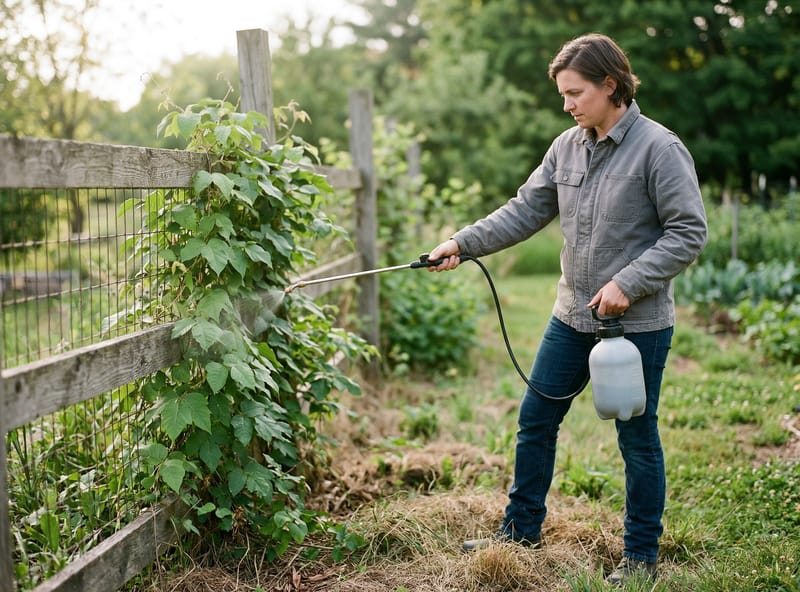
Before touching or spraying poison ivy, put on chemical-resistant gloves (not cloth or leather — urushiol penetrates them), long sleeves, long pants tucked into boots, and eye protection. Urushiol is on every part of the plant, including stems and roots. If any skin contacts the plant, wash immediately with cold water and soap. Never burn poison ivy — inhaling urushiol smoke can cause severe respiratory reactions and emergency hospitalization.
- Mix at the non-selective rate. 4 cups of Salacia per 1 gallon of water. Poison ivy demands the full-strength concentration. Dissolve completely before loading your sprayer.
- Drench everything. This is not a misting job. Spray the tops of leaves, the undersides of leaves, every stem, every vine — including vines climbing trees, fences, or walls. Spray the soil around the base where rhizomes are closest to the surface. Apply until heavy runoff. If you can still see dry leaf surfaces, you have not sprayed enough.
- Full coverage determines your results. Salacia works on contact — if the product does not touch it, it does not kill it. Poison ivy often hides under other foliage, climbs into canopy cover, or sends runners along the ground beneath leaf litter. Find it all. Spray it all.
- Choose the right conditions. Apply on a warm, calm morning when temperatures are between 60 and 80 degrees F. No rain in the forecast. Calm air prevents drift onto desirable plants. Morning application gives the product a full day of warm temperatures to work.
- Repeat when new growth appears. This is not optional. Poison ivy typically requires 3 or more applications following the full protocol. When new shoots emerge from the rhizome — and they will after the first application — hit them again with the same drench technique. Each regrowth will be smaller and weaker.
- Final cleanup. After the root system is exhausted and regrowth stops, hand-remove any remaining dead vines and rhizome fragments with gloves. Bag and dispose of all plant material — do not compost it. Urushiol remains active on dead plant material.
Pet note: Salacia is Pet Friendly (on the label) and OMRI certified organic. Let the treated area dry before allowing pets back — not because of safety concerns, but because animals may be attracted to lick it, which could affect results on the weeds.
Ready to Take Back Your Lawn?
Salacia™ is the first OMRI-certified selective organic herbicide — kills weeds, not grass. Choose your lawn size:
What Happens After Treatment — Zero Residual Effect
This is where Salacia fundamentally separates itself from synthetic herbicides.
Synthetic products leave chemical residues in the soil that persist for weeks or months. Those residues can affect soil biology, contaminate groundwater, and prevent desirable plants from establishing in the treated area. You traded one problem — poison ivy — for another — contaminated soil.
Salacia leaves no synthetic residue. The dehydration mechanism is physical. Once the plant tissue is desiccated, the treatment is done. Nothing lingers in the soil waiting to damage the next thing that grows there.
What This Means for Your Property
- Treated areas recover naturally. Native plants, grass, and ground cover recolonize on their own once the poison ivy is eliminated. You do not need to remediate the soil.
- No groundwater contamination. Nothing synthetic leaches downward through the soil profile.
- No long-term soil damage. The microbial life in your soil — the organisms that make healthy plant growth possible — are not harmed by residual chemicals because there are none.
- You can replant immediately. Once the poison ivy is controlled and dead material is removed, you can seed grass, plant ground cover, or install garden beds in the treated area without waiting for chemical breakdown.
Your yard heals itself once the poison ivy is gone. That is how organic weed control should work. For more on why this matters, see does organic weed killer work.
Where Poison Ivy Grows — State-by-State Guide
Poison ivy (Toxicodendron radicans) is found in every US state except Alaska and Hawaii. It grows from the Atlantic to the Pacific, from the Gulf Coast to southern Canada. If you own property in the continental United States, poison ivy can grow on it.
Common Habitats
- Forest edges and trail borders — the classic encounter zone. Poison ivy thrives at the boundary between open areas and tree cover.
- Fence lines and property borders — vines climb fences, spread along the base, and create dense stands that are difficult to manage.
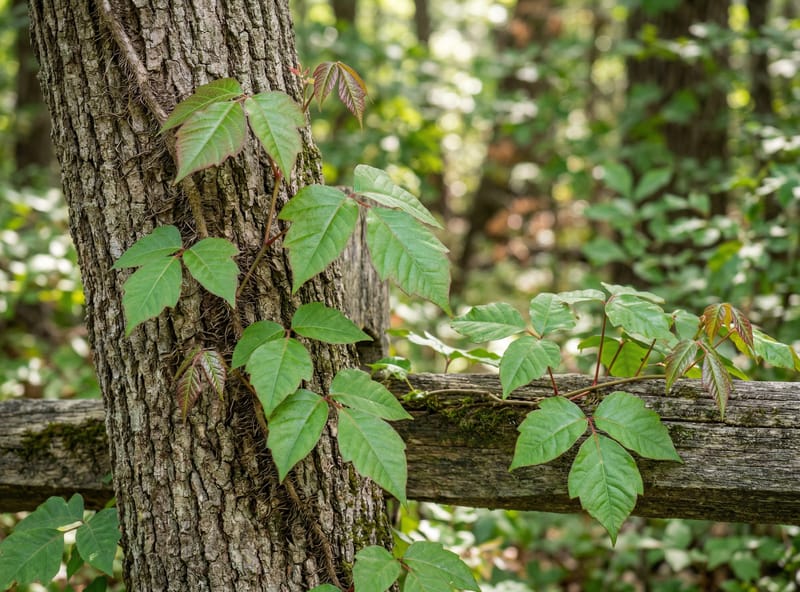
- Around trees. Poison ivy is a climbing vine. It sends aerial rootlets into bark and can climb 50+ feet into the canopy. The characteristic "hairy rope" vine on tree trunks is poison ivy.
- Shaded borders and north-facing slopes — unlike many weeds, poison ivy does not need full sun. It grows aggressively in partial to full shade.
- Disturbed ground — construction sites, cleared lots, roadside ditches. Poison ivy is an early colonizer of bare soil.
Poison ivy is, at its core, a woodland edge plant. According to the USDA Forest Service, it thrives in partly shaded woodlands, canopy gaps, and forest borders — exactly the transition zones where your yard meets the trees. It loves the dappled light and moist soil that woodland edges provide, and once established under that canopy, it spreads aggressively through rhizomes in every direction. If your property backs up to woods, borders a trail, or has mature trees casting shade — you are in prime poison ivy territory.
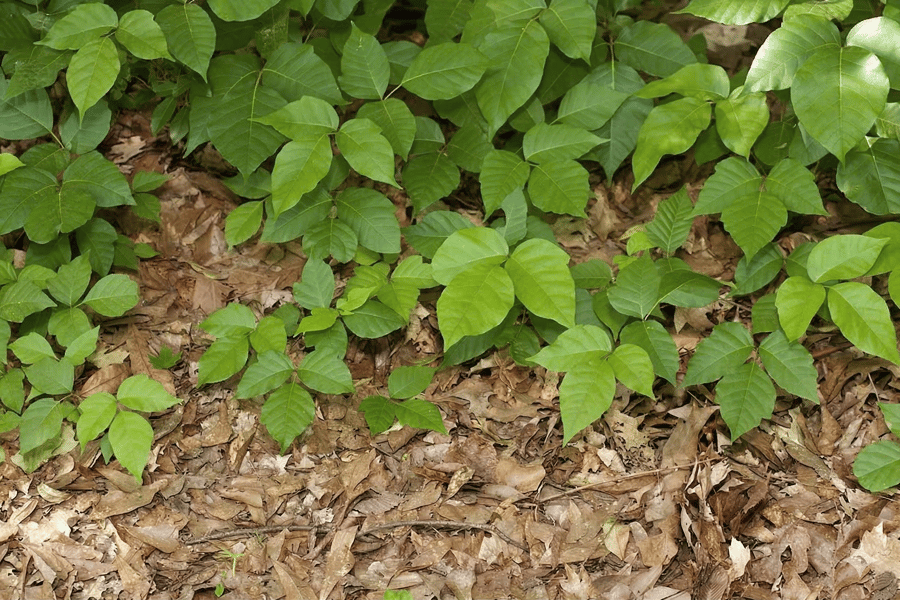
Poison Ivy by Region — State-by-State Guide
While poison ivy grows nationwide, certain regions deal with it more intensely. Here is what you need to know based on where you live:
Northeast (Maine, New Hampshire, Vermont, Massachusetts, Connecticut, Rhode Island, New York, New Jersey, Pennsylvania)
The Northeast is ground zero for poison ivy. Dense mixed forests, humid summers, and abundant forest edges create ideal habitat. Poison ivy is found in every county of every northeastern state. It grows as ground cover in yards, climbs trees along property lines, and colonizes stone walls and fence rows. In suburban neighborhoods throughout Connecticut, New Jersey, and eastern Pennsylvania, poison ivy is one of the top three yard complaints. The combination of old-growth trees and residential properties means constant human-plant contact.
Mid-Atlantic (Delaware, Maryland, Virginia, West Virginia, Washington D.C.)
Warm, humid summers and long growing seasons make the Mid-Atlantic a hotbed for aggressive poison ivy growth. Virginia and Maryland see some of the largest poison ivy plants in the country — climbing vines with trunk diameters exceeding 3 inches are common on mature trees. The region's mix of suburban development and adjacent woodlands means residents encounter poison ivy walking to their mailbox, mowing their edges, and cleaning up fence lines.
Southeast (North Carolina, South Carolina, Georgia, Florida, Alabama, Mississippi, Tennessee, Kentucky)
In the Southeast, poison ivy's growing season is the longest in the country — nearly year-round in Florida, Georgia, and coastal Carolina. The plant rarely goes fully dormant. Warm winters mean rhizomes stay active, and new growth appears earlier in spring. Southern homeowners face a longer battle: while northern states get a reprieve from November through March, southeastern properties need monitoring from February through December.
Midwest (Ohio, Indiana, Illinois, Michigan, Wisconsin, Minnesota, Iowa, Missouri, Kansas, Nebraska)
The Midwest sees some of the densest poison ivy infestations in the country. Farmland edges, fence rows, woodlots, creek banks, and rural properties are heavily colonized. Ohio, Indiana, and Missouri consistently rank among the most affected states. The University of Missouri Extension identifies poison ivy as one of the state's most problematic plants for both rural and suburban properties. Midwestern poison ivy tends to grow aggressively as ground cover in open areas and as thick climbing vines in wooded sections.
South Central (Texas, Oklahoma, Arkansas, Louisiana)
Texas alone spans multiple climate zones, and poison ivy is present in nearly all of them — from the piney woods of East Texas to the Hill Country and river bottoms of Central Texas. Only the far western desert regions are largely free of it. Oklahoma, Arkansas, and Louisiana see heavy infestations along rivers, bayous, and the edges of agricultural land.
Mountain West and Pacific Northwest (Oregon, Washington, Idaho, Montana, Colorado, Utah)
Western poison ivy (Toxicodendron rydbergii) replaces the eastern species at higher elevations and in the Pacific Northwest. It tends to grow as a low shrub rather than a climbing vine. In Oregon and Washington, the closely related Pacific poison oak (Toxicodendron diversilobum) is the more common threat at lower elevations. Colorado hikers and property owners encounter poison ivy along creek corridors and riparian zones on the eastern slope.
States Without Poison Ivy
Alaska and Hawaii do not have native poison ivy populations. California west of the Cascades/Sierra Nevada has poison oak rather than poison ivy — a closely related species that causes the same urushiol reaction but requires the same treatment approach.
The Health Impact — By the Numbers
Poison ivy is not just a nuisance — it is a public health issue with real costs:
- 10+ million Americans suffer poison ivy contact dermatitis every year
- 43,000 emergency department visits annually from severe reactions
- 85% of adults are sensitive to urushiol — only about 15% of people have no reaction at all
- Rashes last 2-4 weeks on average, with severe cases requiring prescription corticosteroids and follow-up medical visits
- Lost workdays and productivity — outdoor workers, landscapers, utility crews, and construction workers are disproportionately affected
- Inhaling smoke from burning poison ivy can cause life-threatening respiratory reactions and emergency hospitalization
This is not a minor irritation. For millions of Americans every year, poison ivy means medical bills, missed work, and weeks of misery. Controlling it on your property is not cosmetic landscaping — it is protecting your family's health.
Why Poison Ivy Is Getting Worse
Research from Duke University has demonstrated that rising atmospheric CO2 levels are making poison ivy bigger, faster-growing, and more toxic. Under elevated CO2 conditions, poison ivy produces a 153% increase in the most allergenic form of urushiol — meaning the rash you get today is worse than what your parents dealt with. The plants also grow larger, produce more biomass, and spread more aggressively than under historical CO2 levels.
This is not a problem that is going away on its own. Every year, poison ivy becomes a bigger, more potent, and more widespread challenge for homeowners, property managers, parks departments, and anyone who works or plays outdoors. Having an effective organic control method is no longer optional — it is essential.
Poison Ivy vs. Poison Oak vs. Virginia Creeper
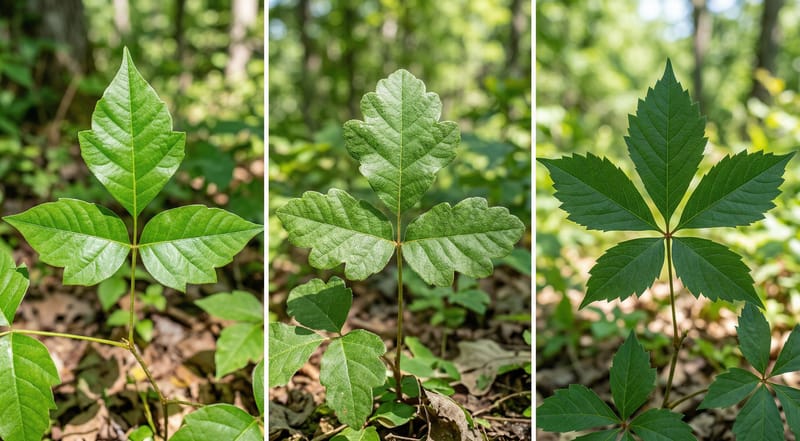 — ID Guide
Before you spray, make sure you are looking at poison ivy. Misidentification wastes product and leaves the real problem untreated. Here is how to tell them apart, based on guidance from Oklahoma State University Extension:
Poison Ivy (Toxicodendron radicans)
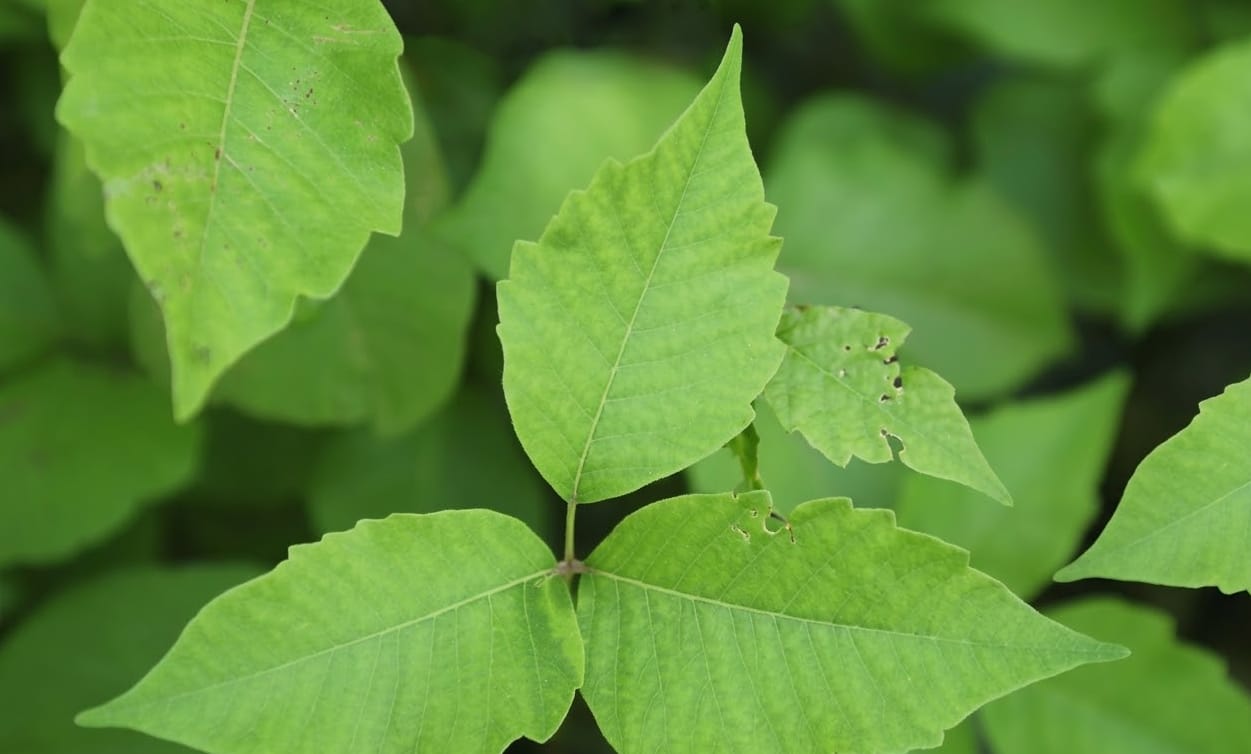
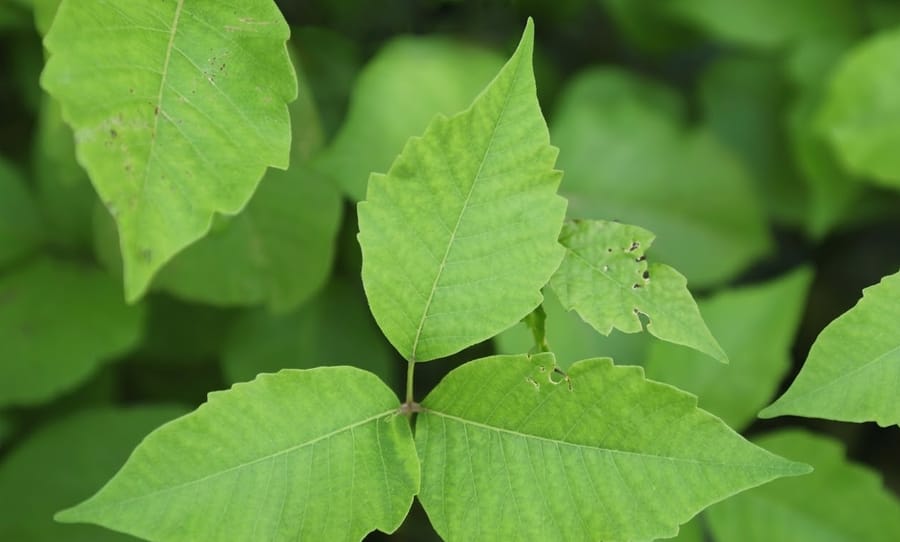
- Leaves of three. Always three leaflets per leaf. The middle leaflet has a longer stem than the two side leaflets.
- Leaf edges: Variable — can be smooth, toothed, or lobed. This variability is what makes identification tricky.
- Shiny leaves in spring (new growth), becoming duller as the season progresses. Fall color is brilliant red or orange.
- Hairy vine. Climbing poison ivy develops aerial rootlets that create a distinctive "hairy rope" appearance on tree trunks and fences.
- White berries in late summer and fall — a key identifier. "Berries white, take flight."
- Growth forms: Ground cover, shrub, or climbing vine — all three from the same species.
Poison Oak (Toxicodendron diversilobum / T. pubescens)
- Also three leaflets, but they are rounded and lobed — resembling small oak leaves.
- More common in the western US (Pacific poison oak) and southeastern US (Atlantic poison oak).
- Tends to grow as a shrub rather than a climbing vine.
- Same urushiol oil — causes the same reaction as poison ivy.
Virginia Creeper (Parthenocissus quinquefolia)
- Five leaflets — not three. This is the key distinction.
- Often grows alongside poison ivy on the same trees and fences.
- Harmless to touch — no urushiol. But it is commonly confused with poison ivy because it shares the same habitats.
- Blue-black berries (not white).
The rule: Leaves of three, let it be. If the plant has three leaflets, shiny spring foliage, and white berries — treat it as poison ivy until confirmed otherwise. When in doubt, upload a photo to Lanaturo Intelligence for instant identification.
Why Most Organic Products Fail on Poison Ivy
Most organic weed control products on the market are non-selective burn-down sprays. They damage the surface foliage — the leaves brown, maybe the top of the stems wilt — and that is where their effectiveness ends. Here is why that approach fails on poison ivy:
- Surface damage only. Generic burn-down sprays affect the leaves but do not deeply dehydrate the stems, vines, and tissue near the root crown. The root system remains untouched and fully energized.
- Regrowth in weeks. With the rhizome intact and loaded with stored energy, poison ivy sends up new growth quickly. You are back to square one — sometimes with even more aggressive regrowth as the plant responds to the stress.
- No protocol for persistence. These products are sold as one-application solutions. "Spray and done." But poison ivy requires a sustained campaign. Without a multi-application protocol designed to deplete the root system over time, a single spray is a temporary inconvenience for the plant — not a death sentence.
- Non-selective collateral damage. Burn-down sprays kill everything they touch — desirable plants, grass, ground cover. After spraying near your garden or lawn, you have dead poison ivy AND dead landscaping. The poison ivy comes back. The landscaping may not.
They sell you one spray. Poison ivy requires a campaign.
That is the fundamental difference with Salacia. It is not a single product — it is a protocol. Drench, wait, repeat. Each application weakens the root system. The plant runs out of energy. The protocol wins. For the broader case on organic efficacy, read does organic weed killer work.
The Best Poison Ivy Killer Without Glyphosate
If you are comparing products, the best poison ivy killer has to pass three tests. It must penetrate the plant's waxy, urushiol-coated armor. It must fit how your family actually uses the yard once it dries. And it should not linger in your soil afterward. Homemade vinegar mixes fail the first test — they scorch the visible leaves and leave the rhizome network untouched, which is why the patch comes back wider every year.
Salacia was built to pass all three: an OMRI-certified organic herbicide strong enough to run the full protocol below, with zero soil residue once dry and a Pet Friendly label. No honest product promises a one-spray miracle on poison ivy. What Salacia promises is a protocol that works: heavy-volume soaks of every reachable surface, 2–3 applications per season, and a root system that runs out of energy before you run out of resolve.
→ Get Salacia — the organic poison ivy killer built for the full protocol
The Salacia Poison Ivy Protocol — Season-Long Control
This is the complete protocol for eliminating poison ivy with Salacia. Follow every step. Poison ivy is not a weed you can spray once and forget — it is a campaign that rewards persistence.
Application 1 — Knock Down Existing Growth
Mix at 4 cups per gallon. Drench all visible foliage, stems, and vines until heavy runoff. Do not miss the undersides of leaves or vines climbing structures. Spray the soil around the base of the plant where rhizomes are near the surface. The goal is total saturation of every surface.
Application 2 — Hit the Regrowth
New shoots will emerge from the rhizome — typically within several weeks. This regrowth will be noticeably smaller and weaker than the original plant. Good. That means the root system is spending energy. Hit the regrowth with the same full-drench technique. Same rate, same thorough coverage.
Application 3+ — Finish It
Continue treating every new flush of growth. By the third application, regrowth is typically sparse — thin shoots, small leaves, minimal vigor. The rhizome is running out of stored energy. Continue until no new growth appears. Most patches need 2–3 applications per season. For established, multi-year patches, expect touch-ups in future seasons — an old rhizome network can push a few final shoots next spring, and a quick spot-soak handles them in minutes. That is not the product failing; that is a years-old root system spending its last reserves.
The End Result
99% control when following the full protocol. The multi-application approach systematically depletes the root system's energy reserves. Each treatment cycle forces the plant to spend more energy than it can recover. Eventually, the rhizome is exhausted and the plant cannot regenerate.
For Properties and Large Infestations
For heavily infested properties, parks, trail systems, or commercial lots: combine the spray protocol with manual rhizome removal after the plant is weakened. Once 2-3 spray applications have depleted the root system's energy, the weakened rhizomes are easier to dig out. Remove as much root material as possible and monitor the area for any regrowth. This combined approach accelerates the timeline for total control.
For pet-specific safety guidance when treating any weed on your property, read Is Organic Weed Killer Safe for Pets? And visit the Weed Control Guide for treatment info across all supported weed species.
Salacia is the first OMRI-certified selective organic herbicide, made by Lanaturo: it removes broadleaf lawn weeds while keeping your grass unharmed.

Lanaturo
Intelligence
Not sure which weed you're looking at? Show Sal.
Sal is the lawn-care brain behind Lanaturo Intelligence. He doesn't just name the weed — he builds your exact treatment plan and checks whether today is the right day to spray.
Ready to Take Back Your Lawn?
Salacia™ is the first OMRI-certified selective organic herbicide — kills weeds, not grass. Choose your lawn size:
Your Yard Should Not Come with a Warning Label
Poison ivy affects over 10 million Americans every year. It sends 43,000 people to the emergency room. It turns your own property into a hazard zone — every walk to the mailbox, every game of catch, every afternoon in the garden becomes a calculated risk.
For decades, the only effective options left synthetic chemicals in your soil for weeks. You were forced to choose: tolerate the poison ivy, or contaminate the ground where your children and pets play.
Related: For the broader switching-decision context — 192,000 lawsuits, WHO classification, the regulatory cycle reshaping the residential market — read our organic alternative to glyphosate guide.
That trade-off is over. Salacia controls poison ivy like the synthetic products do — 99% control following the full protocol — without leaving a single molecule of synthetic residue in your soil. No compromise on efficacy. No compromise on safety. No compromise on your standards.
OMRI certified organic. Pet Friendly. Zero residual chemicals. Proven on poison ivy in sun, shade, and everything in between.
Take your yard back. Every square foot of it. The organic way that actually works.
Salacia is OMRI Listed for organic use and made from naturally derived ingredients. Always follow label directions for best results. Performance may vary based on weed maturity, environmental conditions, and application method. When handling poison ivy, always wear appropriate protective equipment regardless of treatment method.