
 By Pat Kelly
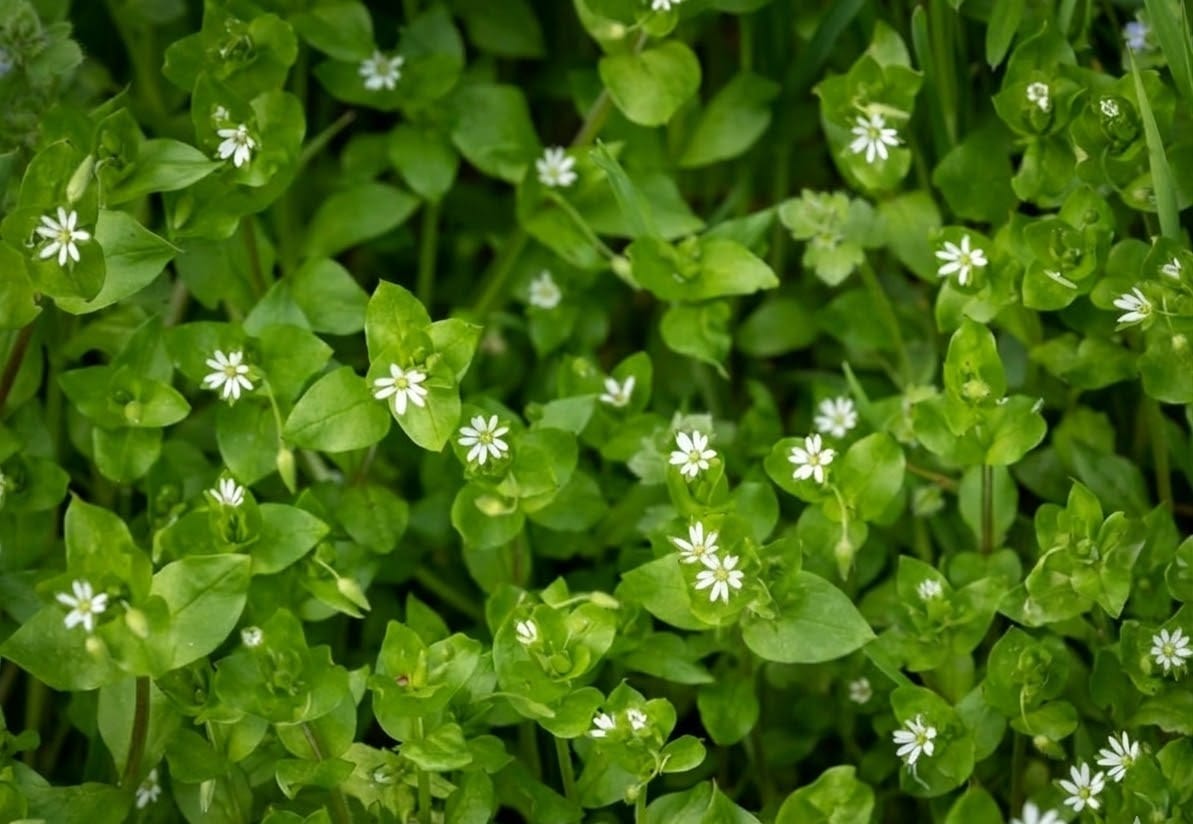
 If you are seeing low-growing mats of tiny white flowers creeping through your lawn in March or April, you are almost certainly looking at chickweed. It is one of the most common lawn weeds in America, and one of the most frustrating — because by the time most homeowners notice it, it has already blanketed entire sections of turf.
Chickweed is a winter annual. It germinates quietly in fall, hides through winter, then explodes in early spring when temperatures sit between 40 and 65 degrees F. It thrives in exactly the conditions where cool-season grasses are still waking up, which gives it a head start your lawn cannot match. Left untreated, a single chickweed plant can produce up to 15,000 seeds before it dies in summer heat — and those seeds will be back next year.
The good news: chickweed is a broadleaf weed, which makes it vulnerable to selective herbicides that target broadleaf plants without harming grass. This guide covers everything — identification, why it is in your yard, where it grows most by region, how to kill it organically without killing your grass, and how to prevent it from returning.
What Is Chickweed? Identification Guide
Accurate identification is the first step to effective control. Chickweed is commonly confused with other low-growing spring weeds like henbit, purple deadnettle, and speedwell — but each requires different treatment approaches. Here is how to identify the two main types of chickweed found in American lawns.
Common Chickweed (Stellaria media)
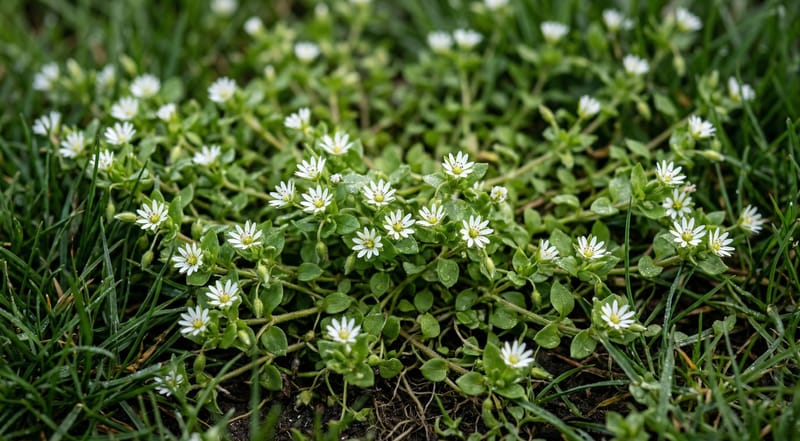
Common chickweed is the species you will encounter most often. It forms dense, low-growing mats that hug the ground and spread outward rather than growing upward. Key identification features:
- Leaves: Small, smooth, oval-shaped, with pointed tips. They grow in opposite pairs along the stem. Leaves are bright green with no fuzz or hair.
- Flowers: Tiny white star-shaped blooms, roughly 6 mm across. Each flower has 5 petals, but each petal is so deeply notched that it appears to have 10 petals. This is a reliable ID feature.
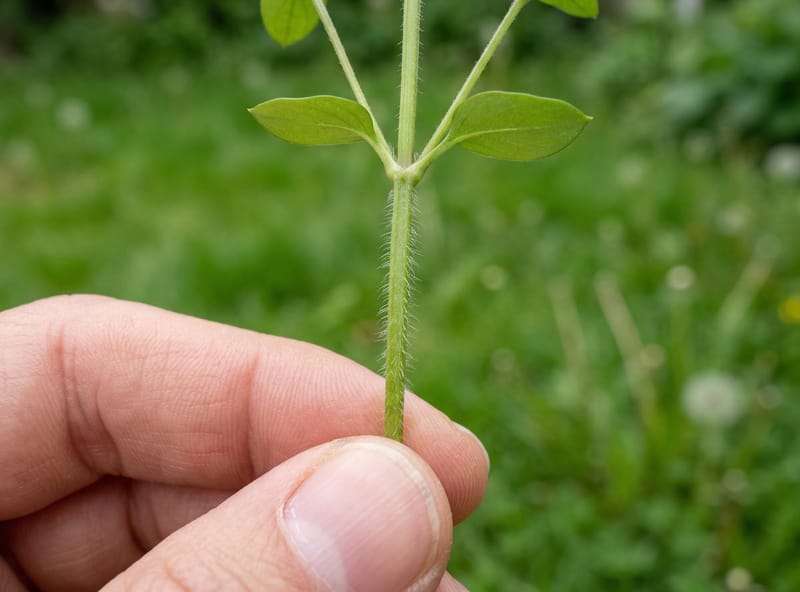
- Stems: Thin, trailing stems that root at the nodes where they contact soil. The single most distinctive identification feature is a single line of fine hairs running down one side of the stem — rotate the stem and you will see it. No other common lawn weed shares this trait.
- Growth habit: Low, mat-forming. Stays close to the ground, spreading laterally rather than growing tall. A single plant can cover several square feet.
- Lifecycle: Winter annual — germinates in fall (September to November), grows slowly through winter, then explodes in early spring when temperatures reach 40 to 65 degrees F. Dies back in summer heat.
Mouse-Ear Chickweed (Cerastium fontanum)
Mouse-ear chickweed looks similar at first glance but has several distinguishing characteristics:
- Leaves: Slightly larger than common chickweed, with a distinctive fuzzy or hairy texture on both the leaves and stems. The leaves are more oblong and rounded — resembling a mouse ear, which is where the name comes from.
- Stems: Also trailing and mat-forming, but covered in fine hairs throughout — unlike common chickweed's single hair line.
- Lifecycle: Perennial. Unlike common chickweed, mouse-ear chickweed can persist year-round and does not die back in summer. This makes it a longer-term problem if left untreated.
- Flowers: White, similar to common chickweed but slightly larger. Same deeply-notched petal structure.
What Chickweed Is Not
Several spring weeds are frequently confused with chickweed. Quick differentiation tips:
- Henbit — upright growth (not mat-forming), square stems, pink-purple tubular flowers, scalloped round leaves that clasp the stem.
- Purple deadnettle — similar to henbit with square stems and purple flowers, but the upper leaves are distinctly purplish-red and triangular.
- Speedwell (Veronica) — low-growing like chickweed, but flowers are blue or violet with 4 petals (not 5). Leaves are rounder with scalloped edges.
If you are still unsure what you are looking at, the single line of hairs on the stem test is definitive. If the stem has one line of hairs running down one side, it is common chickweed.
Why Chickweed Is in Your Yard
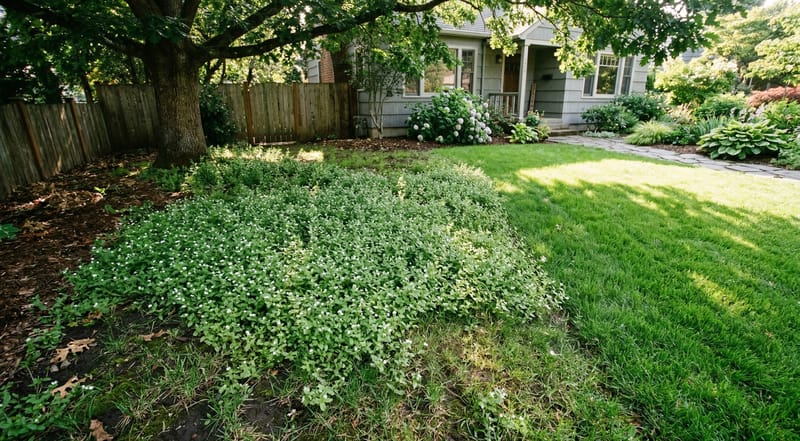
Chickweed does not invade at random. It shows up because your lawn has conditions that favor it over your grass. Understanding why it is there is the key to eliminating it permanently — not just this season, but every season.
- Cool, moist conditions. Chickweed's sweet spot is 40 to 65 degrees F with consistent moisture. It germinates in fall when the soil is cool and wet, and grows most aggressively in early spring. If your yard stays damp — from shade, clay soil, poor drainage, or overwatering — chickweed has ideal growing conditions.
- Thin turf. Chickweed is an opportunist. It fills gaps where grass is thin, sparse, or absent. Bare patches from winter damage, heavy foot traffic, disease, or drought stress are open invitations.
- Shade. Chickweed tolerates shade far better than most grass species. The areas under trees, along north-facing walls, and in any spot that gets less than 4 hours of direct sunlight are prime chickweed territory.
- Compacted soil. Heavy, compacted soil stresses grass root systems while chickweed — with its shallow, fibrous roots — handles compaction without issue.
- Overwatering. Lawns watered too frequently create the consistent surface moisture that chickweed needs to thrive. Deep, infrequent watering favors deep grass roots over shallow-rooted weeds.
- Prolific seed production. A single common chickweed plant can produce between 800 and 15,000 seeds in its lifetime. Those seeds can remain viable in the soil for years. Even after you eliminate every visible plant, the seed bank below the surface is waiting for the next opportunity.
The fundamental message: chickweed is there because your grass is weak where it is growing. The chickweed fills gaps. Kill the chickweed and address the underlying conditions, and your lawn reclaims the space.
Where Chickweed Grows Most — By Region
Chickweed is found in all 50 states, but it is far more problematic in some regions than others. Climate drives everything — chickweed needs cool temperatures and consistent moisture to thrive. Here is where it hits hardest.
Northeast
New York, Pennsylvania, Massachusetts, Connecticut, New Jersey, Vermont, Maine — the Northeast is chickweed's stronghold. Cool, wet springs and fall moisture create ideal germination and growth conditions. Chickweed ranks among the top 5 most common lawn weeds across the entire region. If you are in the Northeast and seeing low-growing mats of tiny white flowers in March or April, it is almost certainly chickweed.
Upper Midwest
Ohio, Michigan, Wisconsin, Minnesota, Indiana, Illinois — the transition zone between warm and cool climates is perfect for chickweed. It explodes in March and April when snowmelt saturates the soil and temperatures hover in the 40 to 60 degree range. The Upper Midwest also sees mouse-ear chickweed persisting through summer in shaded, irrigated lawns.
Pacific Northwest
Washington, Oregon — mild winters and consistent rainfall mean chickweed can grow nearly year-round in the Pacific Northwest. It never fully dies back in many areas west of the Cascades because summer temperatures often stay moderate enough to sustain growth. This makes the Pacific Northwest one of the most challenging regions for chickweed control.
Mid-Atlantic
Virginia, Maryland, Delaware, North Carolina — early spring chickweed invasions are a staple of Mid-Atlantic lawns. The region's moderate winters allow fall-germinated chickweed to establish strong root systems before its spring growth surge. By the time dogwoods bloom, chickweed is already matted across thin lawn areas.
Mountain West
Colorado, Utah — chickweed is primarily an issue on irrigated lawns in the Mountain West. The combination of cool-season turf, regular irrigation, and moderate spring temperatures creates favorable conditions despite the region's generally arid climate.
Where Chickweed Is Less Common
The deep South (Alabama, Mississippi, Louisiana, southern Georgia) sees less chickweed because summer heat arrives earlier and lasts longer, shortening chickweed's growing window significantly. The desert Southwest (Arizona, New Mexico, west Texas) is generally too hot and dry for chickweed to establish unless lawns are heavily irrigated and shaded.
How to Kill Chickweed With Salacia
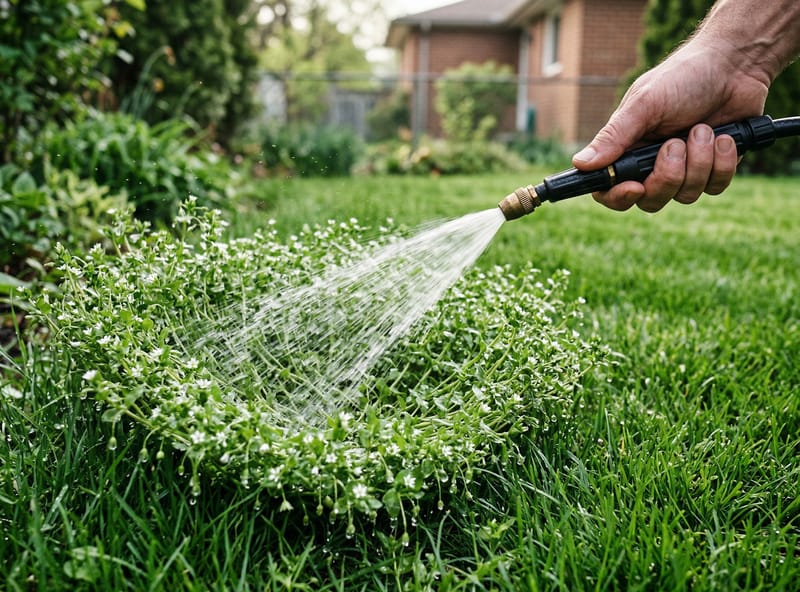
Chickweed is a broadleaf weed — and broadleaf weeds are exactly what selective herbicides are designed to target. The challenge with most organic weed killers is that they are non-selective: they burn everything they contact, including your grass. That is fine for driveways and patios, but it defeats the purpose when chickweed is growing in your lawn.
Salacia by Lanaturo is the first OMRI-certified selective herbicide. The naturally derived formula works through rapid osmotic dehydration — not poisoning. The product draws moisture out of broadleaf weed tissue on contact, causing the plant to dry out and collapse. Grass — with its different leaf structure and physiology — is designed to be preserved at the selective mixing rate.
Important: Always test a small area of your lawn first before full application. Salacia is designed to be selective, but temporary paling or yellowing on grass is possible depending on irrigation, lawn health, and environmental conditions. Results vary — your lawn is unique.
Chickweed's thin, soft leaves and shallow root system make it highly responsive to this dehydration mechanism. Here is how to apply it:
- Mow first. Cut your lawn to normal height before treating. This exposes chickweed foliage and ensures maximum product contact.
- Mix at the selective rate. 1 lb (3 cups) of Salacia per 1 gallon of water. This concentration targets broadleaf weeds while being designed to preserve your grass. You are starting from dry granules — see how a water-soluble granular works if you have never mixed one.
- Full coverage is everything. Chickweed forms dense mats — do not just mist the top surface. Get thorough coverage on the canopy, stems, and the soil area around the base. The hidden growth underneath the visible mat is what grows back if you only treat the surface. Drench the foliage until it runs off. Your results are directly proportional to your coverage. Blanket spraying works well for large chickweed patches — similar to treating clover mats.
- Apply on a calm morning, 60 to 80 degrees F. Warm, dry conditions accelerate the dehydration process. Avoid windy days and do not apply if rain is expected within 4 hours.
- Expect 1 to 2 applications. Younger chickweed plants respond quickly. Mature, established mats may require a follow-up application for complete control.
For non-lawn areas (garden beds, fence lines, gravel paths): use the non-selective rate of 1.5 lb (4 cups) per gallon for faster, more aggressive control.
The selective advantage is the entire point. Chickweed grows as a dense mat interwoven with your grass. Non-selective treatments would wipe out both. Salacia is designed to kill the chickweed mat while preserving the grass underneath — no reseeding, no dead patches, no starting over.
For detailed application guidance across seasons and climates, see our timing and application best practices.
Ready to Take Back Your Lawn?
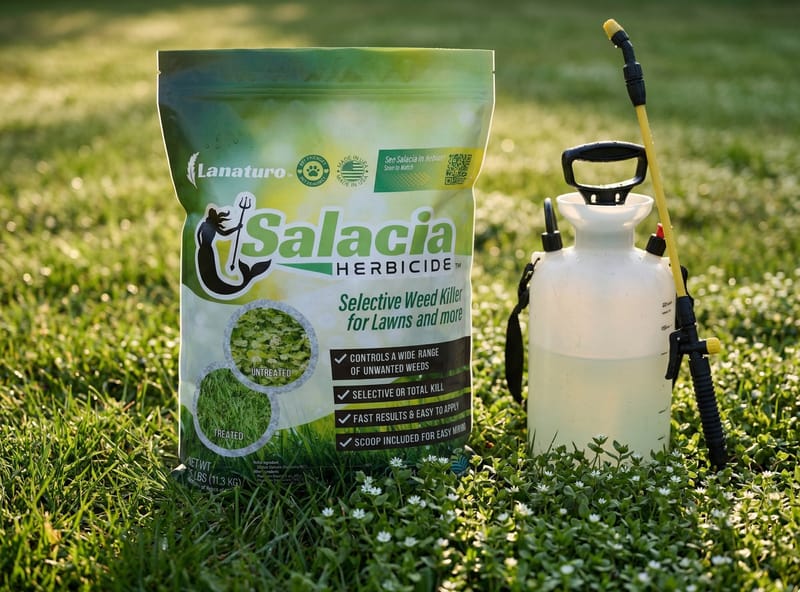
Salacia™ is the first OMRI-certified selective organic herbicide — kills weeds, not grass. Choose your lawn size:
Timing Is Everything
With chickweed, when you treat matters as much as how you treat. Chickweed follows a predictable lifecycle, and catching it at the right stage makes control dramatically easier.
The Spring Window
Early spring — when chickweed is actively growing but before it flowers and sets seed — is your best treatment window. In most regions, this means late February through mid-April, depending on your local climate. Once temperatures consistently exceed 75 degrees F, common chickweed begins to decline on its own, but by then it has already dropped thousands of seeds.
Treat before it flowers. This is the critical point. If chickweed flowers and seeds before you treat, you have eliminated this year's plants but guaranteed next year's crop. Breaking the seed cycle is how you reduce chickweed pressure over time — not just for this season, but for subsequent years.
Fall Treatment
Because chickweed germinates in fall, treating young seedlings in late September through November can prevent the spring explosion entirely. Fall-germinated chickweed plants are small and highly vulnerable. Catching them early means they never reach the mat-forming stage.
Nail the Weather Window
Use the Lanaturo Intelligence Application Score to identify the ideal treatment window for your location. Temperature, humidity, wind speed, and precipitation forecasts all affect application effectiveness. The tool analyzes conditions and tells you exactly when to spray for maximum results.
How to Prevent Chickweed from Coming Back
Killing existing chickweed is step one. Preventing its return is step two — and the more important one for long-term lawn health. Every prevention strategy comes back to the same principle: build a lawn dense enough that chickweed cannot find a foothold.
Overseed Thin Areas in Fall
Chickweed germinates where grass is thin. After treating chickweed in spring, overseed those areas in early fall (September in most cool-season zones). New grass seedlings fill the gaps before chickweed seeds have a chance to germinate. Dense turf is the best long-term weed suppression available.
Raise Your Mowing Height
Mow at 3 to 4 inches for cool-season grasses. Taller grass shades the soil surface, blocking light that chickweed seeds need to germinate. It also strengthens root systems, making your lawn more competitive. Every time you scalp your lawn short, you are creating conditions that favor chickweed over grass.
Reduce Overwatering
Chickweed thrives in consistently moist surface soil. Switch from frequent, shallow watering to deep, infrequent irrigation. This encourages deep grass roots while denying chickweed the surface moisture it depends on. Water early in the morning so the lawn surface dries by midday.
Core Aerate Compacted Soil
Compacted soil stresses grass but does not bother chickweed. Annual core aeration in fall — pulling small plugs of soil to relieve compaction — opens the soil for grass root penetration and tips the competitive balance toward your turf.
Improve Drainage and Reduce Shade
Where possible, improve drainage in low-lying areas that stay wet. Prune lower tree branches to increase sunlight to shaded lawn sections. Both moves reduce the cool, moist, shaded conditions that chickweed favors. In areas where deep shade is permanent, consider shade-tolerant grass varieties or ground cover alternatives rather than fighting a losing battle against chickweed year after year.
For a broader look at broadleaf weed management and prevention, visit our Weed Control Guide. And to understand why organic selective treatment preserves your lawn while non-selective methods destroy it, read Does Organic Weed Killer Work?
Comparing your options?
Our full breakdown of what to look for — and what to avoid — is in the best organic weed killer. Four criteria, real comparison, no marketing fluff. If keeping your grass is the worry, see the best weed killer that won't kill grass.

Lanaturo
Intelligence
Not sure which weed you're looking at? Show Sal.
Sal is the lawn-care brain behind Lanaturo Intelligence. He doesn't just name the weed — he builds your exact treatment plan and checks whether today is the right day to spray.
Ready to Take Back Your Lawn?
Salacia™ is the first OMRI-certified selective organic herbicide — kills weeds, not grass. Choose your lawn size:
Your Lawn Deserves Better Than Chickweed
Chickweed is one of those weeds that looks harmless until it isn't. By the time those tiny white flowers catch your eye, the mat underneath has already claimed territory your grass will not get back without intervention. But chickweed's thin leaves and shallow roots also make it one of the most responsive broadleaf weeds to selective treatment.
You do not have to choose between killing the weed and saving your lawn. You do not have to accept burned-out patches from non-selective sprays. And you do not have to wait until summer heat does half the job while seeds ensure the problem returns next spring.
Pet Friendly. OMRI certified organic. The first selective organic herbicide — built for exactly this.
Not sure if what you are looking at is chickweed or something else? Open Lanaturo Intelligence — tap the green icon on any page, upload a photo, and get instant weed identification plus a tailored treatment plan for your specific situation.
Salacia is OMRI Listed for organic use and made from naturally derived ingredients. Always follow label directions for best results. Performance may vary based on weed maturity, environmental conditions, and application method.