
 By Pat Kelly
 Every homeowner with a weed problem faces the same question: how do you get rid of the weeds without destroying the grass? It sounds simple, but until recently, organic options could not do it. Every organic herbicide on the market was non-selective — it killed everything it touched, grass included. The result was bare patches, reseeding, and more weeds than you started with. That changed with the introduction of selective organic herbicides. This guide covers why most methods fail, what selectivity actually means, and how to eliminate broadleaf weeds from your lawn while keeping every blade of grass intact.
Related: For the broader case on why homeowners are switching, including the 192,000 U.S. lawsuits and 32 countries restricting it, read our deep guide to a glyphosate-free weed killer that actually works.
Why Most Weed Removal Methods Fail
If you have tried to kill weeds without killing grass before, you probably used one of these three approaches. All of them share the same fundamental problem: they either do not work long-term, or they damage the lawn in the process.
Hand Pulling: A Never-Ending Cycle
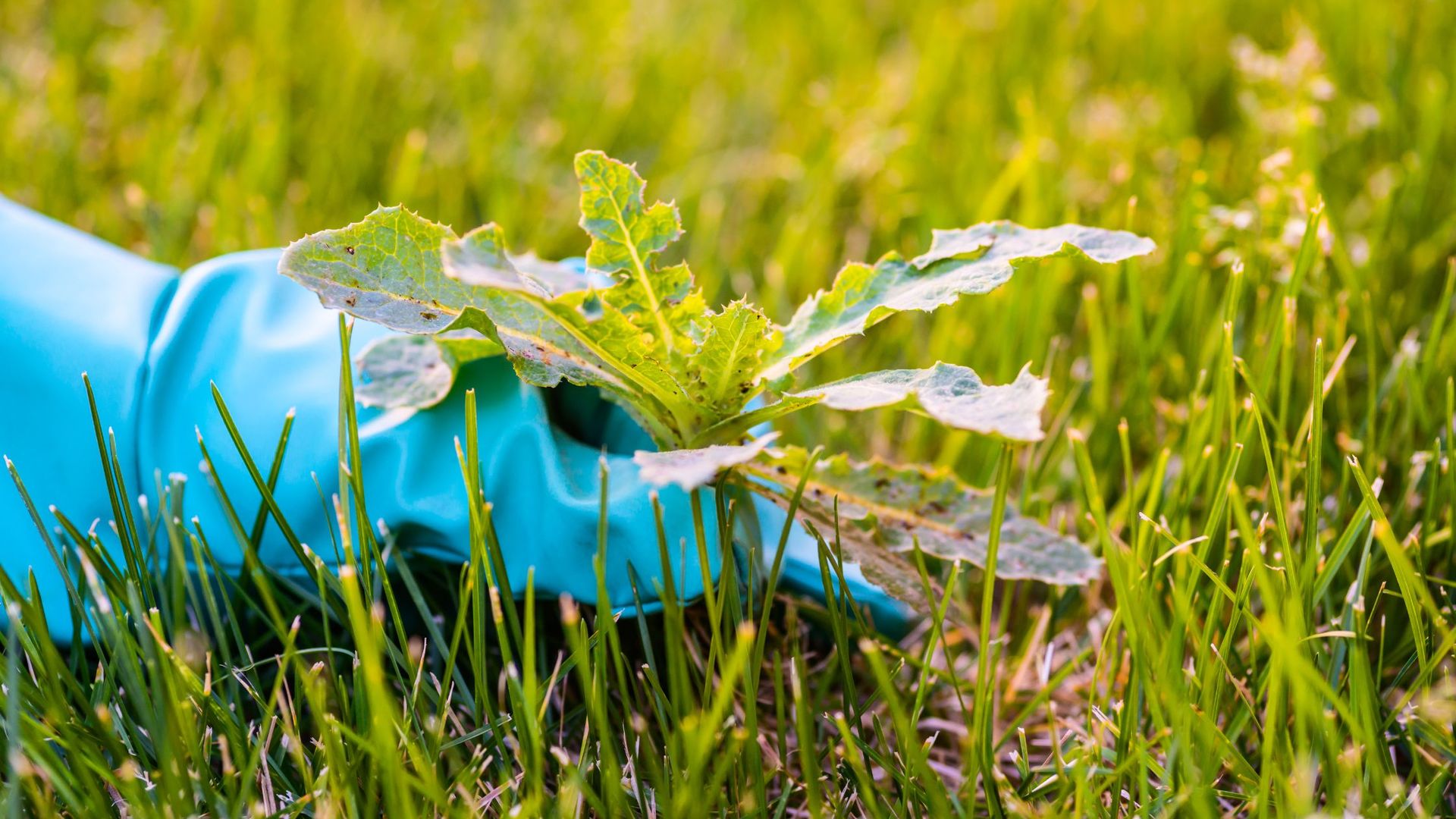
Pulling weeds feels productive in the moment, but it rarely solves anything. Dandelions have taproots that extend over a foot below the surface. Ground ivy spreads through underground stolons that fragment when disturbed. Wild violet produces rhizomes that snap off and regenerate independently. Unless you extract every millimeter of root tissue — which is nearly impossible — the plant grows back.
Worse, pulling disturbs the soil surface and exposes buried weed seeds to sunlight. Most weed seeds can remain viable in the soil for years, waiting for the right conditions to germinate. Every time you pull, you are creating those conditions. The result is a cycle that never ends: pull weeds, disturb soil, trigger new germination, pull again.
Mowing Low: Temporary Cosmetics
Mowing removes the visible portion of the weed, but the root system stays untouched. Within days, the plant pushes new growth from the crown — often flatter and more adapted to avoiding the mower blade. Some weeds, like clover and ground ivy, grow as low-profile mats that the mower passes right over. Dandelions flatten their rosettes in response to repeated mowing, making them harder to cut and harder to see until they bolt and scatter seeds across the yard.
Mowing low also stresses the grass. Cutting below the recommended height weakens the turf, reduces its ability to compete with weeds, and thins the canopy — which lets more sunlight reach the soil surface and triggers more weed germination. You end up with shorter grass, the same weeds, and a lawn that is less capable of fighting them off naturally.
Non-Selective Sprays: The Nuclear Option
Most organic weed killers available at garden centers are non-selective — they kill everything they contact. Spray it on a dandelion in your lawn and the dandelion dies, but so does a six-inch radius of grass around it. The dead patch becomes a bare spot. Bare soil is the most hospitable environment for weed seeds. Within weeks, new weeds fill the gap — often more aggressively than the original one.
Non-selective organic sprays work well on driveways, sidewalk cracks, and gravel. They are counterproductive on lawns. The product kills weeds, but it also destroys the competitive grass canopy that was suppressing other weeds. Every bare patch you create is an invitation for the next generation. This is why so many homeowners conclude that organic weed control "does not work" — they were using the wrong type of product for the job. For more on this distinction, see our guide on whether organic weed killers actually work.
The Selectivity Concept: Why It Matters
The reason most methods fail at killing weeds without killing grass comes down to one word: selectivity. A selective herbicide targets one category of plants while leaving another unharmed. In lawn care, this means killing broadleaf weeds (dicots) while preserving grass (monocots).
The selectivity is rooted in plant architecture. Broadleaf weeds have wide, horizontal leaves that present a large surface area relative to their mass. Grass has narrow, vertical blades that shed liquid and absorb far less product per unit area. When a properly formulated selective herbicide is applied, the broadleaf weeds absorb enough to be lethally dehydrated, while the grass absorbs so little that it recovers fully.
The Key Distinction
Non-selective = kills all vegetation (grass + weeds). Useful for hardscapes and total clearing.
Selective = kills broadleaf weeds only. Grass stays intact. This is what lawns need.
In the synthetic world, selective herbicides have existed for decades. In the organic world, they did not exist at all — until the introduction of Hybrisal Technology. For a deeper technical explanation of how selectivity works at the plant level, read our guide on what is a selective weed killer and how selective weed killers work.
The Organic Selective Solution
Salacia is the first OMRI-certified selective herbicide. It solved the problem that made organic weed control impractical on lawns: the inability to kill weeds without killing grass. Salacia works through rapid osmotic dehydration — a physical mechanism that draws moisture out of plant cells through osmosis.
When the formula contacts broadleaf weed foliage, it creates a high-concentration solution on the leaf surface. This concentration gradient forces water out of the plant cells, collapsing the tissue from the leaves downward through the crown. The wide, horizontal leaves of broadleaf weeds absorb enough product to reach lethal dehydration. The narrow, vertical blades of grass absorb less and recover.
This is not a chemical poison. It is a physical process — the same osmotic principle that draws moisture out of a cucumber when you salt it. No synthetic compound enters the plant. No synthetic residue remains in the soil. The dehydration is mechanical, not chemical, which is why the product qualifies for OMRI certification under USDA organic standards.
OMRI Certified
Independently verified by the Organic Materials Review Institute. Meets the USDA organic standard — the same certification required for use on organic farms.
Pet Friendly
The osmotic dehydration mechanism targets plant biology. Animal biology does not respond the same way. Salacia carries a Pet Friendly on its label. Read more in our Pet Friendly weed killer guide.
Dual-Mode (Hybrisal)
One product, two modes controlled by mixing rate. Selective mode for lawns targets broadleaf weeds. Non-selective mode for hardscapes eliminates all vegetation. No other organic herbicide offers this.
Ready to Take Back Your Lawn?
Salacia™ is the first OMRI-certified selective organic herbicide — kills weeds, not grass. Choose your lawn size:
Application Guide: How to Get It Right
Proper application is the difference between effective weed control and wasted product. Organic selective herbicides work through contact — the formula must reach the weed foliage and remain on it long enough to initiate dehydration. Here is how to maximize results.
Mixing Rate
For lawn use, always use the selective mixing rate listed on the product label. This concentration is calibrated to deliver enough product to dehydrate broadleaf weeds while remaining below the threshold that would damage grass. Using a higher concentration than the label specifies can harm turf. Follow the label — it is the most important step.
Temperature and Weather
Apply when weeds are actively growing and temperatures are between 60 and 85 degrees Fahrenheit. Active growth means the weed is transpiring — moving water through its tissue — which accelerates the dehydration process. Avoid spraying before rain, as water will dilute the product on the leaf surface before it can work. Apply when the forecast shows at least several hours of dry weather following application.
Coverage Technique
Because organic herbicides work through contact, thorough coverage is critical. The product must coat the weed foliage evenly. Use a pump sprayer with a fan-tip nozzle for even distribution. Spray until the weed leaves are glistening wet but not dripping. If the product is pooling or running off the leaf, you are using too much per plant — spread it across more weeds instead.
Timing Within the Season
Spring and fall are the most effective application windows for most broadleaf weeds. In spring, weeds are actively growing and vulnerable. In fall, perennial weeds are pulling resources down into their roots for winter storage — dehydrating the foliage at this stage can exhaust the root reserves before dormancy. For a complete seasonal breakdown, see the timing and application guide.
Common Weeds You Can Remove Without Killing Grass
A selective organic herbicide targets broadleaf weeds — plants with wide, flat leaves that are structurally different from grass. Here are the most common lawn weeds that can be eliminated while your turf stays untouched.
Dandelion
The most recognized lawn weed in North America. Deep taproot makes pulling ineffective — the root snaps and regenerates. A selective herbicide dehydrates the broad rosette leaves and works downward through the crown to kill the entire plant, including the taproot. Controlled with one application in most cases.
Clover
Spreads quickly through stolons to form dense mats that crowd out grass. The trifoliate leaves are highly absorptive, making clover one of the easiest broadleaf weeds to control with a selective herbicide. Responds well to a single application during active growth.
Ground Ivy (Creeping Charlie)
One of the most aggressive lawn invaders. Spreads through surface runners and underground stolons, forming a dense network that chokes out grass. The rounded leaves absorb product effectively. Deep-rooted patches may require a follow-up application to fully exhaust the stolon network.
Wild Violet
Produces charming purple flowers but forms thick colonies that displace turf. Heart-shaped leaves have a waxy coating that can reduce absorption — thorough coverage is especially important. Apply during active growth when the waxy layer is thinnest.
Chickweed
A low-growing annual that thrives in cool, moist conditions. The small, succulent leaves are easy targets for dehydration — chickweed responds rapidly to selective organic treatment. Best treated in early spring before it sets seed and perpetuates the cycle.
Thistle
A deep-rooted perennial with a reputation for stubbornness. The large, spiny leaves absorb product well, but the extensive root system stores enough energy for regrowth. A follow-up application one to two weeks after the first treatment exhausts the root reserves and delivers complete control.
All of these weeds share the same structural trait: broad, horizontal leaves that absorb more product than narrow grass blades. This is why selectivity works — it exploits the fundamental architectural difference between dicots and monocots. For the complete science, see how selective weed killers work.
Before and After Results
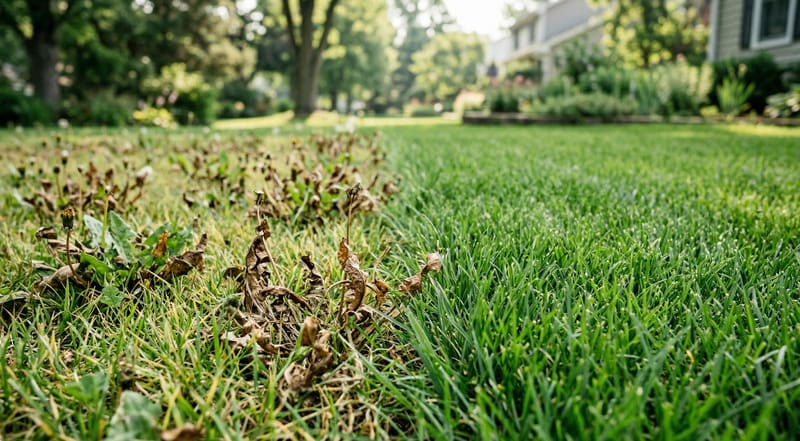
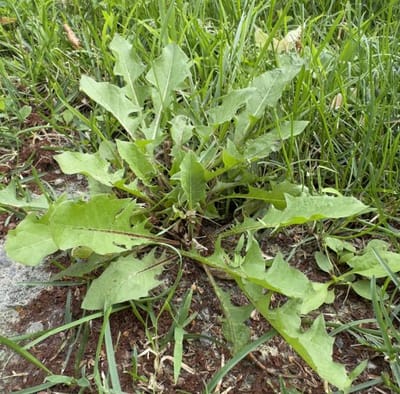
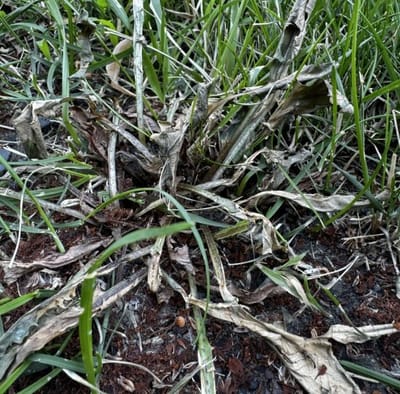
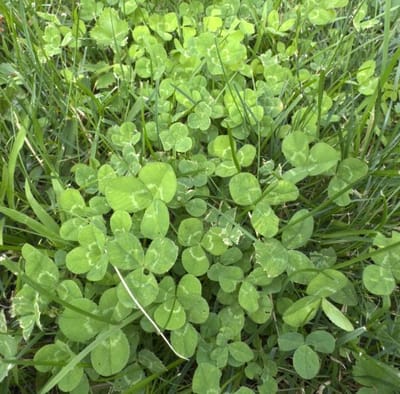
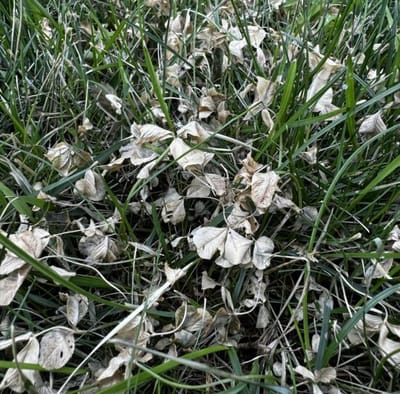
Real lawns, real weeds — eliminated with an OMRI-certified selective organic herbicide. Grass stays intact.
Not sure what's in your lawn?
Our Weed Control Guide covers 46 weeds with before-and-after photos, mixing rates, treatment techniques, and full guides.
Explore the Weed Control Guide →Ready to choose a product?
Once the selective principle clicks, the practical question is which product to trust on a real lawn. Our ranked answer: the best weed killer that won't kill grass.

Lawn
Advisor
Not sure which weed you're looking at? Show Sal.
Sal is Lanaturo's lawn-care expert. He doesn't just name the weed — he builds your exact treatment plan and checks whether today is the right day to spray.
Ready to Take Back Your Lawn?
Salacia™ is the first OMRI-certified selective organic herbicide — kills weeds, not grass. Choose your lawn size:
Your Grass Deserves Better Than Collateral Damage
The reason you could not kill weeds without killing grass was not your technique — it was the products available to you. Every organic herbicide on the market was non-selective. Pulling left root fragments that regenerated. Mowing only cut the tops while the roots thrived below. Non-selective sprays created bare patches that invited more weeds. The first OMRI-certified selective herbicide changed the equation. Osmotic dehydration targets broadleaf weed tissue while grass blades — narrow, vertical, and structurally different — absorb less and recover. One product. One application for most weeds. No synthetic residue. No dead grass.
Pet Friendly label. OMRI certified organic. The lawn you want, without the trade-offs.
This article is for informational purposes. Always follow product label directions for application rates, timing, and use. Salacia is OMRI certified organic and labeled Pet Friendly. Grass may show temporary paling or yellowing after application and then recovers — test a small area first to see how your lawn responds before treating the whole yard. Results vary based on weed species, growth stage, and application conditions.
Sources: Penn State Extension — Weed Management in Turf · University of Minnesota Extension — Lawn Weeds