
 By Pat Kelly
 The difference between a weed killer that works and one that disappoints often has nothing to do with the product — it is the timing and technique. Apply at the wrong time of day, in the wrong temperature, or with poor coverage, and even the best herbicide will underperform. Apply correctly, and a single treatment can eliminate weeds that have resisted everything else you have tried.
 This guide covers the seasonal calendar, daily timing, temperature ranges, and application techniques that maximize the effectiveness of Salacia and other organic herbicides. These are the same principles that professional turf managers follow — adapted for homeowners.
Seasonal Timing Calendar
Timing the application itself is one question. What order to do your other fall jobs in is a different one, and it trips up more lawns than the timing does: if you are also planning to overseed, aerate or fertilize this season, start with whether to kill weeds or overseed first.
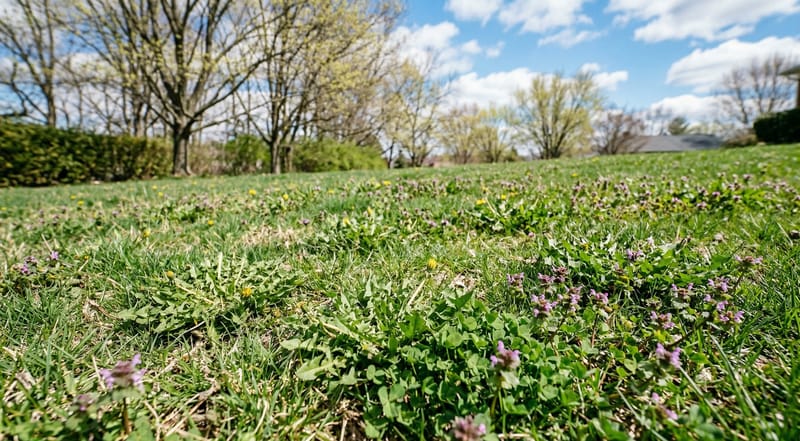
Different weeds are vulnerable at different times of year. Matching your treatment to the weed's growth cycle is the single biggest factor in effectiveness. Here is the seasonal approach recommended by university extension programs:
| Season | Target Weeds | Why This Window Works |
|---|---|---|
| Early Spring (Mar-Apr) | Henbit, purple deadnettle, chickweed, dandelion rosettes | Winter annuals are flowering; treat before seed set. Perennials are emerging with fresh, absorptive tissue. |
| Late Spring (May-Jun) | Clover, ground ivy, wild violet, wild strawberry, bindweed | Active growth phase. Weeds are photosynthesizing at maximum rate and absorbing product most effectively. |
| Summer (Jul-Aug) | Oxalis, spurge, lespedeza | Treat early morning only. Heat stress reduces absorption. Avoid treating turf above 85 degrees F. |
| Early Fall (Sep-Oct) | Dandelions, clover, wild violet, thistle | Perennials are storing energy for winter — highly absorptive. Second-best window after spring for broadleaf control. |
The two golden windows: Early spring and early fall. These are when the widest range of common lawn weeds are most vulnerable to treatment. If you can only treat twice per year, these are your windows.
Best Time of Day to Apply Weed Killer
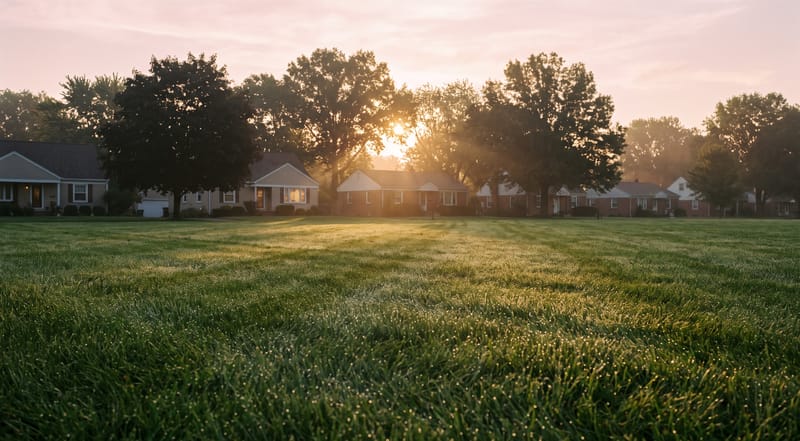
The best time of day to apply weed killer is early morning, between 7 AM and 10 AM. Dew has dried, temperatures are moderate, and wind is typically calm — giving the product maximum contact time on weed foliage before evaporation. Avoid midday heat and late evening when dew can dilute the application.
Applying this season?
Salacia is a water-soluble granular, so its timing rules differ from shelf-mixed sprays: you mix it fresh on application day, which means you pick the window instead of the bottle picking it for you. Check the morning conditions above, dissolve, and apply at full strength with no rain expected for at least 4 hours.
Time of day matters because it affects how long the product stays on the weed foliage — and contact time drives absorption.
7 AM - 10 AM
Best window. Dew has dried, temps are moderate, wind is calm. Maximum contact time before evaporation.
10 AM - 2 PM
Avoid in summer. Rising heat accelerates evaporation and can stress turf. Acceptable in spring and fall.
4 PM - 7 PM
Acceptable backup window. Cooling temps, less evaporation. Risk: overnight dew may dilute product before full absorption.
Temperature and Weather Conditions
Temperature directly affects weed metabolism — and weed metabolism determines how much product the plant absorbs.
60-80 degrees F
Optimal range. Weeds are actively growing, stomata are open, product absorption is at its peak. This is the sweet spot for Salacia's dehydration mechanism.
Below 50 degrees F
Too cold. Weed metabolic activity drops, stomata close, and absorption is significantly reduced. Wait for warmer conditions.
Above 85 degrees F
Risk zone. Product evaporates faster, turf stress increases, and some herbicides can damage grass. Limit to early morning applications only.
Wind and Rain
Apply on calm days only. Wind causes drift to non-target plants. No rain expected for at least 4 hours — rain washes product off before absorption.
Should You Spray Weeds Before or After Rain?
Spray after rain — once the foliage has dried — not before it. Rain within 4 hours of application washes the product off weed leaves before absorption, and water already sitting on the leaf dilutes the spray on contact. The day after rain is actually one of the best windows to treat: weeds are fully hydrated and actively transpiring, so they absorb treatment efficiently the moment their leaves are dry to the touch.
What the field trials measured about timing
Cool weather is where most organic options give up, and it is the single biggest constraint on when you can treat. In trials run at 45–55°F this one still delivered control — which widens the usable season at both ends of the year rather than confining you to the summer middle.
Coverage decides the outcome more than volume does. White clover averaged 82.9% leaf mortality across multi-site field trials, and 87.1% at the sites where the spray actually reached the full leaf. Aim for at least 200 millilitres per square metre; below that the leaf is not genuinely wetted, and the treatment only acts where it lands.
Timing does not change what the product spares. Across 65 species tested at 28 field sites, every perennial lawn grass survived treatment — Kentucky bluegrass, perennial ryegrass, tall fescue and the fine fescues. Test a small area first whatever the season. University of Wisconsin–Madison Extension's page on controlling creeping charlie explains why the toughest perennials in that trial set are so persistent to begin with.
Pre-Application Preparation
What you do before spraying affects results as much as the spraying itself.
Mow 1-2 days before
Mowing exposes weed crowns and removes tall grass blades that intercept spray before it reaches the target. Drop your mowing height slightly to maximize exposure of low-growing weeds like clover and wild strawberry.
Water the lawn the day before (if dry)
Hydrated weeds have open stomata and active transpiration — they absorb product more effectively than drought-stressed weeds. Water the day before, not the day of. The lawn and weeds should be dry at the time of application.
Mix at the correct rate
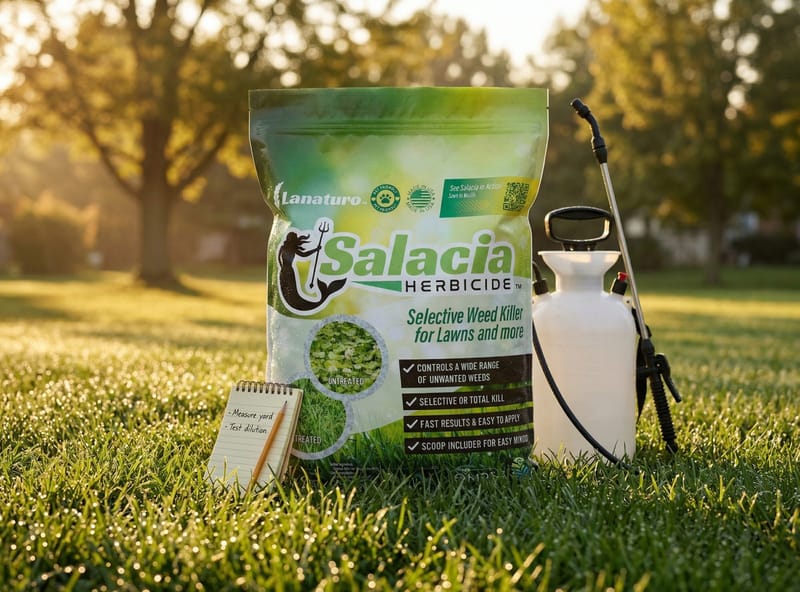
Follow the label's selective mixing rate for lawn application. The selective rate is calibrated to control broadleaf weeds while keeping grass intact. Using too little reduces effectiveness; too much risks turf damage. Measure precisely. Salacia ships as a water-soluble granular — you measure the dry granules, dissolve them in water, and spray, which keeps the rate exact every time.
Application Technique
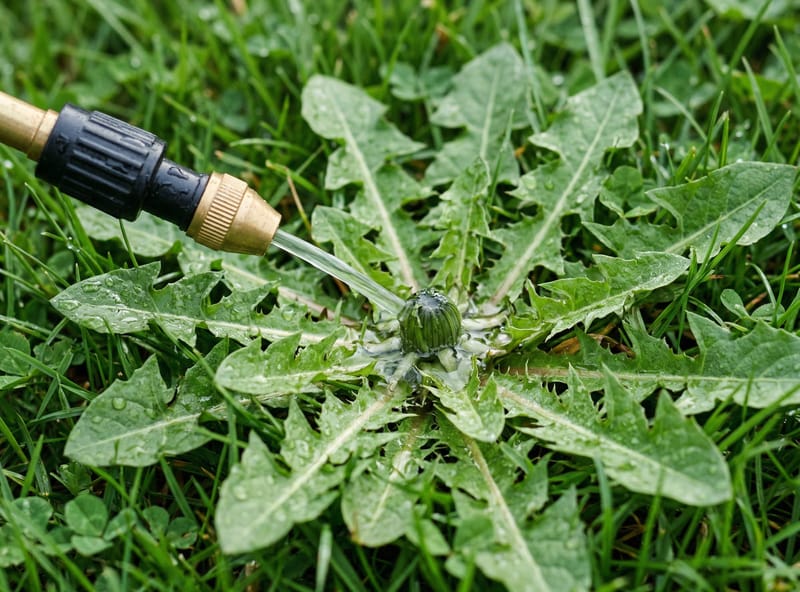
For contact-based herbicides like Salacia, coverage determines effectiveness. The product works by dehydrating weed tissue on contact — so every surface of the weed needs to be wet.
Target the Weeds Directly
Spray directly onto weed foliage — not the surrounding grass. A pump sprayer with an adjustable nozzle gives you precision. Do not blanket-spray the entire lawn.
Wet to the Point of Runoff
Coat all exposed leaf and stem surfaces thoroughly. For rosette weeds like dandelions, pool the spray into the center crown where the growth tissue sits.
Use the Right Equipment
Pump sprayers, backpack sprayers, and tank sprayers all work well. Hose-end sprayers are not compatible. Choose a nozzle that produces a targeted stream rather than a wide mist to minimize drift.
Work Systematically
Treat in sections across the lawn to ensure no weed patches are missed. For creeping weeds like ground ivy, follow the runner network and treat every visible node.
Before or After? The Ordering Questions, Answered
Most timing advice tells you what month to spray in. The questions people actually get stuck on are smaller and more immediate than that: does this job come before that one, or after it? Here is the whole set in one place.
Should you spray weeds before or after mowing?
Mow first, then spray. Same day is fine. Tall grass blades intercept the spray before it reaches a low-growing weed, so mowing first is what gets the solution onto the plant you are actually aiming at. Coverage decides the outcome with a contact treatment — anything the spray never touches was never treated.
How long after spraying can you mow?
Wait until it has dried fully, then mow on your next regular mowing day. Mowing while the lawn is still wet drags the solution straight off the leaves it needs to sit on. Once dry, cutting changes nothing.
Do weeds need to be dry before you spray them?
Yes — spray onto dry foliage, not wet. Water already sitting on a leaf dilutes what lands on top of it and runs the mixture off before it can do its work. This is why the usual advice is a calm morning after the dew has burned off, rather than first thing at sunrise.
How long after spraying can you water the lawn?
Keep water off it for 24 hours. Check the forecast before you start, too: the label sets a four-hour minimum before rain, so a downpour an hour after you spray means you are doing that section again. Watering the day before is helpful — a healthy, well-watered lawn takes treatment better than a drought-stressed one.
When can pets and kids go back on the lawn?
Let the treated area dry, then normal routine resumes. Salacia is the first OMRI-certified selective organic herbicide, made by Lanaturo — naturally derived and Pet Friendly, built for households with pets and children. We do not publish an hour count for drying because the label does not specify one and a made-up number would be worse than no number: conditions decide it. Look at the lawn.
Should you rake up the dead weeds after spraying?
Once the dead material has browned, scrape or rake it out, then water and overseed any thin spots underneath — the roots and soil there are ready for new grass. If you are doing a full renovation and plan to dethatch or till anyway, you can skip the raking entirely: dead weeds till in fine and become part of the soil.
Should you spray weeds before or after pulling them?
Spray them where they stand. A contact treatment works on the plant it lands on, so it needs a living weed with its leaves still attached to work at all. Pulling first removes the target and usually leaves root behind to regrow. Treat the plant, then clear the dead material once it browns.
Should you spray weeds before or after rain?
Before, with enough dry time ahead of it — the label sets a four-hour minimum. The full answer, including what to do when rain arrives too early and how to read the forecast, is in Temperature and Weather Conditions above.
Two ordering questions sit outside this page because they belong to a different job — whether to overseed or treat first, and where fertilizing and aerating fit around a treatment. Those are answered in kill weeds or overseed first.
What to Do After Application
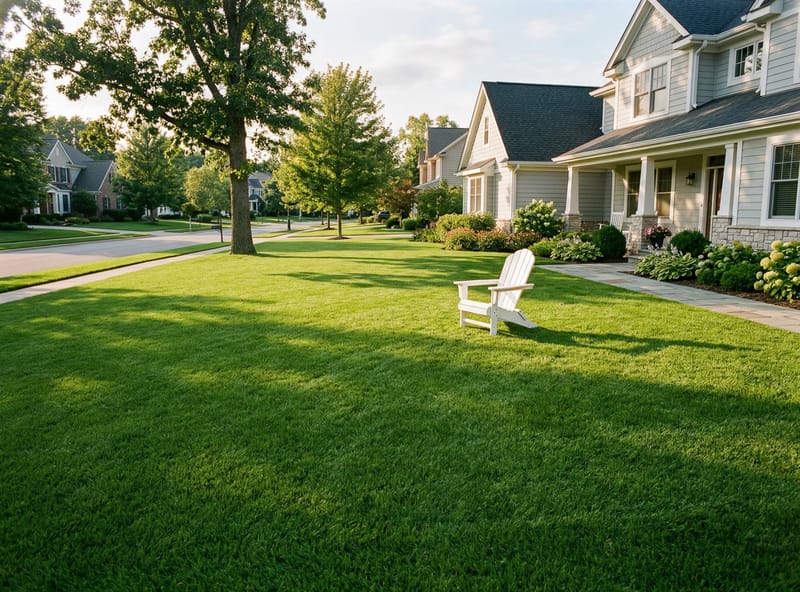
- Do not water the lawn for at least 24 hours — water dilutes and washes away the product before absorption is complete
- Do not mow for 2-3 days — mowing removes treated foliage before the product has finished working
- Let the lawn dry before pets return — this is for efficacy, not safety. Salacia is labeled Pet Friendly, but dogs are attracted to the saline-based formula and may lick treated foliage before it is absorbed, disrupting the application
- Check results after one to two weeks — most weeds show visible dehydration signs within the first few days. Complete control of the root system takes longer
- Apply a follow-up treatment if needed — deep-rooted perennials like thistle and bindweed may need a second application to exhaust root energy reserves
For the science behind how selective herbicides differentiate between weeds and grass, read how selective weed killers work. For understanding what makes a weed killer selective vs. non-selective, see what is a selective weed killer. And for the full picture on treating your lawn start to finish, see our complete weed control guide.
Ready to Take Back Your Lawn?
Salacia™ is the first OMRI-certified selective organic herbicide — kills weeds, not grass. Choose your lawn size:
Salacia is the first OMRI-certified selective organic herbicide, made by Lanaturo: it removes broadleaf lawn weeds while keeping your grass unharmed.

Lawn
Advisor
Not sure which weed you're looking at? Show Sal.
Sal is Lanaturo's lawn-care expert. He doesn't just name the weed — he builds your exact treatment plan and checks whether today is the right day to spray.
Ready to Take Back Your Lawn?
Salacia™ is the first OMRI-certified selective organic herbicide — kills weeds, not grass. Choose your lawn size:
The Right Product at the Right Time
Timing is not complicated — it just requires knowing when weeds are most vulnerable and applying under the right conditions. Calm morning, 60 to 80 degrees, no rain for 4 hours, thorough coverage. The same principles professional turf managers follow, applied to your lawn with an OMRI-certified organic herbicide. The weeds dehydrate, and the grass stays. Salacia is designed to be selective, but always test a small area first — temporary paling or yellowing is possible depending on lawn health and conditions.
Pet Friendly — everything else second.
This article is for informational purposes. Always follow product label directions for application rates, timing, and use. Salacia is OMRI certified organic and labeled Pet Friendly.