
 By Pat Kelly
 One plant. One billion pollen grains. Every season.
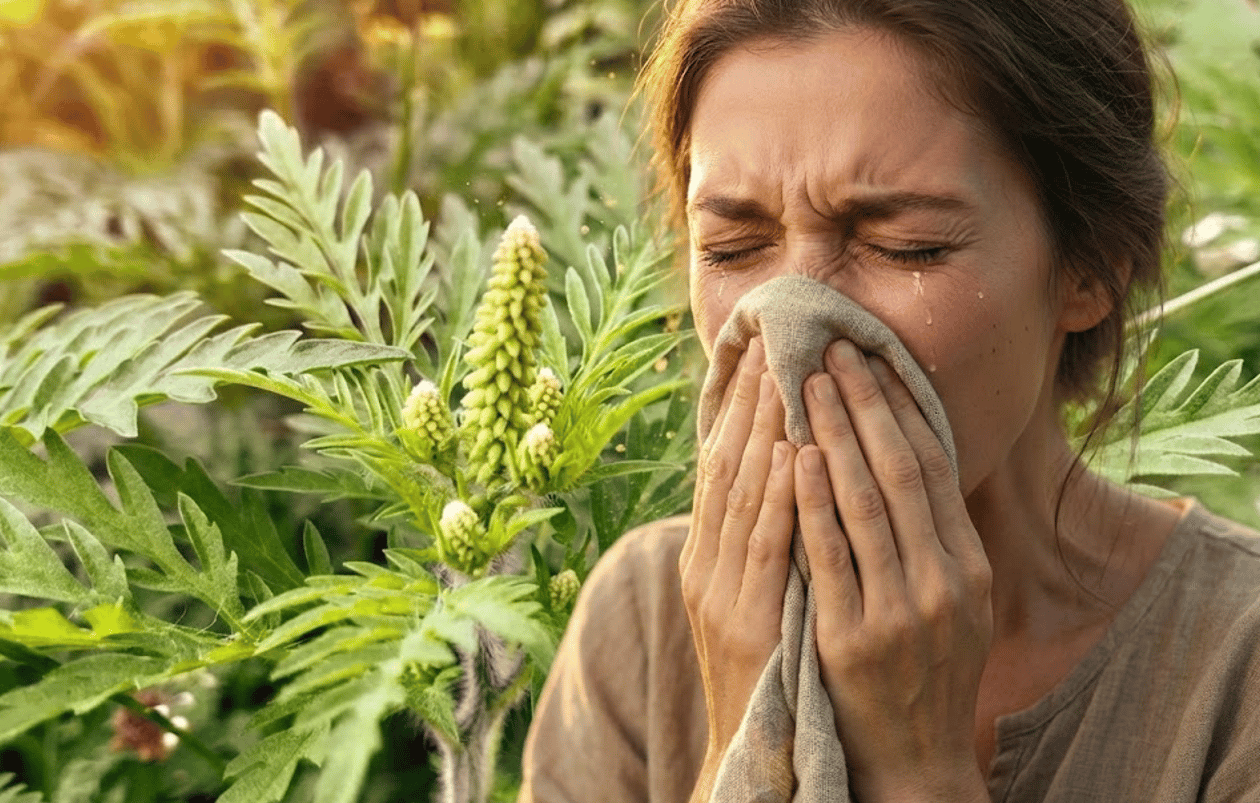
That is not a typo. A single common ragweed plant (Ambrosia artemisiifolia) releases up to one billion pollen grains per year. Those grains travel hundreds of miles on wind currents. They have been detected 400 miles out to sea and two miles above ground level. And they carry the Amb a 1 protein — one of the most aggressive allergens the human immune system encounters.
If ragweed were only a lawn weed, it would be bad enough. But ragweed is not just ruining your backyard. It is driving an $18 billion annual healthcare crisis, developing resistance to the most widely used herbicides in agriculture, and threatening the corn and soybean crops that account for $112 billion in annual US farm receipts. It is, by almost any measure, the most economically destructive weed in North America.
And it is getting worse. Here is a look at what can be done about it — in your lawn and on your farm.
The Public Health Crisis
 : Ragweed Allergies and the $18 Billion Healthcare Burden
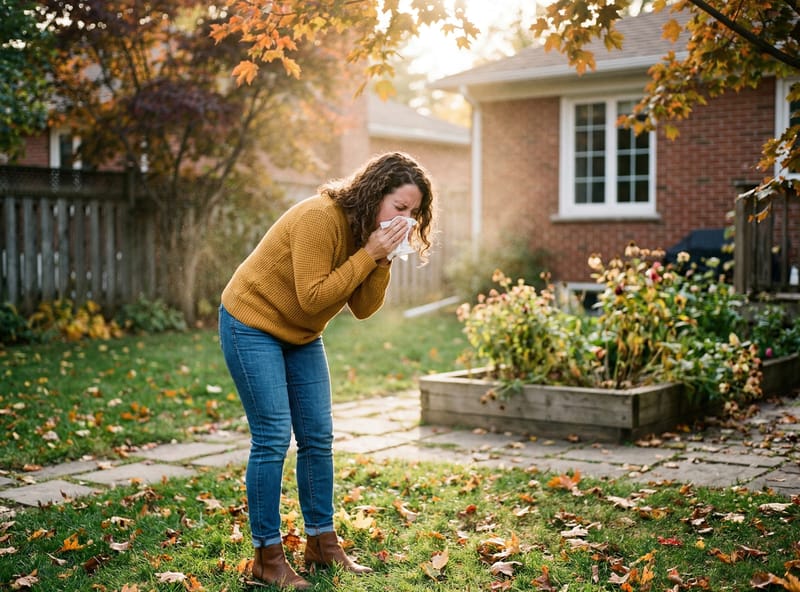
Every August through October, an estimated 23 million Americans develop symptoms specifically from ragweed pollen allergy. That is more than the populations of New York, Los Angeles, Chicago, Houston, and Phoenix combined — all sneezing, congested, and miserable for two to three months straight.
The Allergy and Asthma Network reports that allergic rhinitis — the clinical name for hay fever — costs the US healthcare system $18 billion annually. Ragweed is the leading trigger of fall allergic rhinitis, driving a substantial share of that burden. That figure includes physician visits, emergency room trips, prescription medications, and immunotherapy. It does not include the indirect costs: lost productivity, missed work days, reduced quality of life, and the cascading effects on children's school performance.
According to data from the National Health and Nutrition Examination Survey, over 26% of the US population is sensitized to ragweed — meaning their immune systems have been primed to react. Among people who test positive for any environmental allergy, ragweed sensitivity is the single most common finding.
The treatment market alone is projected at $2.5 billion globally in 2024, growing to $4.56 billion by 2034. Antihistamines, nasal corticosteroids, immunotherapy injections, sublingual tablets — an entire pharmaceutical industry exists because of one weed genus.
Climate Change Is Making Ragweed Worse — Measurably
This is not a future projection. It is already happening, and the EPA has measured it.
Between 1995 and 2015, ragweed pollen season grew longer at 10 of 11 monitoring stations across the central US and Canada. The extension was most dramatic in northern latitudes: 25 additional days in Winnipeg, 24 in Saskatoon, 21 in Fargo, 18 in Minneapolis. That is not a subtle shift. That is nearly a month of additional ragweed exposure that did not exist a generation ago.
The mechanism is straightforward: later first frosts mean ragweed plants live longer and produce pollen for more weeks. But there is a compounding factor. Rising atmospheric CO2 directly stimulates ragweed growth. Research published in the journal Environmental Health Perspectives found that ragweed plants grown in elevated CO2 conditions produced 60 to 80% more of their allergenic protein. More plants, producing more pollen, for more weeks, containing more potent allergens. Every variable is moving in the wrong direction.
Pollen concentrations across the US increased 21% between 1990 and 2018. Computer models project a quadrupling of ragweed pollen concentration in parts of North America and Europe by 2050. The number of ragweed-sensitized people is expected to more than double.
This is not a weed you can ignore and hope goes away. The trajectory is set, and every year it gets harder.
Ragweed in Your Lawn: Identification and Why It Is There
Seventeen species of ragweed grow in North America. The two most common in residential settings are common ragweed (Ambrosia artemisiifolia) and giant ragweed (Ambrosia trifida).
Common ragweed: Grows 1 to 3 feet tall. Deeply divided, fern-like leaves that look almost lacy. Stems are hairy and branching. Flowers are small, green, and inconspicuous — clustered on spikes at the top of the plant. Most people do not even realize ragweed is flowering because the blooms are not showy. It is an annual — it germinates in spring, produces pollen in late summer, drops seeds, and dies with the first frost.

Giant ragweed: The name is earned. Giant ragweed can reach 12 to 15 feet tall in favorable conditions. Leaves are large with three to five lobes (not fern-like). It is more common in agricultural settings and along disturbed areas but shows up in residential lots, especially near fields and roadsides.
Commonly confused with goldenrod. Ragweed and goldenrod bloom at the same time. But goldenrod has bright yellow, showy flowers — it is insect-pollinated, not wind-pollinated, and rarely causes allergies. If the yellow flowers are obvious, it is probably goldenrod. If you can barely see the flowers at the top of a hairy-stemmed plant with lacy leaves, that is your ragweed. For a detailed comparison chart, see our guide on how to kill ragweed.
Why it is in your lawn: Ragweed thrives on disturbed soil. Construction sites, recently graded areas, thin or bare patches in lawns, roadsides, field edges — anywhere the soil has been opened up. Healthy, thick turf grass actually suppresses ragweed effectively. If ragweed is establishing in your lawn, it is exploiting a weakness: thin grass, bare soil, compaction, or poor drainage.
How to Kill Ragweed With Salacia
Here is the good news: Salacia works exceptionally well on common ragweed.
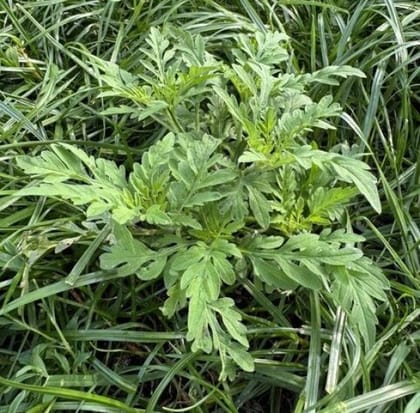
Ragweed is a broadleaf annual with relatively thin leaf tissue and active metabolism during the growing season — exactly the profile that responds strongly to Salacia at the selective mixing rate. Our field results on common ragweed have been consistently among the best of any weed species we have tested.
Timing matters. Catch ragweed young — before it reaches 4 to 6 inches tall. Young ragweed has thin cell walls, minimal root development, and maximum surface area relative to its biomass. A single thorough application at the selective rate produces complete control on juvenile plants. Wait until the ragweed is 2 to 3 feet tall with mature stems, and you will need more product and possibly a repeat application.
Selective rate in lawns. At the lower mixing concentration, Salacia targets the ragweed while your grass stays green and untouched. This is Hybrisal Technology — concentration-dependent selectivity. Spray the ragweed directly, wet every leaf surface, and include the soil area around the base. For scattered ragweed plants across a lawn, a targeted spray approach is more efficient than blanket application.
Non-selective rate for heavy infestations. If ragweed has colonized a bare patch, a fence line, or a vacant area, the higher mixing rate delivers maximum knockdown power. This mode will affect any grass in the spray zone, but in areas dominated by ragweed, there is likely no healthy turf left to protect anyway. After treatment, rake out the dead material and overseed.
Do not let it go to seed. This is critical with ragweed because of the volume of seeds a single plant produces — up to 62,000 seeds per plant that remain viable in soil for years. Every mature ragweed plant you leave standing drops a seed bank that will haunt you for the next 3 to 5 seasons. Treat early. Treat thoroughly. Prevent seeding.
Check Sal's application score before spraying. Ragweed pollen season means you are likely working outdoors during warm, dry conditions — which happen to be good application conditions. But wind can carry spray off-target, and rain within 4 hours washes product off before absorption. Let Sal check the variables for your location.
See the Results
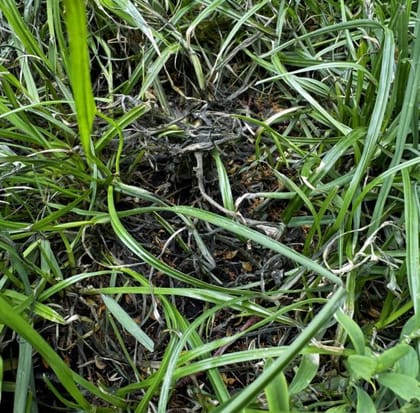
Real results, real lawns — watch Salacia eliminate tough weeds while your grass stays perfectly untouched.
Ready to Take Back Your Lawn?
Salacia™ is the first OMRI-certified selective organic herbicide — kills weeds, not grass. Choose your lawn size:
The Agricultural Crisis
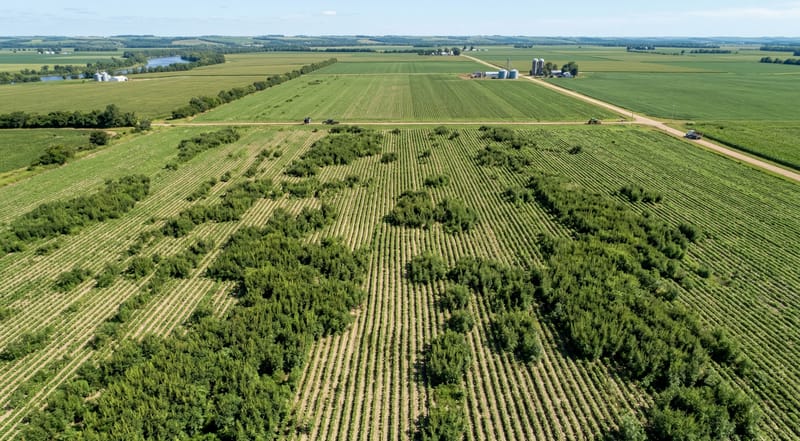 : When Herbicides Stop Working
If ragweed in your lawn is a nuisance, ragweed in a soybean field is an emergency. And for an increasing number of American farmers, the emergency is becoming unmanageable.
Common ragweed competes aggressively with crops. In soybeans, uncontrolled ragweed causes yield losses of up to 75%. In corn, yield losses exceed 35% at moderate ragweed density. These are not theoretical projections. They are measured in replicated field trials conducted across the Midwest and Mid-Atlantic states.
To put that in economic terms: corn and soybean production represents $112.7 billion in annual US crop cash receipts. Every percentage of yield lost to ragweed translates directly to hundreds of millions in farm revenue destroyed.
For decades, the solution was simple: spray glyphosate. Glyphosate-tolerant crops allowed farmers to spray glyphosate over entire fields, killing ragweed and other weeds without harming the crop. It was cheap, effective, and nearly universal — over 90% of soybean acres and 73% of corn acres were treated with glyphosate by the early 2010s.
Then the resistance started.
The Resistance Timeline
1998: Common ragweed populations resistant to ALS-inhibiting herbicides (Group 2) confirmed in Indiana and Ohio. The first crack in the system.
2004: Glyphosate-resistant common ragweed confirmed. The backbone of American weed management starts to fail.
2014: Maryland confirms ragweed populations resistant to both glyphosate AND ALS herbicides simultaneously. Two-way resistance.
2017: Three-way resistant ragweed confirmed in Delaware and the Eastern Shore of Maryland — populations resistant to glyphosate, ALS inhibitors, AND PPO inhibitors (Group 14). This is catastrophic because PPO herbicides were the fallback option when glyphosate failed.
The University of Maryland Extension states it plainly: for soybean farmers facing ragweed populations resistant to glyphosate, ALS inhibitors, and PPO inhibitors simultaneously, there are no effective post-emergent herbicide choices remaining.
Read that again. For soybean farmers in the Mid-Atlantic dealing with three-way resistant ragweed, there is no post-emergent herbicide that works. None. The pipeline is empty.
The Scale of the Problem
A study from Cambridge University Press estimated that glyphosate-resistant weeds — with ragweed species among the most damaging — would reduce the farm-gate value of major field crops in Ontario alone by Can$290 million annually if farmers did not adjust their management. Even with adjusted herbicide programs (at an additional cost of $28 million), crop losses still totaled $15 million.
Scale that to the US Midwest, where corn and soybean acreage is an order of magnitude larger, and the economic exposure is measured in billions.
Purdue University's weed science department has documented ALS-resistant ragweed populations throughout Indiana. The University of Minnesota Extension reports that ragweed species are among the most frequently resistant weeds in the state.
The USDA Economic Research Service has documented the cascading effect: as glyphosate effectiveness declined, farmers reported reduced weed control on almost 44% of soybean acres by 2012. The response — layering additional herbicides like dicamba and 2,4-D — increases costs, introduces new environmental risks, and creates selection pressure for the next round of resistance.
The industry is running out of chemical modes of action. Common ragweed has evolved resistance to every major herbicide class thrown at it. This is not a weed management problem anymore. It is a weed management crisis.
Salacia Ag: A Different Approach
The same Hybrisal Technology that powers Salacia for residential lawns is being developed for agricultural applications. Salacia Ag is designed to provide selective ragweed control in crop settings — targeting ragweed in corn and soybean fields without harming the crop.
Consider what this means for a farmer facing three-way resistant ragweed: an OMRI-certified organic herbicide that uses an entirely different mode of action than glyphosate, ALS inhibitors, or PPO inhibitors. A product that the ragweed has never been exposed to. A new tool in a toolbox that is running empty.
Salacia Ag represents a fundamentally different approach to the resistance crisis. Instead of developing another synthetic chemistry that ragweed will eventually evolve around, it introduces an organic mechanism that sidesteps the entire resistance pathway. The same principle that makes Salacia effective on residential ragweed — where it delivers some of our best field results — applied at agricultural scale.
Salacia Ag is currently in development. If you are a grower dealing with herbicide-resistant ragweed in corn, soybeans, or other crops, we want to hear from you. Your field experience shapes our development priorities.
Why Ragweed Is Different From Other Weeds
Most lawn weeds are a cosmetic problem. Ragweed is a public health hazard. Every ragweed plant on your property is a pollen factory actively contributing to the allergic misery of your family, your neighbors, and your community. Pollen from your ragweed does not stay on your property — it disperses for miles.
This changes the calculus. Killing dandelions is about lawn aesthetics and personal preference. Killing ragweed is about reducing allergen load in your environment. It is about fewer asthma attacks in your children. Fewer missed work days. Fewer households spending hundreds of dollars annually on allergy medications.
Our approach to many weeds acknowledges their ecological roles — dandelions have nutritional value, pollinator value, and purposes worth acknowledging. Ragweed has none of those redeeming qualities for residential landscapes. This is a weed that earns its eradication.
For step-by-step lawn treatment instructions and application tips, see our complete guide on how to kill ragweed in your lawn.
Long-Term Ragweed Prevention
Ragweed is an annual that depends on disturbed, open soil to germinate. Thick, healthy turf is the best prevention — ragweed seed simply cannot compete when the ground is covered.
Mow high (3 to 3.5 inches). Taller grass shades the soil and blocks the sunlight ragweed seeds need to germinate.
Overseed bare spots immediately. Every bare patch is a ragweed invitation. Fill gaps with grass seed, especially after any soil disturbance.
Do not let it set seed. If you cannot treat ragweed immediately, at minimum mow it before the flower spikes produce pollen. This will not kill the plant, but it prevents seed production and reduces the allergen load. A mowed ragweed plant may attempt to re-flower from lower nodes — mow again, or follow up with Salacia.
Watch the calendar. In most of the US, ragweed germinates from late spring through early summer. Scout your property in May and June. Catching ragweed at the seedling stage is far more effective than fighting a mature stand.
For the complete weed management toolkit, visit our Weed Control Guide.
Salacia is the first OMRI-certified selective organic herbicide, made by Lanaturo: it removes broadleaf lawn weeds while keeping your grass unharmed.

Lawn
Advisor
Not sure which weed you're looking at? Show Sal.
Sal is Lanaturo's lawn-care expert. He doesn't just name the weed — he builds your exact treatment plan and checks whether today is the right day to spray.
Ready to Take Back Your Lawn?
Salacia™ is the first OMRI-certified selective organic herbicide — kills weeds, not grass. Choose your lawn size:
One Weed. Two Markets. One Technology.
Ragweed sits at the intersection of three accelerating crises: a public health epidemic affecting 50 million Americans, a climate trajectory that makes every season worse than the last, and an agricultural herbicide resistance emergency that has left farmers with fewer effective tools every year.
For homeowners, the solution is here. OMRI certified organic, Pet Friendly, and selective — Salacia delivers exceptional results on common ragweed while your lawn stays untouched. Every ragweed plant you eliminate is one less billion-grain pollen factory polluting the air your family breathes.
For agriculture, the need is urgent. The herbicide resistance pipeline is narrowing. Ragweed is evolving faster than the chemical industry can respond. Salacia Ag represents a new direction — an organic mode of action that bypasses the resistance mechanisms ragweed has already developed against conventional chemistries.
Pet Friendly. OMRI certified. The first selective organic herbicide — and the beginning of a new chapter in weed management.
Are you a grower dealing with herbicide-resistant ragweed in your crops? Contact us about Salacia Ag — we are actively developing agricultural applications and your field data matters.
Salacia is OMRI Listed for organic use and made from naturally derived ingredients. Always follow label directions for best results. Performance may vary based on weed maturity, environmental conditions, and application method. Salacia Ag is currently in development — contact us for information on agricultural applications.