
 By Pat Kelly
 Ragweed is the most hated weed in North America — and for good reason. It colonizes thin spots in lawns, chokes out healthy grass, and produces clouds of pollen that trigger fall allergies in tens of millions of Americans every year. Allergic rhinitis — driven largely by ragweed pollen — costs an estimated $18 billion in annual US healthcare spending.
The real problem is how fast ragweed spreads. A single plant can produce more than 60,000 seeds, and those seeds can survive in the soil for decades. If you let ragweed go unchecked for one season, you may be dealing with it for years. And every plant you leave standing is a pollen factory making allergy season worse for your entire neighborhood.
The good news: ragweed is a broadleaf weed, and broadleaf weeds are vulnerable to selective herbicides that target them without harming your grass. This guide covers everything you need — from identifying ragweed to eliminating it organically, keeping your lawn intact, and preventing it from coming back.
What Is Ragweed?
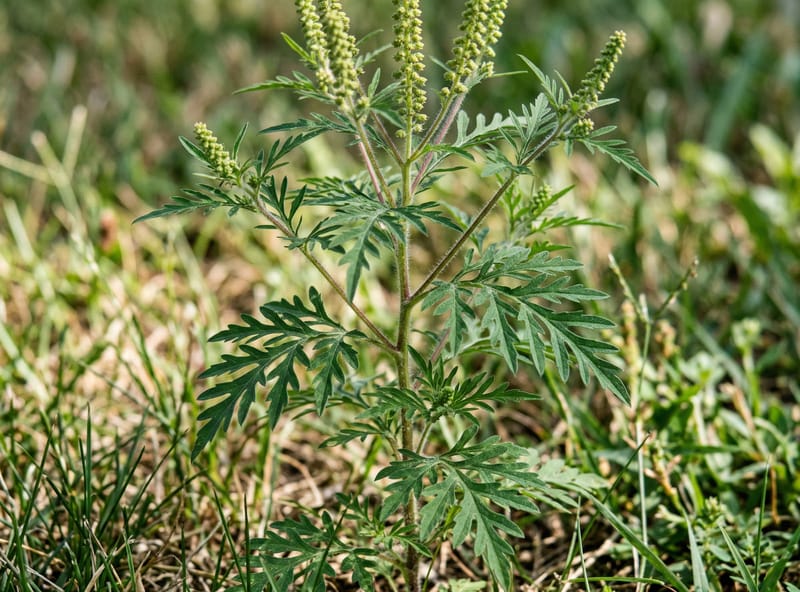
Ragweed belongs to the genus Ambrosia and is native to North America. Two species cause the most problems for homeowners and land managers:
Common Ragweed (Ambrosia artemisiifolia)
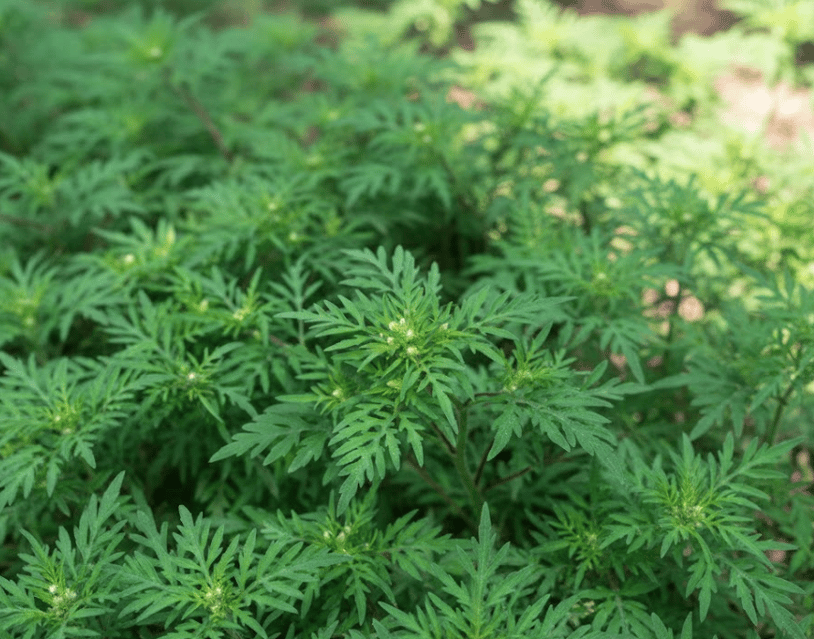
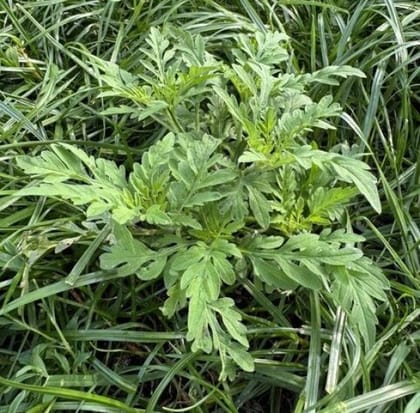
Common ragweed is the variety you are most likely to find in your lawn. It grows 1 to 3 feet tall with finely divided, fern-like leaves that look almost feathery. The stems are hairy and branching, and the plant produces small green flower spikes at the top.
It thrives in disturbed soil, thin turf, garden edges, and anywhere grass coverage is weak. Once established, it grows aggressively and competes directly with your lawn for water, nutrients, and sunlight.
Giant Ragweed (Ambrosia trifida)
Giant ragweed is a completely different challenge. It can tower 6 to 15 feet tall, with large, three- to five-lobed leaves that look nothing like its smaller cousin. Giant ragweed is more common in agricultural fields, roadsides, and floodplains, but it can invade residential properties near these areas.
It is one of the most problematic weeds in Midwest agriculture because of its size and rapid growth rate.
Ragweed Season
Ragweed is an annual plant. Seeds germinate in late spring, the plant grows through summer, and flowering peaks from July through October. A single common ragweed plant can release roughly one billion pollen grains over the course of a season — making it the dominant source of fall pollen allergies across most of the United States.
After the first hard frost, ragweed dies. But the seeds it dropped are already in the soil, waiting for next spring.
Ragweed vs Goldenrod: How to Tell the Difference
Ragweed and goldenrod bloom at the same time in late summer and early fall, which leads to one of the most common plant misidentifications in North America. Millions of people blame goldenrod for their allergies when ragweed is the actual culprit. Here is how to tell them apart:
| Feature | Ragweed | Goldenrod |
|---|---|---|
| Flowers | Small, green, inconspicuous — you can barely see them | Bright yellow, showy plumes — impossible to miss |
| Leaves | Finely divided, fern-like, feathery | Narrow, lance-shaped, smooth edges |
| Pollination | Wind-pollinated — pollen goes airborne in massive quantities | Insect-pollinated — pollen is heavy and sticky, stays on flowers |
| Causes allergies? | Yes — the #1 cause of fall hay fever | Rarely — unfairly blamed because it blooms at the same time |
| Height | 1-3 feet (common) / 6-15 feet (giant) | 2-5 feet |
| Stems | Hairy, branching, green | Smooth or slightly hairy, upright |
The simple rule: If the flowers are yellow and showy, it is goldenrod — leave it alone. Goldenrod is a valuable native pollinator plant. If the flowers are green and barely visible on a hairy-stemmed plant with lacy leaves, that is ragweed — and it needs to go.
Not sure what you are looking at? Open Sal, tap the green icon, and upload a photo for a confirmed species ID.
Why Ragweed Is a Problem for Your Lawn and Your Health
Most lawn weeds are a cosmetic nuisance. Ragweed is a public health hazard that also destroys your turf.
- Aggressive competition. Ragweed steals water, nutrients, and sunlight from surrounding grass. A dense patch of ragweed can thin out turf in a single growing season.
- Massive seed production. Each plant drops 60,000 or more seeds. Those seeds can remain viable in the soil for decades, creating a persistent seed bank that keeps producing new plants year after year.
- Allergy health crisis. Ragweed pollen is the leading trigger of fall allergies in the United States. An estimated 23 million Americans suffer ragweed-specific allergy symptoms annually. A single plant releases up to one billion pollen grains that travel hundreds of miles on wind currents. Every ragweed plant on your property is actively contributing to the allergic misery of your household and your neighbors.
- Getting worse every year. Climate change is extending ragweed season by an average of 11 days nationwide — and up to 25 days in northern regions like Fargo and Winnipeg. Rising CO2 levels are increasing pollen production per plant. The problem is accelerating, not shrinking.
- Exploits weak spots. Ragweed germinates where grass is thin, bare, or stressed. Compacted soil, over-mowed areas, and patchy turf are open invitations.
Killing dandelions is about lawn aesthetics. Killing ragweed is about reducing the allergen load in your environment — fewer asthma triggers for your children, fewer miserable fall mornings, fewer missed work days. This is a weed that earns its eradication.
What Kills Ragweed?
Several ragweed control methods exist, and the right one depends on where ragweed is growing and whether you need to preserve the surrounding plants.
- Manual pulling — effective for small infestations if you pull before the plant seeds, but labor-intensive and impractical for larger areas.
- Selective organic herbicides — target broadleaf weeds like ragweed while preserving grass. The organic approach for lawn owners who want results without synthetic chemicals.
- Chemical selective herbicides — synthetic broadleaf herbicides (2,4-D, dicamba, triclopyr) that kill ragweed in lawns but come with environmental tradeoffs.
- Pre-emergent herbicides — prevent ragweed seeds from germinating in the first place. Applied in early spring before germination.
- Cultural control — maintaining thick, healthy turf is the best long-term ragweed prevention. Ragweed cannot establish where grass is dense.
For most homeowners dealing with ragweed in their lawn, a selective herbicide combined with good lawn care practices is the most effective approach.
How to Kill Ragweed Organically Without Killing Grass
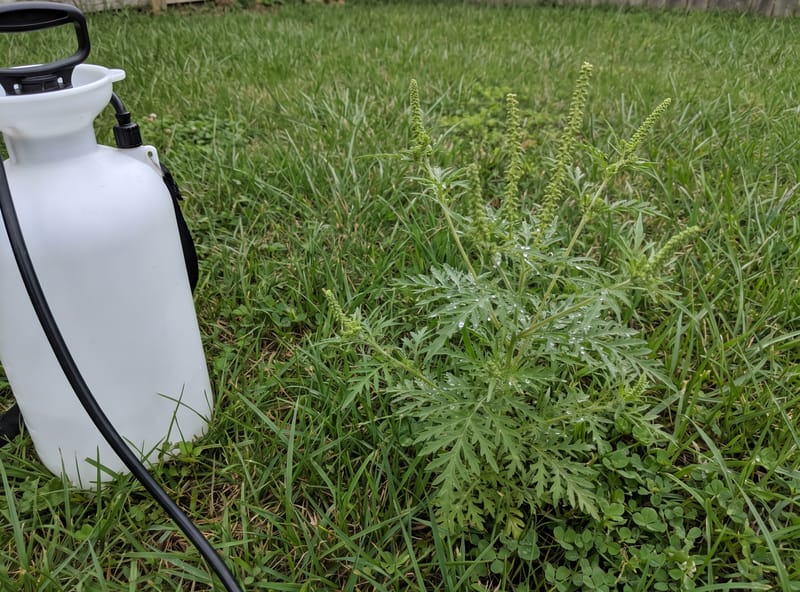
This is the question most lawn owners are really asking: what kills ragweed but not grass?
The challenge with most organic weed control methods is that they are non-selective. They kill everything they contact — weeds and grass alike. That is fine for driveways and fence lines, but it is useless if you want to save your lawn.
Selective organic herbicides solve this problem. They target broadleaf weeds like ragweed based on the biological differences between broadleaf plants and grasses. Ragweed absorbs the treatment and dehydrates from the root up. Your grass stays untouched.
Salacia: The First OMRI-Certified Selective Herbicide
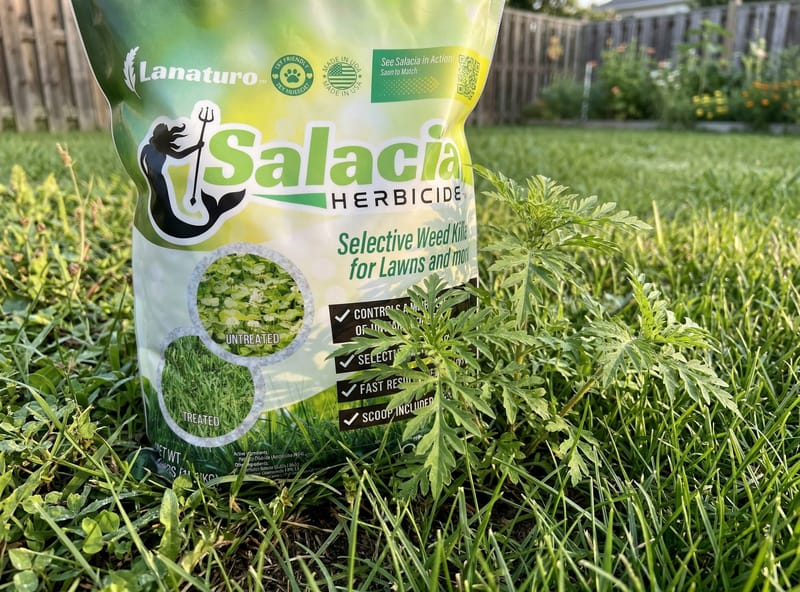
Salacia by Lanaturo is the first OMRI-certified selective herbicide on the market. It uses Hybrisal Technology — a naturally derived formula that works through dehydration, not poisoning. The formula draws moisture out of broadleaf weed tissue, causing the plant to dry out and collapse from the root up. It ships as a water-soluble granular — you dissolve the concentrate and spray, instead of paying to ship pre-mixed water.
Because the mechanism is physical — not chemical — there is no synthetic residue accumulating in your soil. And because it is selective, your grass is preserved throughout the process.
Salacia is also Pet Friendly. The naturally derived ingredients that are devastating to broadleaf weed tissue are benign to animal biology. The Pet Friendly is right on the label.
Application Tips for Ragweed
- Timing matters. Apply when ragweed is young and actively growing — ideally when plants are under 6 inches tall. Smaller plants are far more vulnerable than mature ones.
- Coverage is key. Make sure the spray contacts the ragweed foliage thoroughly. The dehydration process requires contact with the leaf surface.
- Warm, dry conditions are best. Apply on a day with no rain in the forecast. Warm temperatures accelerate the dehydration process.
- Let the lawn dry before use. If you have pets, let the treated area dry before allowing them back on the lawn — not for safety, but for efficacy. Salacia is saline-based, and dogs are attracted to salt. If they lick treated foliage before it is absorbed, they can disrupt the application.
- Repeat as needed. For heavy infestations, a second application may be needed for mature plants or new germination from the seed bank.
See the Results
Real results, real lawns — watch Salacia eliminate tough weeds while your grass stays perfectly untouched.
Ready to Take Back Your Lawn?
Salacia™ is the first OMRI-certified selective organic herbicide — kills weeds, not grass. Choose your lawn size:
Chemical Ragweed Herbicides
Synthetic selective herbicides are the conventional approach to ragweed control in lawns. The most common active ingredients are:
- 2,4-D — the most widely used broadleaf herbicide. Effective on ragweed when applied to young, actively growing plants.
- Triclopyr — effective on tougher broadleaf weeds and often combined with 2,4-D for broader coverage.
- Dicamba — another broadleaf-selective option, usually found in combination products.
- Atrazine — used in certain warm-season grass types only (St. Augustine, centipede). Not safe for cool-season lawns.
These products work, but they come with tradeoffs. Synthetic herbicides can persist in soil, contaminate water runoff, and affect non-target organisms. And there is a growing problem: ragweed is developing resistance to every major synthetic herbicide class. Common ragweed populations resistant to glyphosate, ALS inhibitors, and PPO inhibitors have been confirmed across the Midwest and Mid-Atlantic — sometimes all three resistances in the same population.
If you want to understand the full picture, read our guide on the hidden costs of synthetic herbicides. For the deep dive on ragweed resistance and the agricultural crisis it is causing, see Ragweed: The Billion-Dollar Weed.
For homeowners who prefer to avoid synthetic chemicals entirely, selective organic herbicides provide an effective alternative that sidesteps the resistance problem altogether.
Giant Ragweed Control
Giant ragweed (Ambrosia trifida) is a different beast. Plants can grow over a foot per week in ideal conditions and reach 15 feet tall by midsummer. Once giant ragweed matures, it becomes extremely difficult to control.
Early intervention is everything. The window to effectively treat giant ragweed is when plants are young — ideally under 12 inches tall. At this stage, selective herbicides are most effective.
For residential properties:
- Scout early. Watch for giant ragweed seedlings in late spring. They are easy to identify by their large, three-lobed leaves.
- Treat immediately. Apply a selective herbicide as soon as you spot young plants. Do not wait for them to grow.
- Mow before seeding. If plants get ahead of you, mow them before they flower to prevent seed set. This will not kill the plant, but it stops the next generation.
- Repeat monitoring. Giant ragweed seeds germinate in waves throughout spring and early summer. A single treatment may not catch all of them.
Ragweed in Agriculture: The Herbicide Resistance Crisis
Ragweed is not just a lawn problem. It is one of the most economically damaging weeds in American agriculture, particularly in soybeans and corn — where uncontrolled ragweed can cause up to 75% yield loss.
The agricultural challenge has been compounded by a growing herbicide resistance crisis. Common ragweed has evolved resistance to glyphosate, ALS inhibitors, and PPO inhibitors — in some regions, all three simultaneously. The University of Maryland Extension has stated plainly that for soybean farmers facing three-way resistant ragweed, there are no effective post-emergent chemical choices remaining.
This is why Salacia Ag — the agricultural application of the same Hybrisal Technology that powers residential Salacia — represents a fundamentally different approach. An OMRI-certified organic herbicide using an entirely different mode of action than anything ragweed has developed resistance to. A new tool for a toolbox that is running empty.
For the full analysis of the ragweed resistance timeline, the economic scale of the crisis, and what Salacia Ag means for growers, read Ragweed: The Billion-Dollar Weed.
For pastures and non-crop areas, mowing before flowering combined with selective herbicide applications provides the most practical control. Consult your local extension service for region-specific timing.
How to Prevent Ragweed from Coming Back
Killing existing ragweed is only half the battle. The seed bank in your soil can keep producing new plants for years. Long-term prevention requires addressing the conditions that allow ragweed to establish in the first place.
Build a Thick, Competitive Lawn
This is the single most effective ragweed prevention strategy. Ragweed cannot germinate where grass is dense and healthy. Overseed bare or thin spots in early fall (cool-season grasses) or late spring (warm-season grasses) to eliminate the gaps ragweed exploits.
Mow at the Right Height
Taller grass shades the soil surface, making it harder for ragweed seeds to germinate. Keep your mower at the upper end of the recommended height for your grass type — typically 3 to 4 inches for most cool-season lawns.
Never Let Ragweed Go to Seed
One plant equals 60,000 seeds. If you see ragweed flowering, remove it or mow it immediately. Every plant that seeds this year is hundreds of new plants next year.
Consider Pre-Emergent Applications
Pre-emergent herbicides applied in early spring can prevent ragweed seeds from germinating. This is especially useful if you have had heavy ragweed pressure in previous years.
Address the Root Cause
Ragweed is an indicator weed — it tells you something about your lawn. If ragweed keeps coming back in the same spots, those areas likely have compacted soil, poor drainage, or insufficient grass coverage. Fix the underlying problem, and ragweed loses its foothold.
For a complete guide to managing broadleaf weeds in your lawn, visit our Weed Control Guide. For other common broadleaf weeds, see our guides on killing clover and killing dandelions. For timing and application best practices, check our seasonal guide.
Fighting more than one weed?
Most lawns battling one broadleaf weed have others growing alongside it. Our ranked guide to the best weed killer that won't kill grass covers the full lineup a selective treatment clears in the same pass.

Lawn
Advisor
Not sure which weed you're looking at? Show Sal.
Sal is Lanaturo's lawn-care expert. He doesn't just name the weed — he builds your exact treatment plan and checks whether today is the right day to spray.
Where Ragweed Grows Most
Common ragweed grows in nearly every state, but it is thickest through the Midwest, the Ohio and Mississippi valleys, and the East — Illinois, Indiana, Ohio, Missouri, Iowa, Kentucky, Tennessee, Michigan, Pennsylvania and New York — and it is expanding its northern edge as growing seasons lengthen.
It is a summer annual that favours disturbed, open ground: field edges, new construction, roadsides, and any lawn thin enough to let sunlight reach bare soil. A single plant can carry enormous quantities of pollen, which is why a small patch on your own property is worth taking seriously well before it flowers in late summer.
Treat it young and treat it before bloom. Once it is flowering the pollen is already released, and the value of removing the plant that season drops sharply. At the selective lawn rate Salacia targets it while being designed to spare grass; temporary paling or yellowing of nearby turf is possible and recovers. Always test a small area of your lawn first. Not sure what you are looking at? Sal will identify it from a photo.
Ready to Take Back Your Lawn?
Salacia™ is the first OMRI-certified selective organic herbicide — kills weeds, not grass. Choose your lawn size:
Your Lawn Deserves Better Than Ragweed
Ragweed is persistent, aggressive, and the single worst allergy trigger in North America — affecting over 50 million people every year, with seasons getting longer as the climate shifts. Every ragweed plant on your property is a billion-grain pollen factory actively polluting the air your family breathes.
You do not have to choose between effective weed control and an organic lawn. You do not have to accept synthetic residues in your soil or worry about what your pets are walking through. And you do not have to rely on chemical herbicides that ragweed is increasingly evolving resistance to.
Pet Friendly. OMRI certified. The first selective organic herbicide — built for exactly this.
Salacia is OMRI Listed for organic use and made from naturally derived ingredients. Always follow label directions for best results. Performance may vary based on weed maturity, environmental conditions, and application method.