
 By Pat Kelly
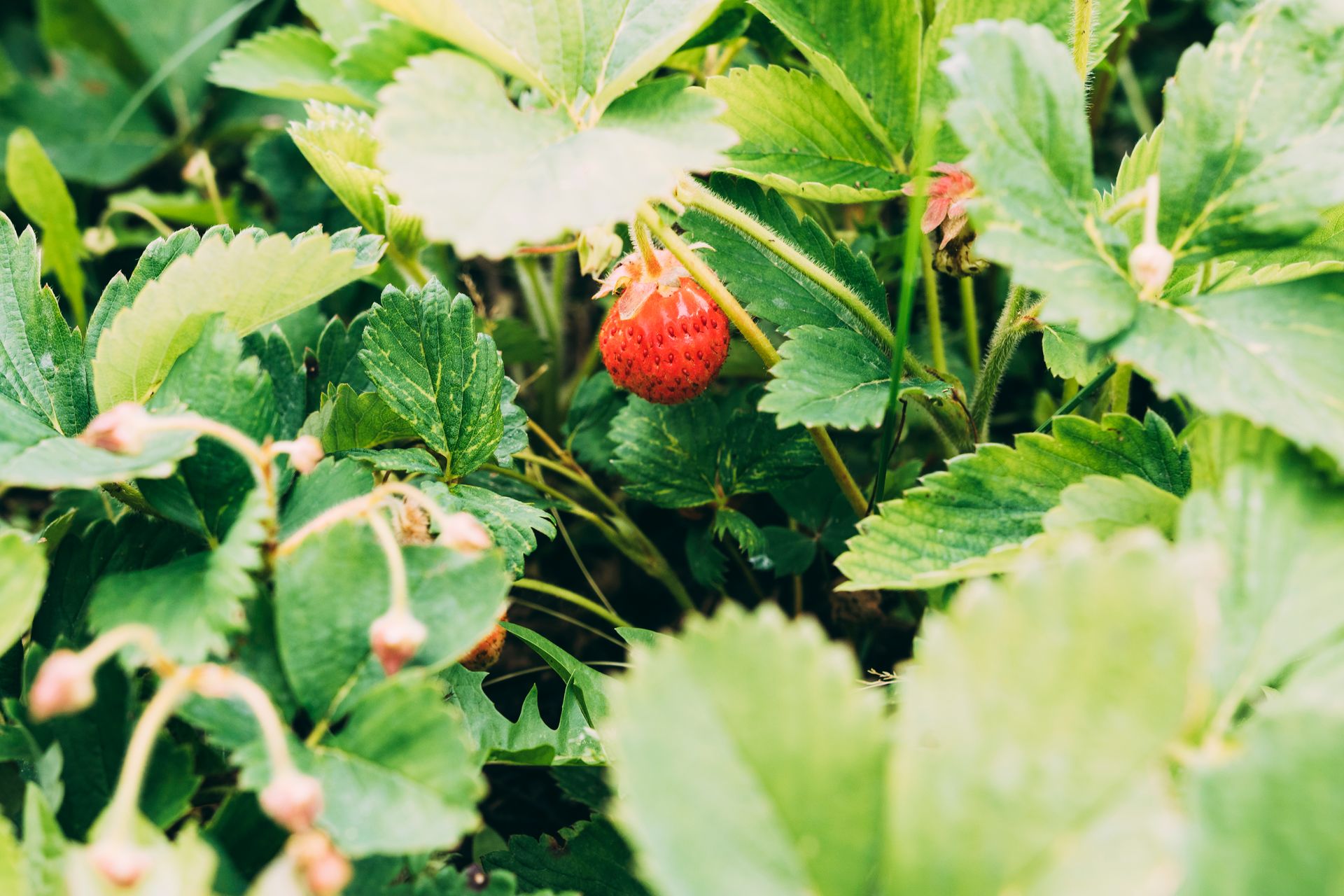
 Those small, three-leafed plants spreading across your lawn are wild strawberries — and despite the charming name, they are aggressive weeds that choke out grass and resist removal. Wild strawberries and their invasive look-alike, mock strawberry, spread through runners that root at every node, creating dense mats that shade out turf and compete for water and nutrients. Hand-pulling is futile because every fragment left behind regenerates.
The good news: wild strawberries are broadleaf plants, which means a selective herbicide can target them without harming your grass. Salacia, the first OMRI-certified selective herbicide, controls wild strawberries through osmotic dehydration while leaving your turf intact.
How to Identify Wild Strawberries in Your Lawn
Wild strawberries (Fragaria virginiana) are low-growing perennial weeds that spread through stolons (runners) and form dense ground-cover mats. According to Penn State Extension, they are among the most common broadleaf lawn weeds in the eastern United States.
Key identification features:
- Trifoliate leaves: Three leaflets per stem, each with serrated (toothed) edges
- White flowers: Five-petaled white flowers with yellow centers, appearing in spring
- Red berries: Small, downward-hanging red fruits (edible but tiny)
- Runners: Horizontal stolons that spread along the ground surface, rooting at nodes to create new plants
- Low growth habit: Stays close to the ground, typically under 6 inches tall
- Habitat: Prefers sunny to partially shaded areas with moist, well-drained soil
Wild Strawberry vs. Mock Strawberry
 — Know the Difference
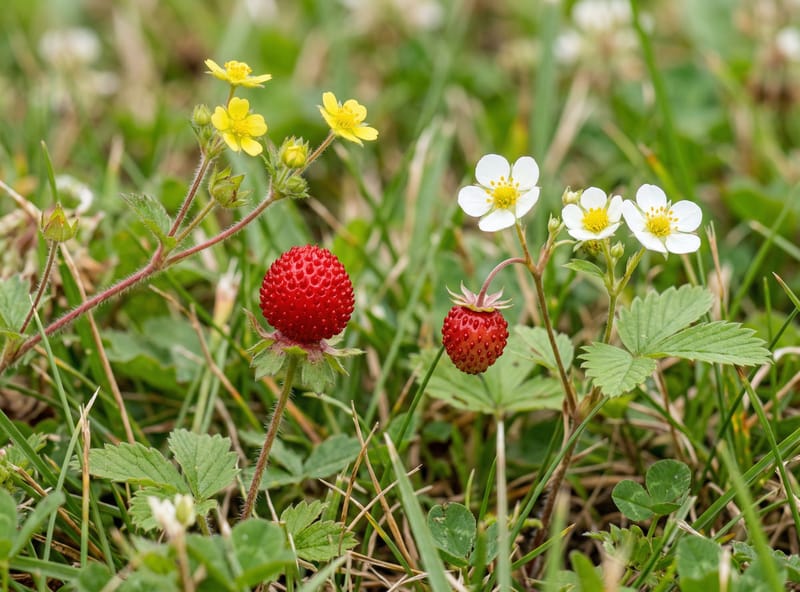
Many lawn "wild strawberries" are actually mock strawberry (Potentilla indica, formerly Duchesnea indica) — an invasive species from Asia that closely resembles the native wild strawberry. Both spread aggressively and are treated the same way, but knowing which you have helps with identification.
Wild Strawberry (Native)
- White flowers with five petals
- Berries hang downward
- Fruit is flavorful (small but edible)
- Leaflets have rounded teeth
- Native to North America
Mock Strawberry (Invasive)
- Yellow flowers with five petals
- Berries point upward
- Fruit is tasteless and dry
- Leaflets have pointed teeth
- Invasive from Asia
The easy test: Check the flower color. White flowers = wild strawberry. Yellow flowers = mock strawberry. Both are broadleaf weeds that respond to selective herbicide treatment, so the control method is the same regardless of species.
Why Wild Strawberries Are a Lawn Problem
Wild strawberries may look innocent, but they are engineered to take over. Their growth strategy is built for rapid colonization:
Runner Networks
Each plant sends out multiple stolons that root at every node, creating daughter plants connected in an expanding network. A single plant can colonize several square feet in one growing season.
Light Smothering
The trifoliate leaves form a dense canopy close to the ground that blocks sunlight from reaching grass below. Without light, turf grass thins, weakens, and eventually dies under the strawberry mat.
Resource Competition
Wild strawberries compete aggressively for water, soil nutrients, and growing space. Their shallow but extensive root system draws resources away from surrounding turf grass.
Dual Reproduction
Wild strawberries spread through both runners AND seeds. Birds eat the berries and deposit seeds across the lawn. Even if you remove all visible plants, seeds in the soil germinate the following season.
Why Pulling and Mowing Fail
Homeowners typically try two approaches before looking for herbicide solutions — and both fail for the same reason: the runner network.
Hand-pulling removes the visible plant but leaves runner fragments and daughter plants in the soil. Each fragment can regenerate into a full plant. In an established infestation, the runner network is so interconnected that pulling one plant barely affects the colony.
Mowing cuts the leaves but does not reach the crown or runners. Wild strawberries grow so low to the ground that even a low mowing height passes over the growth tissue. The plant regrows from the crown within days.
Effective control requires killing the plant tissue at the growth point — the crown where leaves, runners, and roots converge. This is exactly what a selective herbicide targets. For the science behind how selective herbicides differentiate between broadleaf weeds and grass, read how selective herbicides work.
How to Eliminate Wild Strawberries
Salacia controls wild strawberries at its selective mixing rate — killing the broadleaf weed through osmotic dehydration while leaving your grass unharmed. Here is the treatment approach:
Mow before treating
Lower your mowing height to expose the strawberry crowns and runners. Remove grass clippings so the spray reaches the weed tissue directly.
Mix at the selective rate
Follow the label's selective mixing rate for lawn application. This concentration controls broadleaf weeds while keeping grass intact. Salacia is a granular concentrate, so you mix it fresh each time you treat.
Spray all foliage and runners thoroughly
Wet all visible leaves, stems, and runners to the point of runoff. Follow the runner network — every rooted node needs treatment. Missing sections of the network allows regrowth.
Follow up and overseed
Apply a second treatment one to two weeks later if regrowth appears. Once the wild strawberries are dead, overseed the bare patches to establish thick turf that prevents new weeds from establishing.
For detailed application timing, temperature ranges, and seasonal strategy, see the timing and application guide. For non-lawn areas like garden beds, pathways, or fence lines, use Salacia's non-selective mixing rate for complete vegetation removal — see the Lanaturo Weed Control Guide for rate details. To understand how selective herbicides target broadleaf weeds without harming grass, read what is a selective weed killer. And if wild strawberry is creeping out of the lawn and into your borders, our guide to the best weed killer for flower beds covers removal around ornamentals without collateral damage.
Ready to Take Back Your Lawn?
Salacia™ is the first OMRI-certified selective organic herbicide — kills weeds, not grass. Choose your lawn size:
See the Results
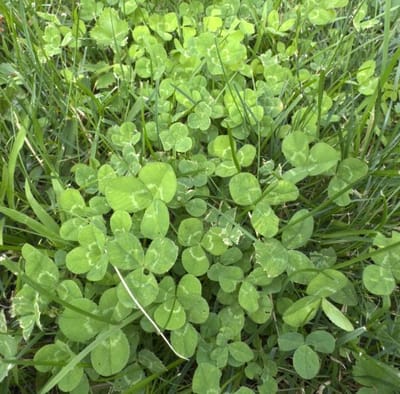
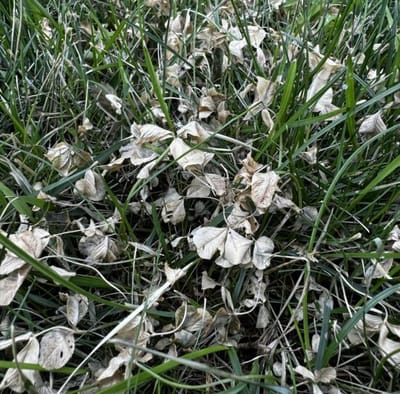
Real results, real lawns — watch Salacia eliminate tough weeds while your grass stays perfectly untouched.
Fighting more than one weed?
Most lawns battling one broadleaf weed have others growing alongside it. Our ranked guide to the best weed killer that won't kill grass covers the full lineup a selective treatment clears in the same pass.

Lawn
Advisor
Not sure which weed you're looking at? Show Sal.
Sal is Lanaturo's lawn-care expert. He doesn't just name the weed — he builds your exact treatment plan and checks whether today is the right day to spray.
Ready to Take Back Your Lawn?
Salacia™ is the first OMRI-certified selective organic herbicide — kills weeds, not grass. Choose your lawn size:
They Spread by Design. You Stop Them by Choice.
Wild strawberries evolved to colonize — runners, seeds, dense mats that shade out everything beneath them. Pulling leaves fragments. Mowing misses the crown. But they are broadleaf plants in a grass lawn, and a selective herbicide that works through dehydration treats them as exactly what they are: targets. The runner network dies. The grass recovers. The lawn comes back.
Pet Friendly — everything else second.
This article is for informational purposes. Always follow product label directions for application rates, timing, and use. Salacia is OMRI certified organic and labeled Pet Friendly.