
 By Pat Kelly
 Thistle is not just another weed — it is a fortified invader with spines sharp enough to pierce gloves and root systems that extend 6 feet deep with lateral runners spreading 15 feet or more. Mowing it makes it worse. Pulling it leaves root fragments that regenerate into new plants within days. By the time most homeowners notice the spiny rosettes in their lawn, the underground network is already deeply established.
Being a broadleaf plant does not automatically make thistle a selective-rate job, and with thistle it does not. The rule is per weed, and this one earns its own answer: precision work at the non-selective rate, on the thistle only. This guide covers what thistle is, why it is so dangerous to lawns, why the usual removal methods make it worse, and the honest organic method — including what it costs the grass immediately around each plant.
What Is Thistle?
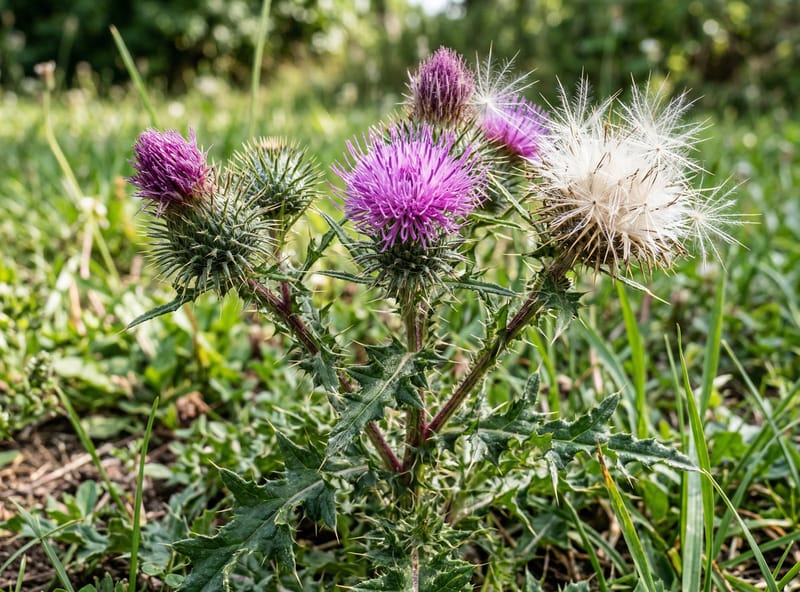
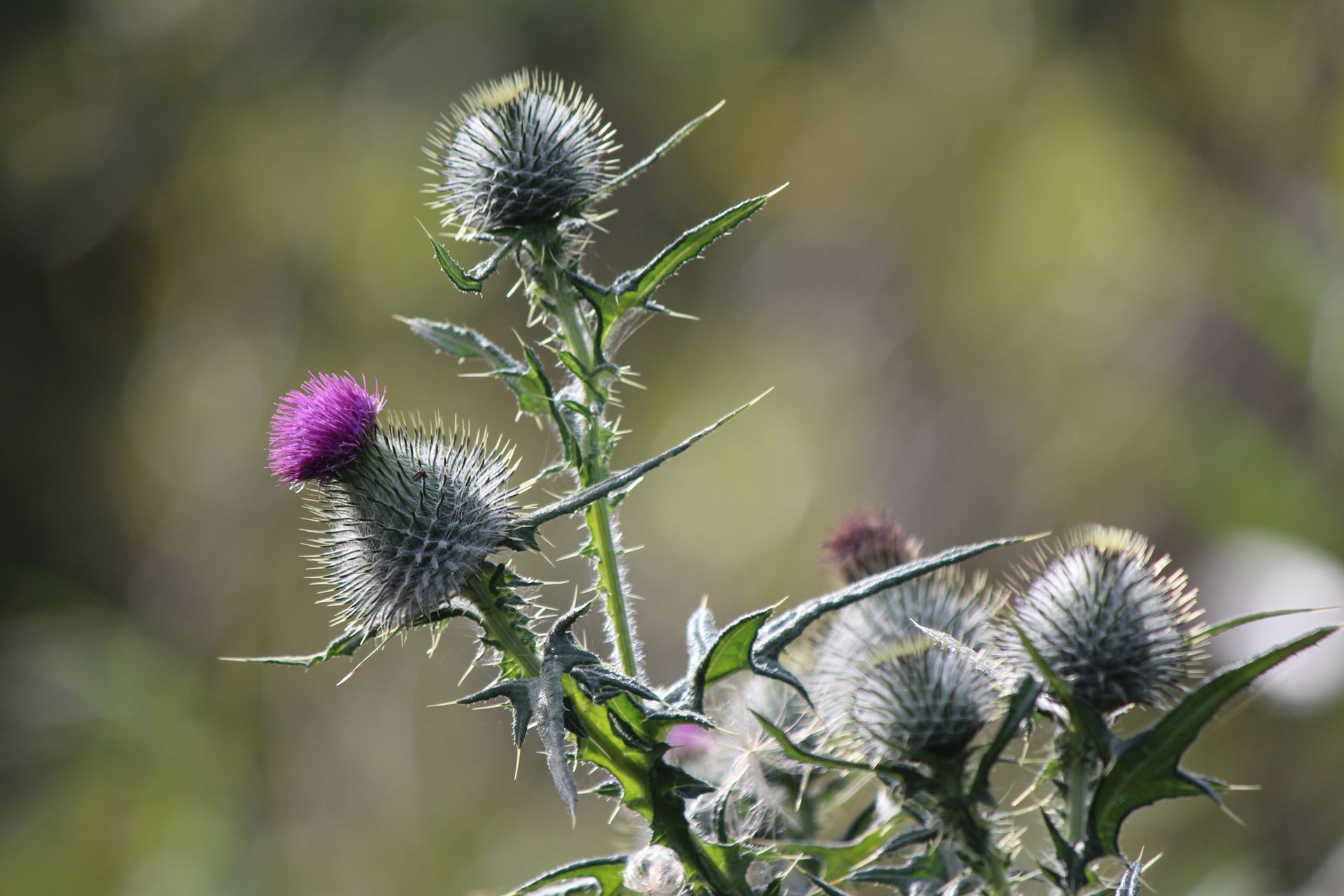
Thistle refers to several species of spiny broadleaf plants in the Asteraceae family, but the most common lawn invader in the United States is Canada thistle (Cirsium arvense). Despite the name, it actually originated in Europe and western Asia. It is classified as a noxious weed in over 40 states due to its aggressive spread and the difficulty of controlling it once established.
How to identify thistle:
- Deeply lobed leaves with sharp spines at each lobe tip
- Grey-green color with a slightly woolly underside
- Grows as a flat rosette in year one, tall flower stalks (2-5 ft) in year two
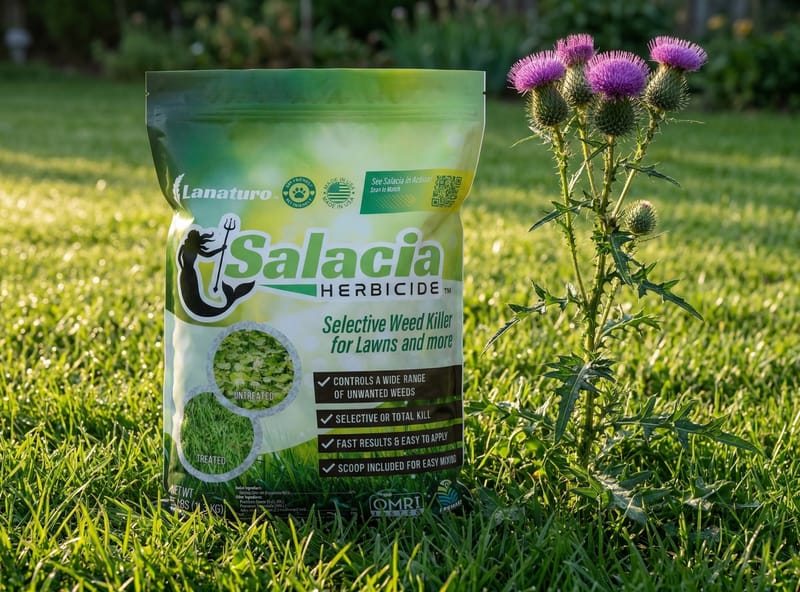
- Purple or pink pom-pom-shaped flower heads
- Stems are grooved and may also have spines
Yes, thistles are sharp. The spines that line thistle leaf margins and stems are rigid enough to pierce leather work gloves and puncture bare skin. This is what makes thistle uniquely dangerous among lawn weeds — it is not just an eyesore, it is a physical hazard for anyone walking barefoot and for pets.
According to the USDA Natural Resources Conservation Service, Canada thistle is one of the most economically damaging weeds in North America, affecting lawns, pastures, and cropland alike.
How to Identify Thistle in Your Lawn
Thistle is easy to name once it has flowered and nearly impossible to ignore once you have knelt on one. The useful identification happens earlier than that, and it comes down to one question with a real consequence attached.
Is it Canada thistle or bull thistle?
Look at how it is arranged, not at the spines. Canada thistle comes up as a patch — many stems of similar height spread across an area, all connected underground by a shared creeping root system. Bull thistle stands alone: one plant, one crown, no runners, often much larger and coarser than its neighbours. Both are spiny; only one of them is a colony.
That difference is not trivia. It decides whether you are treating a plant or a network.
| Canada thistle | Bull thistle | |
|---|---|---|
| How it shows up | A patch of many stems, evenly spread, spreading outward year on year | A single plant on its own, sometimes several scattered but never connected |
| Underground | Creeping horizontal roots running well beyond what you can see; new shoots come up from them | A single taproot. No runners, so no new plants appearing a metre away |
| Size and feel | Slimmer stems, smaller heads, spines sharp but the plant is not bulky | Noticeably coarser and heavier, with a thick spiny stem and a large head |
| Life cycle | Perennial — the roots survive winter and it returns from them | Biennial — a flat rosette one year, a tall flowering stalk the next, then it dies |
| What it means for you | Expect regrowth from root pieces the spray never reached. This is the campaign, not the quick job | Take the plant before it makes its flowering stalk and you have removed it, not just its top |
What does thistle look like before it flowers?
A flat rosette pressed against the soil, with deeply lobed leaves that are wavy along the edge and tipped with spines at every point. It hugs the ground closely enough that a mower rides straight over it. This is the stage most people never notice and the stage worth catching — a rosette has spent nothing on seed yet.
What is often mistaken for thistle?
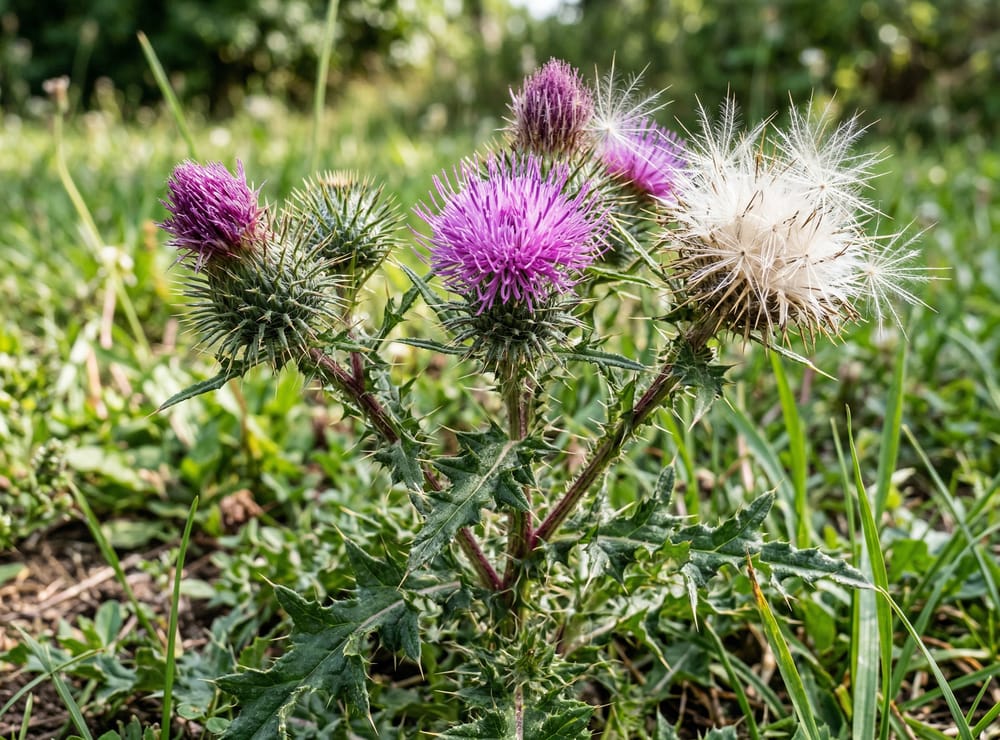
Several lawn plants are called thistle by people who have just stepped on something. The marks that separate a real thistle from a lookalike are consistent: spines on the leaf edges themselves, not just a rough texture; leaves that run down and clasp the stem rather than sitting on a stalk; and a flower head that is a tight tuft of purple filaments sitting on a spiny green base, rather than open petals. If the leaves are soft to the touch anywhere on the plant, it is not a thistle.
If you are not sure what you have, Sal will identify it from a photo and tell you which plant you are actually dealing with — including the times the honest answer is that it is not thistle at all. Every weed in our database has a card in the weed control guide, including the ones we cannot control.
Why Thistle Is Dangerous to Your Lawn
Thistle is not just an eyesore — it is physically dangerous and ecologically aggressive. Understanding what makes it so destructive explains why it requires a targeted approach rather than general lawn maintenance.
Sharp Spines
Thistle spines are stiff enough to pierce leather gloves and puncture bare feet. A lawn with thistle is unsafe for children, pets, and barefoot walking. The spines line the leaf margins, stems, and even the flower heads.
Massive Root System
Canada thistle roots extend 6 feet deep with lateral runners spreading 15+ feet horizontally. These lateral roots send up new shoots every few inches, allowing a single plant to colonize an area several yards wide in one season.
Turf Crowding
Thistle rosettes grow in dense clusters that shade out grass at the soil level. As the patch expands, grass dies from light deprivation and root competition, leaving bare soil that erodes and invites more weeds.
Prolific Seed Spread
A single thistle shoot can produce over 1,500 seeds across its many flower heads, each equipped with feathery plumes that carry them on the wind for miles. Seeds remain viable in the soil for up to 20 years, creating a long-term seed bank that keeps the problem returning.
Why Mowing and Pulling Make It Worse
Most homeowners' first instinct is to mow thistle down or dig it out. Both approaches backfire — and here is why.
Mowing triggers compensatory growth
When the top growth is removed, thistle redirects energy into its root system. The lateral roots respond by producing more shoot buds — not fewer. Each mow cycle can double the number of emerging thistle shoots. This is a well-documented survival mechanism called adventitious bud activation.
Pulling fragments roots into new plants
Thistle roots are brittle. When you pull a thistle plant, the root snaps underground and the remaining fragment — even a piece as small as one inch — regenerates into a new plant. Digging is slightly better but you would need to remove every root fragment from a zone 15+ feet in diameter to prevent regrowth. In practice, this is nearly impossible in a lawn without destroying the turf.
What works is killing the top growth in place, repeatedly, without disturbing the soil — every dig and every pull creates new plants from the fragments it leaves behind. That means treating the plant where it stands and returning for the regrowth, rather than looking for one pass that ends it.
How to Control Thistle Organically
Thistle asks more of a treatment than most weeds do. It stores enough underground to push new shoots after the top is gone, its spines make close work unpleasant, and the rate that actually takes it down is the one that also takes the grass it lands on. Anyone promising you all three at once — dead thistle, untouched lawn, one application — is describing a weed that behaves more politely than this one.
Salacia is the first OMRI-certified selective organic herbicide, made by Lanaturo. It works on contact through rapid osmotic dehydration — it takes down the tissue the spray actually reaches, and it is not carried through the plant into the roots. On most broadleaf weeds the selective rate is enough. On thistle it is not, which is why this page sends you to the non-selective rate and to precision rather than coverage of the whole lawn. Always test a small area of your lawn first.
Step-by-Step Thistle Treatment
Do not mow for 3-4 days before treatment
You want maximum leaf surface area to absorb the product. Let the thistle rosettes grow undisturbed so every leaf is fully expanded and actively photosynthesizing.
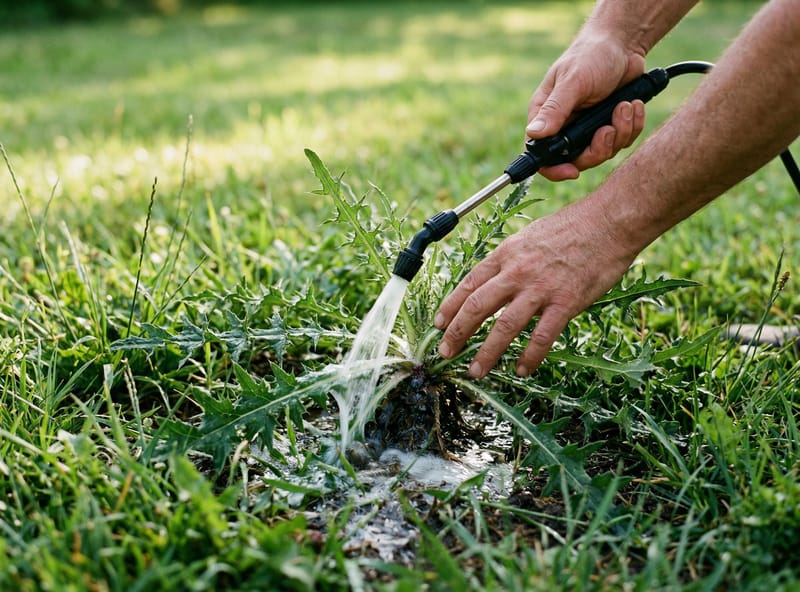
Apply directly to thistle rosettes
Mix at the non-selective rate — 1.5 lb, about 4 cups, per gallon. That is the strongest mix there is; a stubborn thistle needs more solution and more repeat passes, never a heavier scoop. Wet the entire leaf surface to the point of runoff and cover the rosette from several angles so the spray reaches the centre crown where new growth comes from, then drench the crown itself. Work plant by plant rather than sweeping across the lawn: whatever grass the spray lands on will take damage, so the tighter your aim, the less of it you lose. Calm mornings between 60 and 80 degrees work best. Always test a small area of your lawn first.
Wait and monitor for 2-3 weeks
Expect wilting and yellowing within hours to a few days, and give the visible plant a week or two to finish browning. Do not mow the treated area while that is happening — leave the plant standing so you can see exactly what died and what did not. This is a contact treatment, so what it reached is what it took; anything that comes back is regrowth from reserves the spray never touched, and that is what the follow-up pass is for.
Follow-up application on regrowth
Because the root system is so deep, some shoots may re-emerge from surviving root fragments. Apply a second treatment two to three weeks after the first. This depletes the root energy reserves completely. Most thistle patches are fully eliminated after two applications.
For complete application rates and timing charts, see best practices for timing and application. If you are concerned about treating near children or pets, read is organic weed killer safe for pets.
Ready to Take Back Your Lawn?
Salacia™ is the first OMRI-certified selective organic herbicide — kills weeds, not grass. Choose your lawn size:
Before and After Results
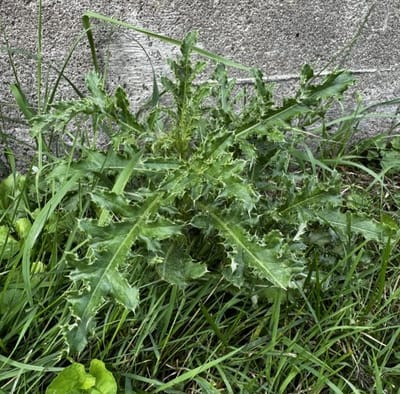
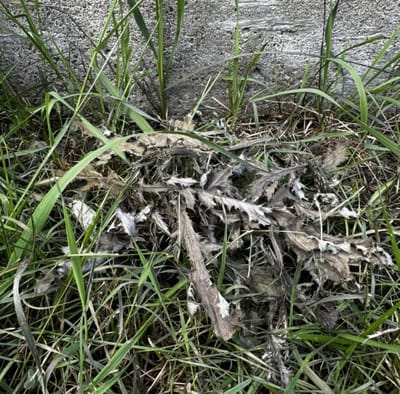
Real results from real lawns. Treating thistle means accepting some damage to the grass the spray lands on — the tighter your aim, the less of it there is, and treated turf grows back. Always test a small area of your lawn first; temporary paling or yellowing around a treated plant is normal and recovers.
When to Treat: Timing Guide
| Season | Thistle Stage | Effectiveness | Notes |
|---|---|---|---|
| Early Fall (Sep-Oct) | Storing energy in roots | Best | Product follows nutrient flow into root system |
| Spring (Apr-May) | Rosette stage, pre-bolt | Very Good | Treat before flower stalks emerge |
| Summer (Jun-Aug) | Flowering/seeding | Moderate | Less effective; avoid temps above 85°F |
| Winter (Nov-Mar) | Dormant | Not Recommended | Plant is dormant; no active absorption |
For a complete weed identification and treatment reference covering all common lawn weeds, visit the weed control guide.
Fighting more than one weed?
Most lawns battling one broadleaf weed have others growing alongside it. Our ranked guide to the best weed killer that won't kill grass covers the full lineup a selective treatment clears in the same pass.

Lawn
Advisor
Not sure which weed you're looking at? Show Sal.
Sal is Lanaturo's lawn-care expert. He doesn't just name the weed — he builds your exact treatment plan and checks whether today is the right day to spray.
Ready to Take Back Your Lawn?
Salacia™ is the first OMRI-certified selective organic herbicide — kills weeds, not grass. Choose your lawn size:
Do Not Let Thistle Own Your Lawn
Thistle spines make your yard unsafe. Its roots spread 15+ feet underground. Mowing makes it multiply. But it can be worn down. Precision treatment at the non-selective rate takes the top growth every time it returns, and a plant that keeps spending reserves on shoots it loses gets weaker each round. Judge it by regrowth coming back thinner and later, not by one application ending it.
Pet Friendly — everything else second.
This article is for informational purposes. Always follow product label directions for application rates, timing, and use. Salacia is OMRI certified organic and labeled Pet Friendly.