
 By Pat Kelly
 Those pretty purple flowers popping up across your lawn are not wildflowers — they are weeds, and they are taking over. Purple weeds are among the most aggressive lawn invaders in North America, spreading through underground rhizomes, creeping stems, and prolific seed production. By the time most homeowners notice the purple blooms, the root systems are already deeply established.
The good news: every common purple-flowering weed is a broadleaf plant, which means a selective herbicide can target them without damaging your grass. This guide covers the four most common purple weeds in lawns, how to identify each one, why they are so difficult to control, and the organic selective method that eliminates them while keeping your turf intact. For a visual ID reference with photos of every weed Salacia controls, see the Weed Control Guide.
Quick identification: the purple flowers in your grass are almost certainly one of four broadleaf weeds — wild violet (heart-shaped glossy leaves), ground ivy / creeping charlie (scalloped leaves, square creeping stems), henbit (round clasping leaves, upright), or purple deadnettle (triangular leaves with a reddish-purple crown). All four are controllable with a selective herbicide that spares your grass — and because all four are broadleaf, one bag of Salacia at the selective lawn rate handles all four, whichever one you have.
Seeing other colors mixed in? We have companion guides to weeds with yellow flowers and weeds with white flowers — the same photo-ID approach, color by color.
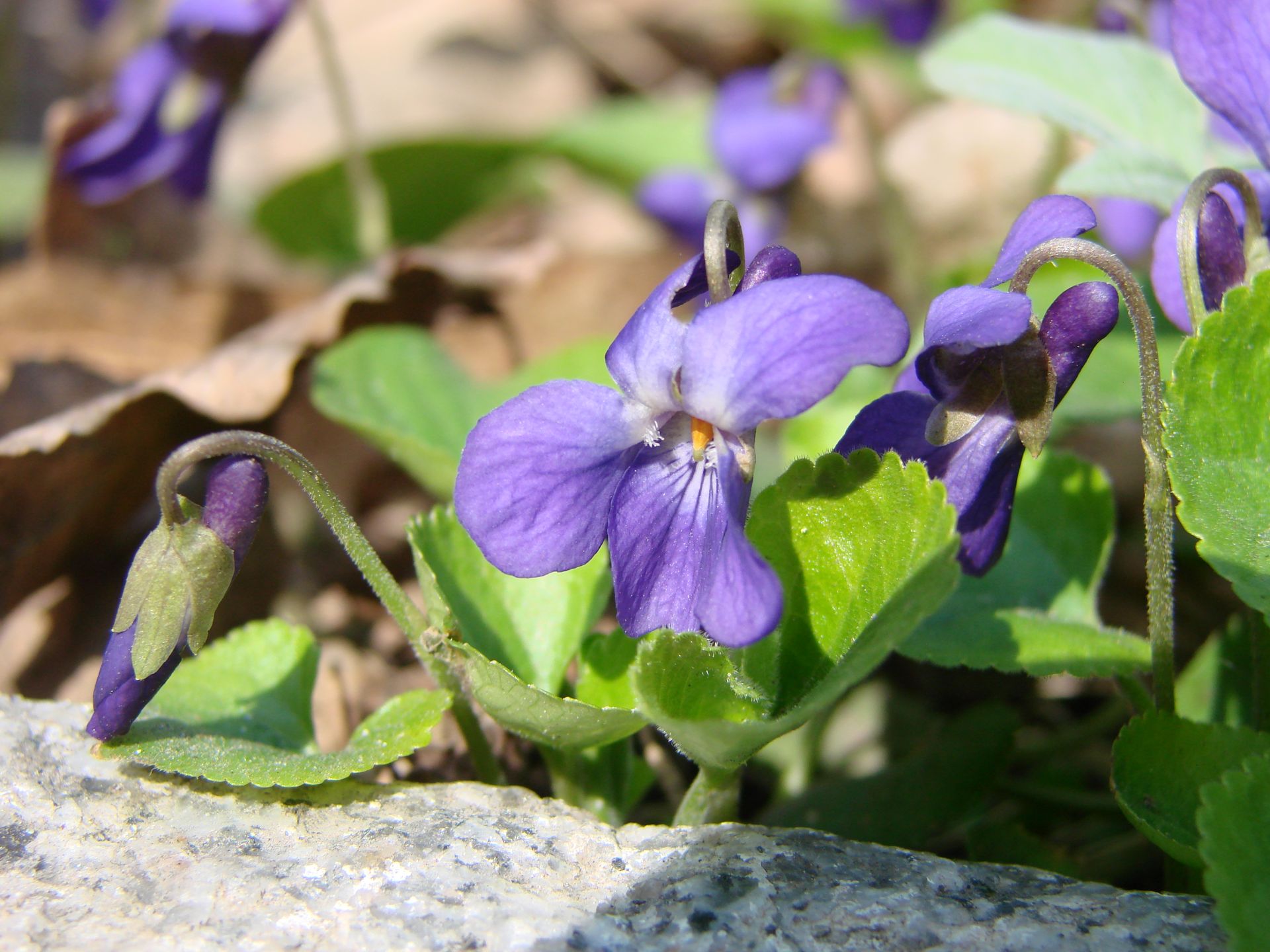
Wild Violet — The Waxy Perennial
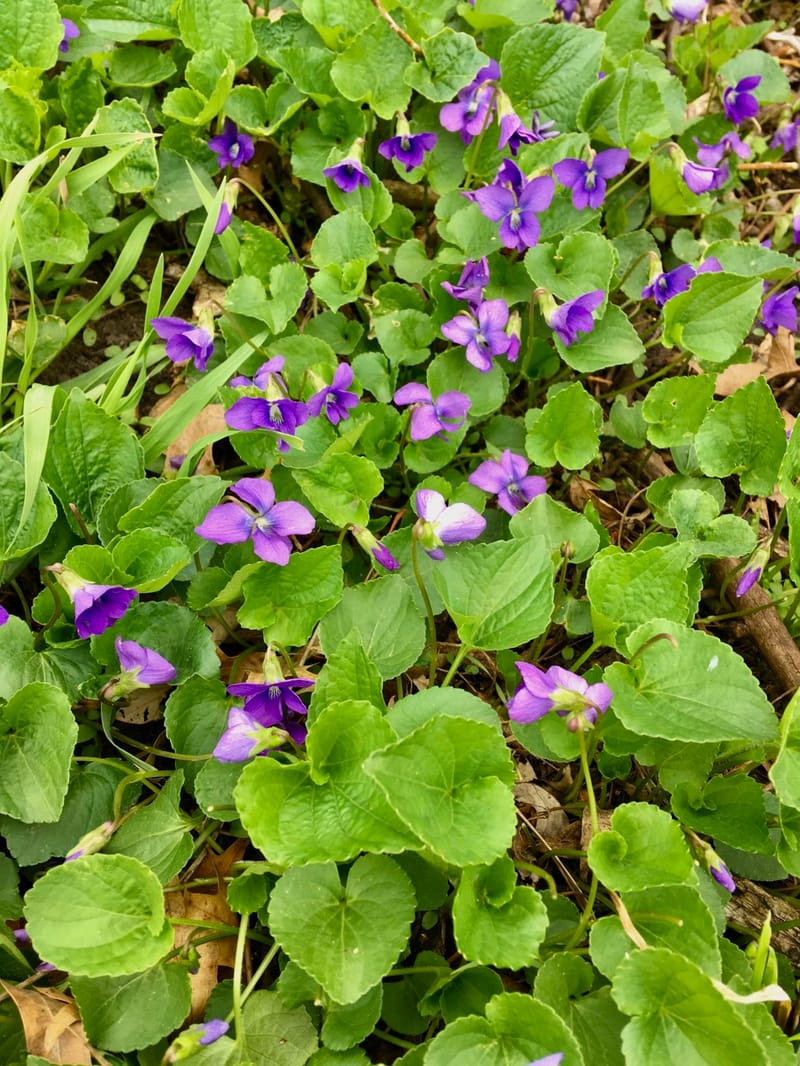
Scientific name: Viola sororia
Wild violet is one of the most frustrating purple weeds homeowners face. It is a perennial — meaning it comes back year after year from the same root system — and its thick, waxy leaves resist absorption of many conventional herbicides. According to Penn State Extension, wild violet is considered one of the most difficult-to-control broadleaf weeds in residential turf.
How to identify:
- Heart-shaped, glossy, hairless leaves
- Grows in a low rosette pattern close to the ground
- Purple, violet, blue, or white flowers in spring
- Spreads through underground rhizomes
- Thrives in moist, shaded areas but tolerates full sun
What makes wild violet particularly dangerous is its dual reproduction strategy. It spreads through both rhizomes (underground stems) and seeds — including cleistogamous flowers that produce seeds underground without ever opening. This means the plant is spreading even when you cannot see any blooms above ground.
Already identified wild violet in your lawn?
Identification is step one. The actual removal — including the canopy-lift technique for the waxy cuticle — is in our dedicated guide: How to kill wild violet in your lawn.
Ground Ivy (Creeping Charlie) — The Aggressive Creeper
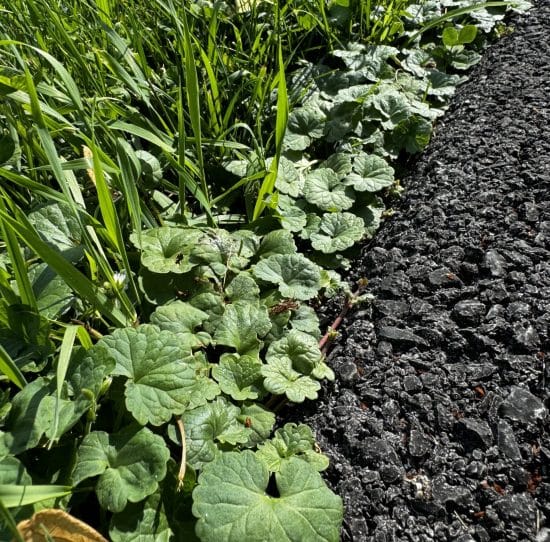
Scientific name: Glechoma hederacea
Ground ivy — also known as creeping charlie, gill-over-the-ground, and run-away-robin — is a member of the mint family and one of the most aggressively spreading purple weeds in North American lawns. Purdue Extension identifies it as a primary lawn weed across the Midwest and Northeast. The University of Minnesota Extension notes it thrives in shaded, moist areas where turfgrass is thin.
How to identify:
- Round, scalloped (kidney-shaped) leaves, slightly hairy
- Square stems — a telltale sign of the mint family
- Small purple to blue-purple tubular flowers
- Creeps along the ground, rooting at every node
- Strong minty smell when crushed
Ground ivy's creeping growth habit makes it especially destructive. As the stems spread across the lawn surface, they root at every leaf node — meaning a single plant can create dozens of new rooted colonies in one growing season. Pulling it up is futile because every fragment left behind can regenerate into a new plant.
Battling creeping charlie?
Ground ivy roots at every node, which means pulling it makes the problem worse. The selective organic approach that breaks the spread cycle is in our full guide: How to kill ground ivy (creeping charlie).
Henbit — The Square-Stemmed Invader
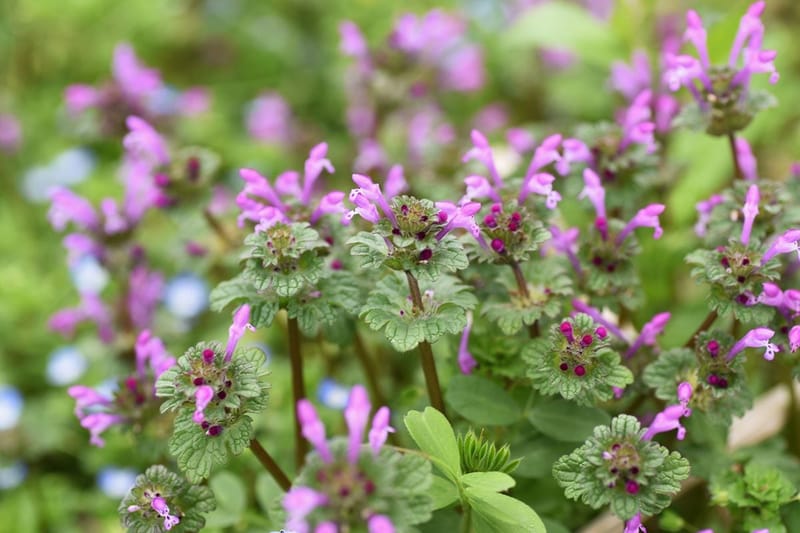
Scientific name: Lamium amplexicaule
Henbit is a winter annual that germinates in fall, survives through winter, and flowers with pink-purple blooms in early spring. It belongs to the mint family (like ground ivy) and shares the characteristic square stems, but henbit grows upright rather than creeping. It favors thin, bare, or disturbed areas of lawn — the patches where turf is weakest. According to UMass Amherst Extension, henbit is especially prevalent in lawns with poor turf density.
How to identify:
- Square stems that grow upright (6 to 12 inches tall)
- Round, deeply veined leaves that clasp the stem
- Pink-purple tubular flowers clustered at the top
- Lower leaves have petioles (stalks); upper leaves do not
- Often confused with purple deadnettle — but henbit leaves are rounder
Henbit vs. Purple Deadnettle — the easy test: Crush the stems. Both have square stems, but henbit leaves are rounder and clasp the stem directly. Purple deadnettle leaves are triangular and the upper leaves turn reddish-purple. Once you spot the difference, you will never confuse them again. And when it is henbit, the dedicated playbook — the fall window, exact rates, prevention — is here: How to Kill Henbit.
Identified henbit in your lawn?
Henbit is a broadleaf winter annual, so a selective herbicide kills it while your grass stays intact. Treat in early spring before it sets seed and the patch will not return next year — remove it with Salacia at the selective lawn rate.
Purple Deadnettle — The Winter Annual
Scientific name: Lamium purpureum
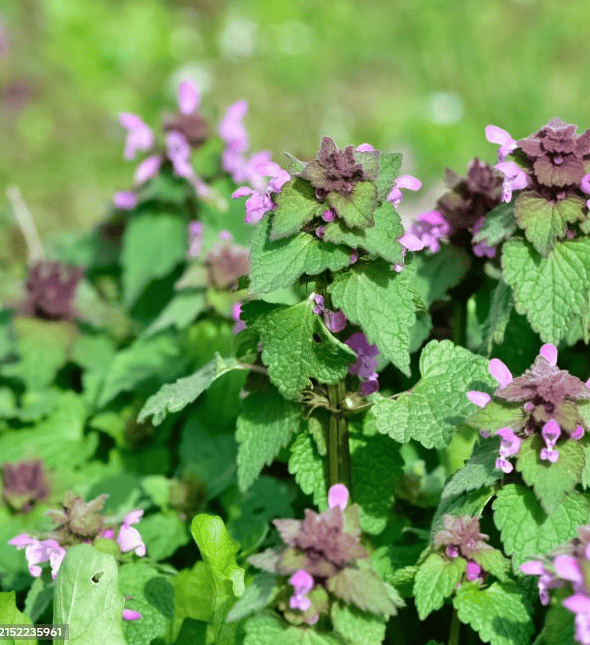
Purple deadnettle is closely related to henbit and shares many characteristics — square stems, mint family membership, winter annual life cycle. But purple deadnettle has a distinctive look: the upper leaves turn reddish-purple, creating a colorful crown that stands out in early spring lawns. Despite the name, it is not related to stinging nettles and does not sting. The Missouri Botanical Garden classifies it as a common cool-season lawn weed across the eastern United States.
How to identify:
- Triangular to heart-shaped leaves with fine hairs
- Upper leaves turn distinctly reddish-purple
- Small pink-purple flowers between the upper leaves
- Square stems, typically 6 to 10 inches tall
- Grows in patches in thin or bare lawn areas
Like henbit, purple deadnettle drops thousands of seeds before dying in summer. The key to long-term control is treating in early spring before flowering — breaking the seed cycle so fewer plants germinate the following fall.
Can't tell them apart? It doesn't matter.
Wild violet, ground ivy, henbit, and purple deadnettle all look similar — purple flowers, low growth, aggressive spreading. Homeowners confuse them constantly. Here is what matters: all four are broadleaf weeds, and Salacia controls every single one of them at the selective lawn rate. You do not need a botany degree to get results. If it has purple flowers and it is growing where your grass should be, Salacia handles it — while your lawn stays intact.
Why Purple Weeds Are So Hard to Kill
Purple-flowering weeds share traits that make them among the most persistent lawn invaders. Understanding these defense mechanisms explains why pulling, mowing, and many herbicides fail.
Waxy Leaf Coating
Wild violet's thick, glossy cuticle repels water-based herbicide sprays. The product beads up and rolls off instead of being absorbed. A dehydration-based herbicide bypasses this barrier by drawing moisture from the tissue rather than needing to penetrate it.
Underground Root Networks
Wild violet spreads through rhizomes. Ground ivy roots at every node. Both weeds have extensive underground systems that regenerate new growth even after the visible plant is removed. Pulling leaves fragments behind that regrow.
Prolific Seed Production
Henbit and purple deadnettle each produce thousands of seeds per plant. Wild violet produces seeds underground. Even after removing the parent plants, the soil seed bank ensures new weeds emerge the following season.
Shade and Moisture Tolerance
Most purple weeds thrive in conditions where grass struggles — shaded areas, moist soil, compacted ground. They fill in wherever turf thins out, then spread into healthy lawn areas from those footholds.
Where Purple Weeds Are Most Common
Purple-flowering weeds grow across most of the continental United States, but some regions deal with them far more than others. Knowing which species dominate your area helps you time treatments and set expectations.
Northeast & Mid-Atlantic (New York, Pennsylvania, New Jersey, Connecticut, Massachusetts, Maryland, Virginia) — Wild violet and ground ivy are the dominant purple weeds. Shaded lawns in this region are especially vulnerable to ground ivy, which thrives in the cool, moist conditions common from spring through fall.
Upper Midwest (Ohio, Indiana, Michigan, Illinois, Wisconsin, Minnesota, Iowa) — Ground ivy (creeping charlie) is the single most complained-about lawn weed in this region. Henbit and purple deadnettle appear heavily in early spring, particularly in thin lawns and disturbed areas.
Southeast (North Carolina, South Carolina, Georgia, Tennessee, Alabama, Kentucky) — Wild violet is widespread, especially in partially shaded yards. Henbit and purple deadnettle bloom earlier here (February-March) and can form dense patches before homeowners even begin spring lawn care.
Pacific Northwest (Oregon, Washington) — Ground ivy and purple deadnettle thrive in the consistently moist, cool climate. Wild violet is also common in shaded areas west of the Cascades.
Mountain West & Plains (Colorado, Missouri, Kansas, Nebraska) — Henbit is the primary purple weed in drier regions, colonizing bare patches where turf struggles. Purple deadnettle appears in irrigated lawns and along fence lines.
How to Control Purple Weeds Without Killing Grass
The central challenge with purple weeds is that they grow inside your lawn. You cannot spray a non-selective herbicide without killing the surrounding grass — which creates bare patches that invite even more weeds. The only approach that works is selective weed control. For a side-by-side look at which products spare turf and which do not, see the best weed killer that won't kill grass.
Salacia is the first OMRI-certified selective herbicide. Its Hybrisal Technology works through osmotic dehydration — drawing moisture out of broadleaf weed tissue while narrow grass blades retain enough moisture to recover. This dehydration-based approach is especially effective against purple weeds because it does not need to penetrate waxy leaf coatings to work. The process draws water out of the tissue from the surface.
Salacia is designed to be selective at the lawn mixing rate, but temporary paling or yellowing of grass is possible depending on lawn health, irrigation, application rate, and conditions. Test a small area first.
Application Strategy for Purple Weeds
Mow low before treating
Drop your mowing height to expose the weed crowns. Purple weeds grow close to the ground — mowing shorter than usual helps the spray reach the base of the plant where the growth tissue sits.
Spray during active growth
Treat in early spring (March-May) or early fall (September-October). For henbit and purple deadnettle, early spring before flowering is critical to prevent seed set. Temperatures between 60 and 80 degrees Fahrenheit.
Thorough coverage on all weed surfaces
Wet the weed foliage thoroughly to the point of runoff. For ground ivy, follow the creeping stems and treat the entire network — missing one rooted node allows regrowth.
Plan for follow-up on perennials
Wild violet and ground ivy may need a second application one to two weeks after the first to exhaust root energy reserves. Henbit and purple deadnettle (annuals) typically need only one treatment if applied before seed set.
For detailed timing charts and application techniques, see the timing and application guide. For the science behind how selective herbicides differentiate between weeds and grass, read how selective herbicides work.
And if dogs or cats share your lawn, read our research-backed guide to choosing a weed killer safe for pets before you spray — it covers re-entry times, the Tufts and Purdue research on lawn chemicals around pets, and what a Pet Friendly label actually means.
Identified your weed? Pick the treatment.
Our full criteria breakdown is in the best organic weed killer guide — and if you want the short version, see the best selective weed killer for lawns: the OMRI-certified organic that handles all four purple weeds at the lawn rate.
Found henbit or purple deadnettle?
Here is how to remove it without killing the grass: both are broadleaf annuals, and Salacia's selective lawn rate dehydrates them on contact while your turf is preserved. Treat before they set seed and the patch does not return next spring.
Ready to Take Back Your Lawn?
Salacia™ is the first OMRI-certified selective organic herbicide — kills weeds, not grass. Choose your lawn size:
See the Results
Real results, real lawns — Salacia eliminates tough weeds while your grass stays perfectly untouched.
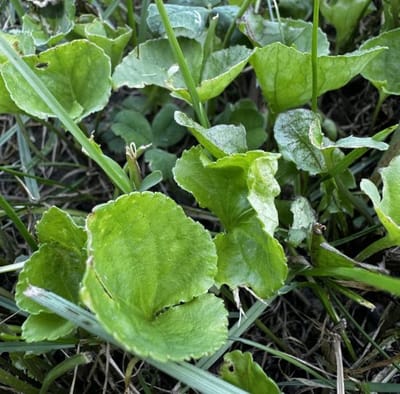 BEFORE
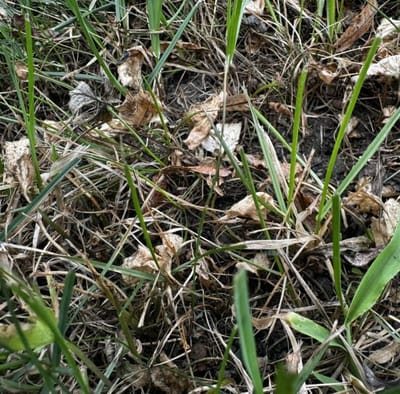 AFTER
AFTER
WILD VIOLET
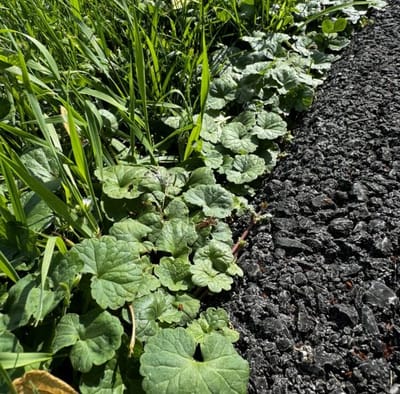 BEFORE
 AFTER
AFTER
GROUND IVY

Lawn
Advisor
Not sure which weed you're looking at? Show Sal.
Sal is Lanaturo's lawn-care expert. He doesn't just name the weed — he builds your exact treatment plan and checks whether today is the right day to spray.
Ready to Take Back Your Lawn?
Salacia™ is the first OMRI-certified selective organic herbicide — kills weeds, not grass. Choose your lawn size:
Your Lawn Does Not Need Purple
Wild violet, ground ivy, henbit, purple deadnettle — they look charming until they own your yard. These weeds have evolved defenses that defeat hand-pulling, mowing, and most conventional sprays. But they are all broadleaf plants, and a selective herbicide that works through dehydration treats them as exactly what they are: targets. Your grass stays. The purple goes.
Pet Friendly — everything else second.
This article is for informational purposes. Always follow product label directions for application rates, timing, and use. Salacia is OMRI certified organic and labeled Pet Friendly.