
 By Pat Kelly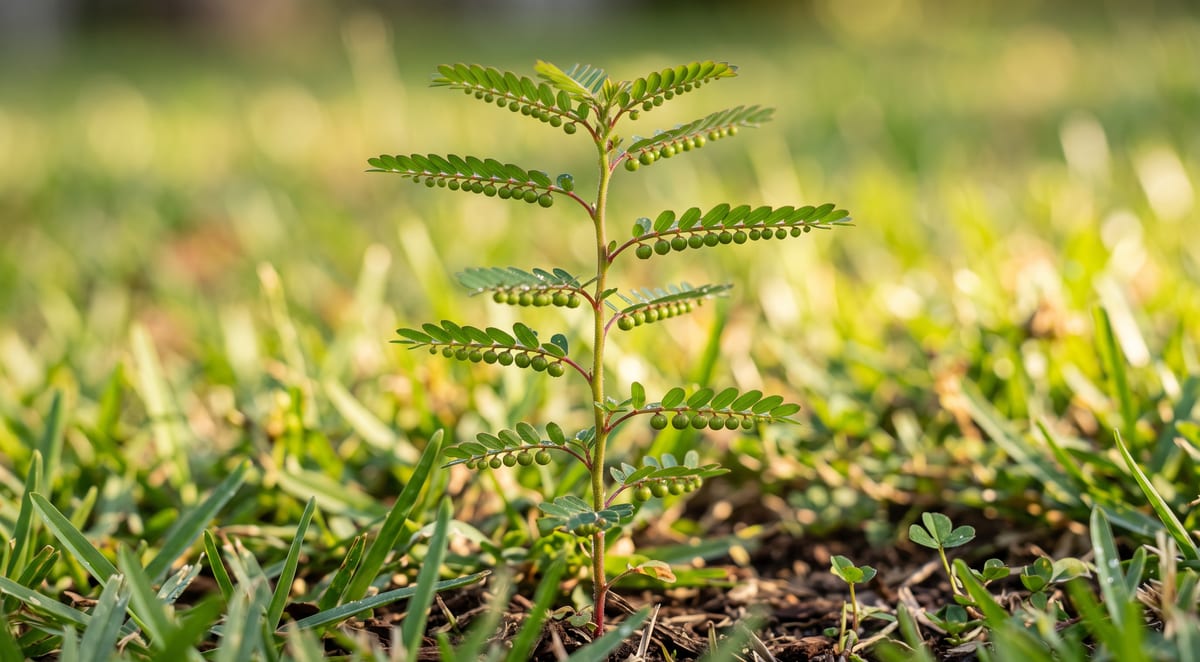
It showed up in June looking like a cute little mimosa seedling. You pulled a few. By August it's everywhere — lawn, beds, sidewalk cracks — and every plant you missed is carrying its next thousand seeds in neat rows underneath its own branches. Meet chamberbitter, the weed the South can't stop talking about from June to October.
Chamberbitter (Phyllanthus urinaria — extension folks also call it gripeweed or leafflower) is a warm-season summer annual broadleaf that has become one of the most complained-about lawn and landscape weeds across Texas, Louisiana, Florida, Georgia and the Carolinas. It wins with two tricks: it germinates later than the weeds your spring routine is built around, and it seeds faster than almost anything else in the yard. Beat those two tricks and it stops winning.
The short answer: Chamberbitter is a late riser — it doesn’t germinate until soil warms to roughly 70–75°F, weeks after spring pre-emergents have faded. Get rid of it by pulling plants before the under-leaf seed capsules mature (it has no bulbs or runners, so pulling genuinely works), keeping turf dense and mowed at the top of your grass’s range, holding 2–3 inches of mulch in beds, and timing any prevention pass to that late soil-temperature window rather than the early-spring calendar.
Not sure it's chamberbitter?
Flip a branchlet over. If there's a row of tiny round green capsules stuck to the underside, that's the signature. Want certainty? Photograph it and send it to Sal, our free weed-ID assistant, right on this page. See how Sal works →
How to Identify Chamberbitter (Flip the Branch)
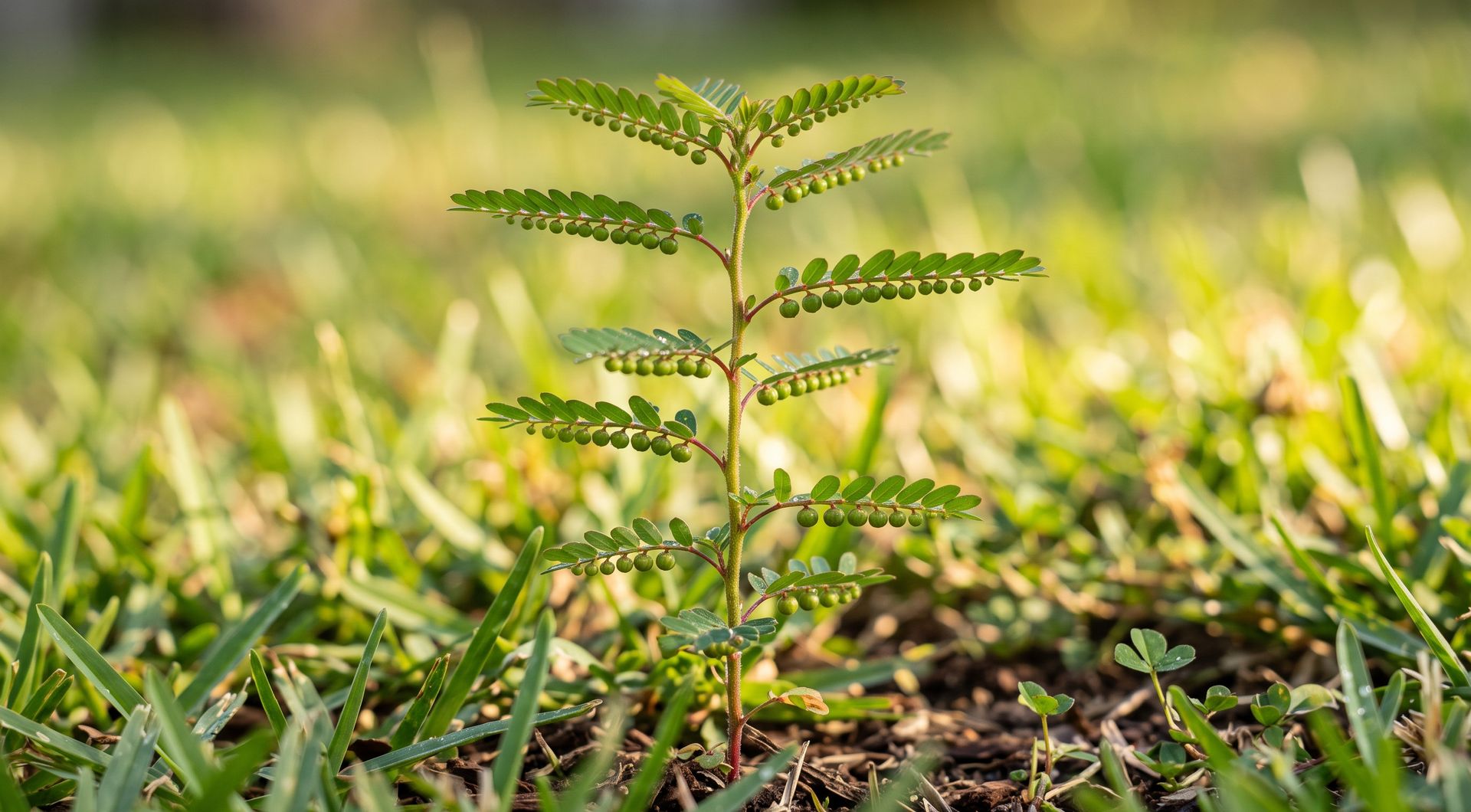
Chamberbitter grows upright on slender, often reddish stems, usually knee-high or less, with small oblong leaflets arranged in two neat rows along each branchlet — which is why half the South calls it “little mimosa.” The leaflets even fold slightly along the midrib. But the identification that settles it in two seconds is underneath:
- Flip a branchlet over. Real chamberbitter carries a row of tiny round, wart-like seed capsules attached directly to the underside of the branch, one under each leaflet pair. Mimosa seedlings have nothing there. No other common lawn weed wears its seeds like this.
- Smooth leaf edges, alternating leaves on the main stem, branchlets held out flat like tiny fern fronds.
- It appears in early summer — if a “mimosa carpet” showed up in your lawn or beds in June or July, chamberbitter is the prime suspect. Per the Clemson Extension factsheet, those capsules are the distinguishing feature to check first.
The Late-Germination Trick: Why Your Spring Routine Misses It
Most lawn-weed prevention in the South is timed to crabgrass, which stirs when soil crosses about 55°F in late winter. Chamberbitter sleeps straight through that. Per LSU AgCenter, it germinates in late spring and early summer, once soil has warmed considerably — around 70–75°F. By then, the pre-emergent barrier you put down in February or March has largely broken down. The weed literally waits out your defense.
Then it makes up for its late start with sheer output. Every one of those under-branch capsules is packed with seed, the capsules burst and fling seed outward as they dry, and a single summer generation can blanket the same ground next June. Chamberbitter has no bulbs, tubers or runners — the seed rain is the whole strategy.
That's the good news hiding in the biology: stop the seed, and you stop the weed. Everything below is that one idea, applied.
Getting It Out of the Lawn
1. Pull it — early, and bag it
Unusual advice on this site, but chamberbitter is one of the few weeds where hand-pulling genuinely wins: it's an annual with no underground storage, it comes up easily from moist soil, and per UF/IFAS hand-weeding works well precisely because nothing resprouts below ground. The rule that matters: pull before the under-leaf capsules mature, and bag what you pull — a mature plant tossed on the lawn or compost still sheds its seed load.
2. Mow at the top of your grass’s range
Chamberbitter seed germinates in warm, sunlit soil. The same canopy play that fights crabgrass and nutsedge works here: St. Augustine at roughly 3–4 inches for standard varieties, bermuda and zoysia at the top of their shorter ranges, and every bare or scalped patch repaired — with plugs or sod in warm-season lawns — before summer sun reaches open soil.
3. The honest herbicide picture
Chamberbitter is a broadleaf, so it sits squarely in the category that selective broadleaf herbicides exist for. On the synthetic side, extensions list combination broadleaf products for warm-season turf and note that pre-emergents such as isoxaben are used against it — always matched carefully to your grass species, because St. Augustine and centipede tolerate far fewer actives than bermuda. We don't sell those, and our lane is the organic one: our own product's verified treatment list doesn't include chamberbitter yet, and we only claim weeds our data covers — so on this one, the pull-early-and-shade-the-soil plan above is our straight recommendation. If your lawn is also carrying clover, oxalis or other broadleaf weeds from our verified list, that's where the organic selective route comes in — more on that below.
Ready to Take Back Your Lawn?
Salacia™ is the first OMRI-certified selective organic herbicide — kills weeds, not grass. Choose your lawn size:
Getting It Out of Beds and Borders
Beds are where chamberbitter builds its empire — open soil, irrigation, full sun. Two moves shut it down:
- Mulch to 2–3 inches and keep it there. Chamberbitter seed needs light at the soil surface to germinate; a maintained mulch layer removes the invitation. Thin, patchy mulch is how beds stay infested — top it up before early summer.
- Hand-pull the escapees monthly through summer, before capsules mature. For gravel, path edges and pavement cracks — off the lawn — a non-selective organic contact spray is the chemical-free option for burning down young seedlings on contact; expect regrowth from any seed still in the soil, and reseed or re-mulch the spot so it doesn't reopen for business.
The Southern Prevention Calendar
Chamberbitter control is a rhythm, not an event — and the rhythm runs later than the one on the back of the spring fertilizer bag:
- Late spring (soil approaching 70°F): this — not February — is chamberbitter's prevention window. If you use any pre-emergent strategy against it, it has to be timed here, with turf dense and mulch topped up before germination begins.
- Early-to-mid summer: patrol and pull. Plants are small, rootable soil is warm and moist, and no capsule has matured yet. This is the highest-value hour of the whole campaign.
- Late summer: zero-tolerance on seed set. Every plant that matures capsules is next year's carpet. Keep pulling, keep bagging.
- Fall: thicken the lawn (warm-season lawns knit best while still growing), repair bare spots, refresh mulch. A closed canopy going into winter is a closed door next June.
Fighting the grassy southern invaders too? The same soil-temperature logic — earlier in the year — runs our crabgrass prevention guide, and the drainage-first plan in our nutsedge guide handles the sedge that loves the same wet summer lawns.
Meanwhile: The Broadleaf Weeds You CAN Clear Organically
A lawn with chamberbitter almost always has company — clover, oxalis, dollarweed, spurge and the rest of the southern broadleaf lineup, all competing with the dense turf you’re trying to grow. Those are exactly what a selective organic herbicide is built for. Salacia, by Lanaturo, is the first OMRI-certified selective organic herbicide: it clears the broadleaf weeds on its verified list from your lawn while the grass is preserved, and it’s Pet Friendly. Chamberbitter isn’t on that verified list yet — we only claim what our data covers, and we’d rather tell you that than guess — but clearing the broadleafs that are is how the turf thickens, and thick turf is chamberbitter prevention.
Start with our ranked guide to the best weed killer that won't kill grass, browse the full weed control guide — or skip the reading and send Sal a photo for an instant ID and an honest answer on whether your weed is one we treat.

Lanaturo
Intelligence
Not sure which weed you're looking at? Show Sal.
Sal is the lawn-care brain behind Lanaturo Intelligence. He doesn't just name the weed — he builds your exact treatment plan and checks whether today is the right day to spray.
Ready to Take Back Your Lawn?
Salacia™ is the first OMRI-certified selective organic herbicide — kills weeds, not grass. Choose your lawn size:
The Honest Bottom Line
Chamberbitter wins by sleeping through your spring defenses and out-seeding your summer. So beat it on its own schedule: pull early and bag it before the under-leaf capsules ripen, keep the mulch thick and the turf tall, and time prevention to warm soil — not the calendar. No bulbs, no runners, no drama: stop the seed and the “little mimosa” carpet thins out season by season. That’s slower than a miracle-spray promise, and unlike the promise, it works.
Salacia is an OMRI-certified selective organic herbicide for the broadleaf weeds on its verified treatment list; chamberbitter is not currently on that list. For listed broadleaf weeds it is designed to be selective at the lawn rate; temporary paling of grass is possible — test a small area first.
Pet Friendly. OMRI certified. Honest about what it does — and doesn't.
This article is for informational purposes. Agronomic guidance references university cooperative-extension sources (LSU AgCenter, Clemson Extension, UF/IFAS). Always follow product label directions. Salacia is OMRI certified organic and labeled Pet Friendly.