
 By Pat Kelly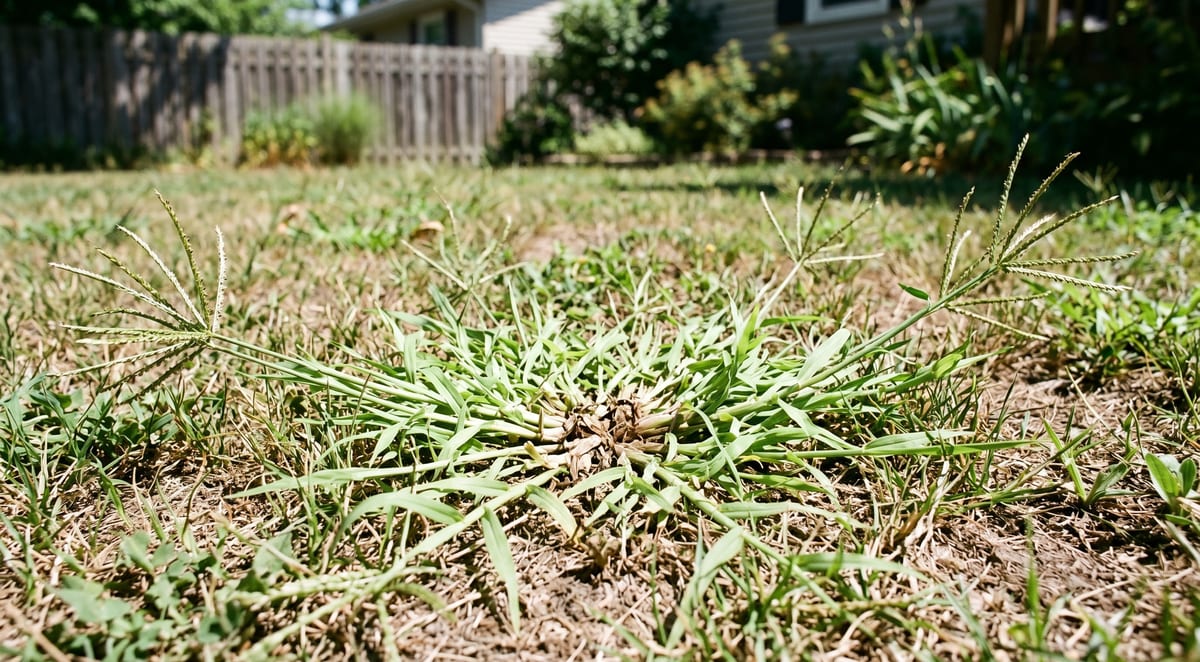
We are going to start with the thing every other page on this topic is too conflicted to tell you: we do not sell a crabgrass killer — and neither does anyone else, not really.
That sounds like a strange way for a weed-control company to open. Here is why we can say it. Lanaturo makes a selective organic herbicide — it tells broadleaf weeds apart from your grass and kills only the broadleaf. Crabgrass is not a broadleaf. Crabgrass is a grass. There is no organic product on earth that can spot-spray one grass out of another grass without killing both — and the synthetic "selective" crabgrass sprays the big brands sell are inconsistent, harsh, and increasingly resistance-prone. So instead of selling you a bottle that won't work, we are going to give you the thing that actually does: the honest organic playbook to make crabgrass stop coming back.
The honest short answer: You cannot organically spot-kill crabgrass in a lawn — it is a grass, and no selective organic grass-herbicide exists. Crabgrass is a summer annual that dies every frost and returns from seed, so the only real lever is prevention: a dense lawn mowed tall (3–4 in), watered deep and infrequently, with bare spots overseeded — a thick canopy shades the soil and stops the seed from germinating. A non-selective organic herbicide only helps for spot-treating crabgrass on bare ground or pavement cracks, never in turf.
Not sure it's even crabgrass?
Half the "crabgrass" people fight is something else — and if yours turns out to be a broadleaf weed, the fix is completely different (and we can help). Take a close-up photo and send it to Sal, our free weed-ID assistant, right on this page. See how Sal works →
Why Nobody Can Spray Crabgrass Out of a Lawn
Every selective weed killer on the market works the same way: it exploits the biological difference between grasses and broadleaf plants. That is how a product can kill the dandelion and spare the lawn around it. It is chemistry that reads "is this a grass or a broadleaf?" and acts accordingly.
Crabgrass breaks that machine, because crabgrass is a grass — botanically a close enough cousin to your turf that no selective product can reliably tell them apart. So:
Your dandelion/clover spray does nothing to crabgrass. It is built to kill broadleaves; crabgrass is a grass. That includes ours — Salacia is an organic selective broadleaf herbicide, and it will not kill your crabgrass. We would rather tell you that than take your money.
The only herbicides that selectively touch crabgrass in a lawn are synthetic (quinclorac, dithiopyr, fenoxaprop and similar). They are not organic, and per UC IPM even quinclorac gives only "partial" control with documented resistance. So the synthetic route is neither clean nor dependable.
That leaves one lever that genuinely works — and it is free. Prevention.
Is It Even Crabgrass? (Most People Are Wrong)
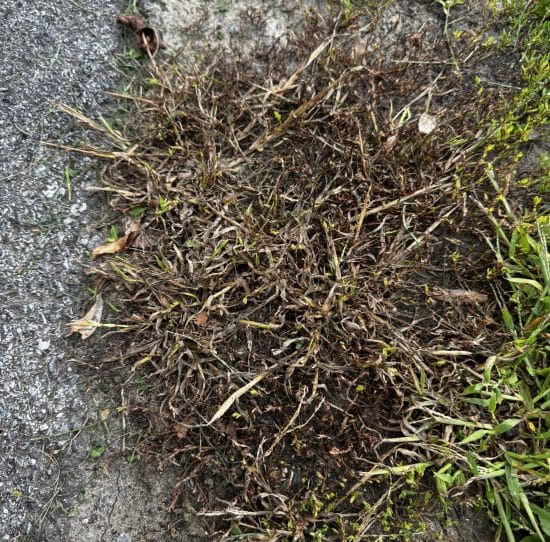
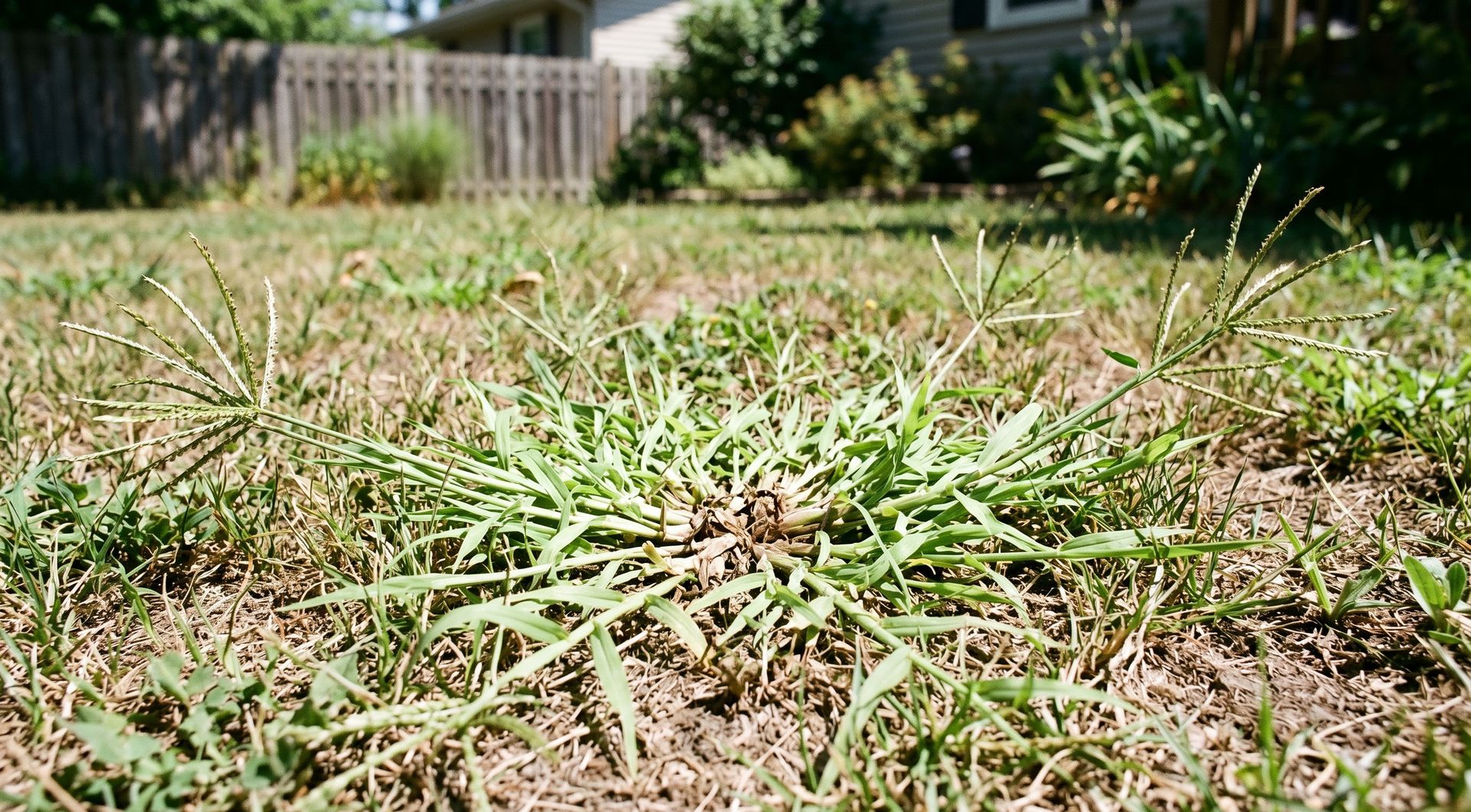
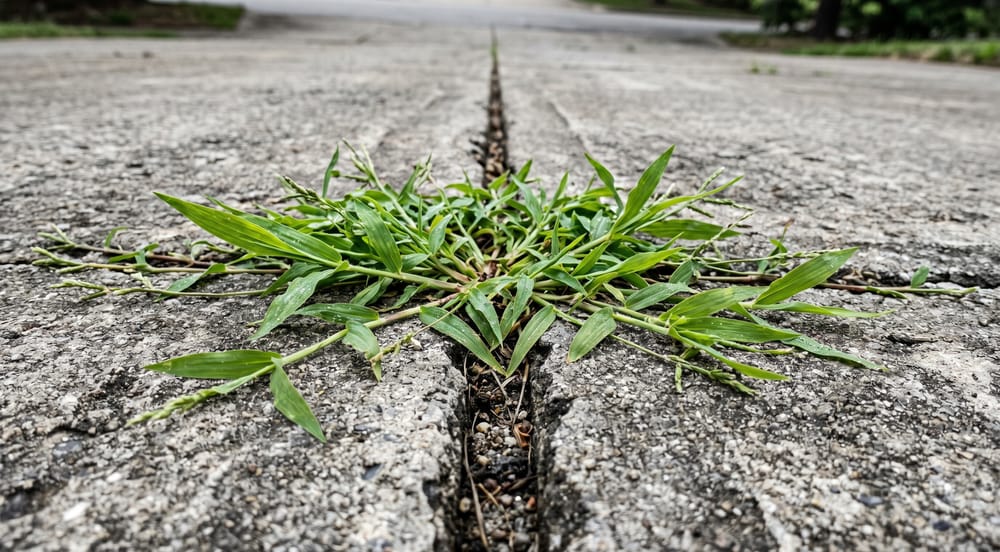
Before you do anything, confirm the suspect — because a large share of self-diagnosed "crabgrass" is a different weed entirely, and the right fix changes completely. Real crabgrass (Digitaria) grows low and flat in a star or wheel shape, spreading finger-like stems out from a central crown, with seed heads that split into several spikes like a tiny bird's foot. It loves hot, sunny, compacted edges — driveway strips, sidewalk seams, thin spots.
Here is why it matters: the lookalikes split into two camps, and only one of them is something we can help with.
| You think it's crabgrass, but… | What it might be | Can Salacia help? |
|---|---|---|
| Clumpy, coarse, upright bunches | Dallisgrass, tall fescue, quackgrass (other grasses) | No — grasses; prevention + renovation only |
| Triangular stem, lighter green, grows fast in heat | Nutsedge (a sedge) | No — see our nutsedge guide |
| Clover-like leaves with tiny yellow flowers | Oxalis (a broadleaf, constantly mistaken for crabgrass) | Yes — broadleaf, organically controllable |
| Low mat with small flowers / broad leaves | Clover, spurge, knotweed (broadleaves) | Yes — these are our wheelhouse |
If your "crabgrass" turns out to be oxalis, clover, or another broadleaf, stop reading the prevention section and jump to the weeds you can actually spot-kill organically — that is the good news. If it is genuinely a grass, prevention is your path. Not sure? Sal will tell you from a photo in seconds.
Why Prevention Is the Entire Game
Crabgrass is a summer annual. It germinates from seed in spring, grows all summer, and — per University of Minnesota Extension — drops its seed and dies at the first frost. There is no overwintering plant to kill. Next year's crabgrass is whatever seed germinates from the soil. That single fact reframes everything:
- One plant produces tens of thousands of seeds — commonly cited up to 150,000 — in a single season. Let a few plants set seed and you reload the soil for years (crabgrass seed stays viable about 3 years).
- Killing a mature plant in August is almost pointless — it has likely already seeded, and post-emergent control after midsummer is, per UMN, "ineffective."
- The leverage point is germination. Stop the seed from sprouting in spring, and you never have a summer problem to spray.
And the best germination-blocker is not a product. UConn Extension puts it bluntly: "A dense, healthy lawn kept at a height of 2½ to 3 inches is a better defense against crabgrass invasion than any herbicide." A thick canopy shades the soil, and crabgrass seed needs warm, sunlit soil to sprout. Deny it the light and it never starts.
The Organic Prevention System That Works
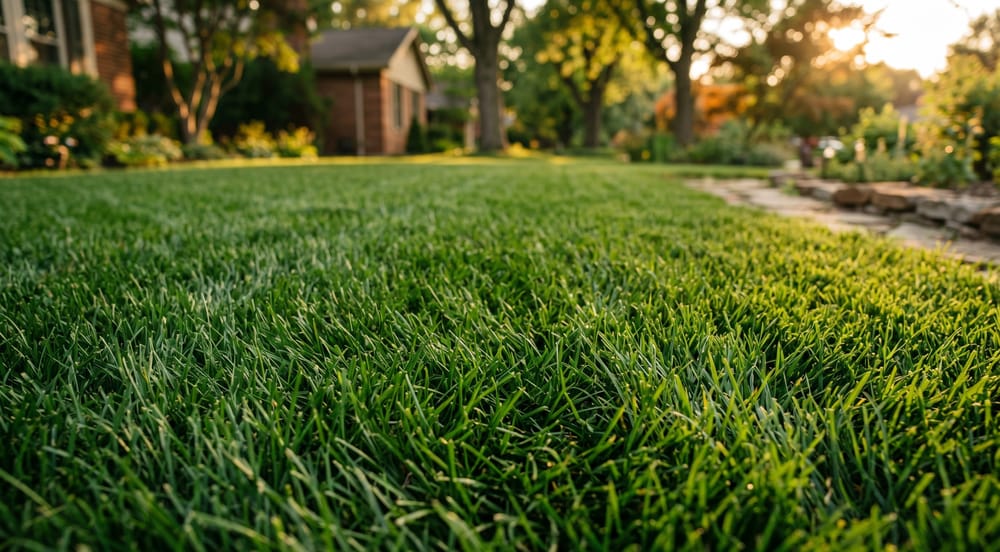
This is the whole strategy, in order of leverage. None of it requires a synthetic chemical, and the honest truth is that the cultural steps matter more than any product you could buy.
1. Mow high — 3 to 4 inches
The single highest-leverage move. Tall grass shades the soil surface so crabgrass seed can't get the light and warmth it needs to germinate. Mowing too short is one of the top causes of crabgrass (per University of Maryland). Raise the deck and leave it there all season.
2. Water deep and infrequent
Crabgrass has shallow roots and thrives on frequent, light watering that keeps the soil surface moist. Instead, water deeply (to a 6–8 inch depth) and less often — per UC IPM. This builds a deep-rooted, competitive turf and leaves the surface dry where crabgrass wants to sprout.
3. Overseed every bare and thin spot
Bare soil is an open invitation. Crabgrass colonizes the thin edges and scalped patches first. Overseed in fall (cool-season lawns) to close the canopy so there is no open, sunlit ground for seed to find.
4. Feed in fall, relieve compaction
Fertilize cool-season turf in fall, not summer (summer feeding favors crabgrass while your lawn is stressed). Core-aerate compacted soil — compaction produces the thin, weak turf crabgrass exploits.
5. Hand-pull young plants — before they seed
For small infestations, pull crabgrass while it's young and the soil is moist, getting the roots. The point is to remove the plant before it dumps tens of thousands of seeds. Pulling after seed-set won't stop next year's crop — but pulling early genuinely shrinks the seed bank.
Timing: The Soil-Temperature Window
If you use any pre-emergent (including the organic option below), timing is everything — and almost everyone gets it wrong by going off the calendar instead of the soil. Crabgrass germinates when soil temperature (not air) holds around 55°F for several consecutive days, measured about 2 inches down. Miss that window and a pre-emergent does nothing.
The classic free cue: when forsythia finishes blooming and redbud starts, your soil is warming toward the 55°F trigger — act before that, not after. Extensions (Iowa State, UConn, UMD) all use this phenology cue, but call it a rough guide — a $10 soil thermometer is more reliable. The main flush comes as soils climb toward 60–70°F.
The Southern Version: Crabgrass in St. Augustine, Bermuda, Centipede, and Zoysia Lawns
Everything above is true everywhere — but if your lawn is in Texas, Florida, Georgia, the Carolinas or anywhere else warm-season grasses rule, the numbers shift against you and the playbook needs three edits. Southern soils cross the 55°F germination trigger as early as mid-February near the coast and mid-March inland — the Clemson Extension warm-season maintenance calendar has homeowners acting a full two months before the northern timing charts — and those soils stay warm enough to keep sprouting new crabgrass flushes deep into summer. One prevention pass in April does not cover a southern season.
1. Split the prevention window
Where a northern lawn faces one spring germination flush, a southern lawn faces months of them. Warm-season extension calendars call for a second prevention pass 8 to 10 weeks after the first — that applies to whatever pre-emergent approach you use, including the corn gluten meal schedule below. One early pass, one follow-up, both timed to soil temperature rather than the calendar.
2. Mow at the top of YOUR grass’s range — not at 4 inches
The “mow 3–4 inches” rule above is written for northern fescue-type lawns. Warm-season grasses are built to run shorter: bermuda and zoysia are healthiest around 1–2 inches, centipede close to that, and St. Augustine is the tall one at roughly 3–4 inches for standard varieties. The principle doesn’t change — stay at the top of your species’ range so the canopy shades the soil — but chasing the 4-inch northern number on bermuda, or scalping St. Augustine short, both hand crabgrass exactly the hot, sunlit soil it needs.
3. Thicken by spreading, not overseeding
Fall overseeding is also a cool-season play. St. Augustine, bermuda, centipede and zoysia thicken sideways, from stolons and runners — so instead of scattering seed, feed and water them into closing their own gaps during their late-spring-through-summer growing season (near the opposite of the fall-feeding rhythm northern lawns follow), and patch dead areas with plugs or sod. A bare spot repaired in June is closed canopy by August — before fall crabgrass can exploit it.
One more honest southern note: several synthetic crabgrass herbicides sold nationally are not labeled for St. Augustine or centipede lawns at all, and using one anyway can injure the very turf you’re defending. Read any label against your grass species before it touches a warm-season lawn — or skip the gamble and let density do the work.
Corn Gluten Meal — The Honest Verdict
Corn gluten meal (CGM) is the organic pre-emergent every "natural lawn" page recommends. We are going to be straight with you about it, because almost nobody else is. CGM is a corn-milling byproduct whose peptides inhibit root formation in germinating seeds — applied at the right time, some seedlings sprout but fail to root.
The catch is in the data the salesy pages leave out:
- It's weak and slow. University consensus (Iowa State and others) is that CGM only reaches partial control (~50–60%) and usually needs 2–3 years of repeated application to get there. One rigorous Oregon State University trial found it gave no weed control at all over two years.
- The effective rate is heavy — and it's a fertilizer. You need about 20 lb per 1,000 sq ft for any weed suppression (most bags suggest less). At that rate it delivers ~2 lb of nitrogen — roughly double a normal feeding — so it fertilizes everything, including weeds already up.
- Rain ruins it. It needs a dry window after germination; any meaningful rain or irrigation lets the inhibited seedlings recover, erasing the effect.
Our honest position: CGM is a legitimate organic supporting tactic and a real fertilizer — but only behind strong cultural control. If your lawn is thin and you're counting on CGM alone, you'll be disappointed. Fix the density first; treat CGM as a bonus, not the plan.
The Vinegar-and-Salt Myth (Please Don't)
Search "kill crabgrass naturally" and you'll be told to mix vinegar, dish soap, and salt. Please don't do this to your lawn. Here's the honest mechanism:
Vinegar (acetic acid) is a non-selective contact burn — it scorches whatever green it touches, including your grass, and only damages the top of the crabgrass. The roots survive and it regrows.
Salt does real, lasting damage — it sterilizes the soil so nothing grows there for a long time, lawn included. It's the opposite of organic lawn care.
Boiling water works on a pavement crack, but in turf it kills your grass in the same pour and leaves a bare spot that — you guessed it — re-seeds crabgrass.
None of these is selective, and none kills crabgrass at the root. The genuinely organic answer is the cultural system above — and for crabgrass on bare ground, gravel, or pavement cracks (not in your lawn), a contact organic herbicide like Salacia at the non-selective rate will burn down young plants. Spot use only — it will take your grass with it if you spray it in the lawn. Then reseed the bare spot so it doesn't become next year's crabgrass nursery.
Ready to Take Back Your Lawn?
Salacia™ is the first OMRI-certified selective organic herbicide — kills weeds, not grass. Choose your lawn size:
The Good News: The Weeds You CAN Kill Organically
Here's the part no crabgrass page tells you, because it's the part that actually helps. Crabgrass almost never travels alone. The same thin, stressed, sunlit lawn that lets crabgrass in is full of broadleaf weeds — and those are a completely different story. Broadleaf weeds are exactly what a selective organic herbicide is built to kill, in your lawn, without harming the grass, and Pet Friendly.
So while you're building the thick turf that prevents crabgrass, clear the broadleaf weeds thinning it in the first place. These we genuinely crush:
- Clover and dandelions — the classic lawn pair, both broadleaf, both organically controllable
- Oxalis and the yellow-flowered crew (oxalis is the weed most often mistaken for crabgrass — and it's a broadleaf we can kill)
- Chickweed, bittercress, and the white-flowered weeds
- Creeping charlie and the purple-flowered weeds
Salacia is the first OMRI-certified selective organic herbicide — it kills broadleaf weeds in your lawn and leaves the grass standing. It won't touch your crabgrass, and we'll never pretend it will. But for everything broadleaf stealing space from your turf, it's exactly the tool — and a denser lawn is your best crabgrass prevention anyway. Not sure what you've got? Ask Sal.
Keep reading: weeds that look like grass but aren't.
Keep reading: spotted spurge, another flat-growing lawn invader.
Broadleaf weeds too?
Grassy invaders take the cultural route — but the broadleaf weeds sharing that lawn can be treated directly. See the best weed killer that won't kill grass for the selective option.

Lawn
Advisor
Not sure which weed you're looking at? Show Sal.
Sal is Lanaturo's lawn-care expert. He doesn't just name the weed — he builds your exact treatment plan and checks whether today is the right day to spray.
Ready to Take Back Your Lawn?
Salacia™ is the first OMRI-certified selective organic herbicide — kills weeds, not grass. Choose your lawn size:
The Honest Bottom Line
Crabgrass is a grass, so no organic spray can selectively remove it from your lawn — and the synthetic ones barely work. The real, free, durable fix is a thick lawn mowed tall, watered deep, and overseeded so the seed never gets the light to sprout. Treat the broadleaf weeds you actually can — that density is the whole prevention strategy. We'd rather tell you the truth and earn the lawn than sell you a bottle that can't deliver.
Salacia is an OMRI-certified selective organic herbicide for broadleaf weeds. It does not control crabgrass or other grasses in turf. For broadleaf weeds it is designed to be selective at the lawn rate; temporary paling of grass is possible — test a small area first.
Pet Friendly. OMRI certified. Honest about what it does — and doesn't.
This article is for informational purposes. Agronomic guidance references university cooperative-extension sources (UC IPM, UMN, UConn, Iowa State, University of Maryland, Illinois, and Clemson Extension). Always follow product label directions. Salacia is OMRI certified organic and labeled Pet Friendly.