
 By Pat Kelly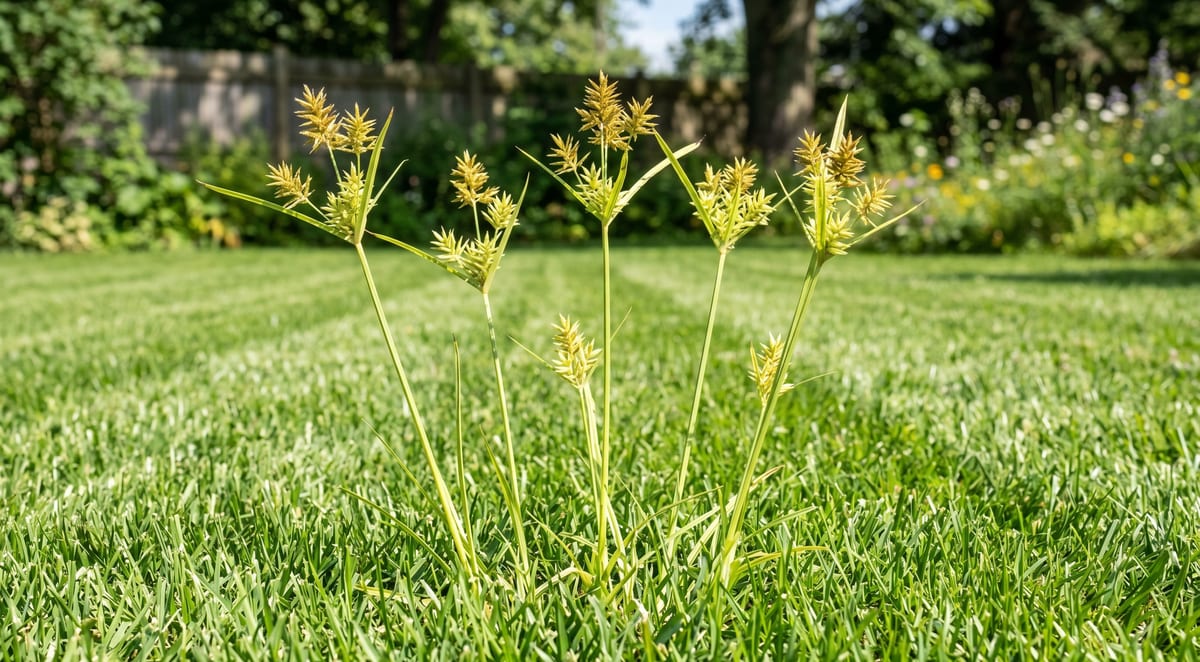
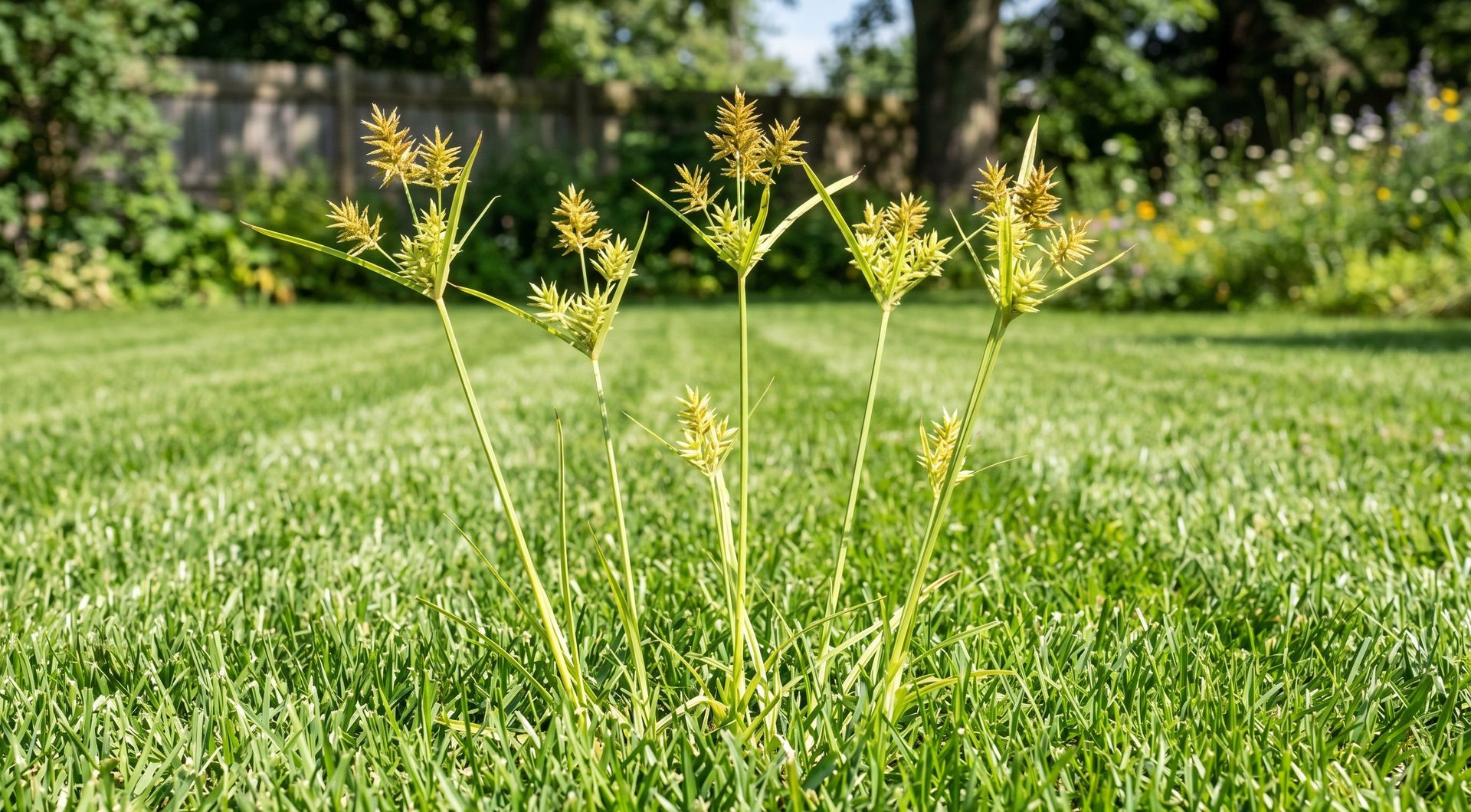
You mowed three days ago. This morning there are pale, yellow-green spikes standing a head taller than the rest of the lawn — like the grass grew overnight in just those spots. You sprayed your weed killer on them last week and nothing happened. You are not doing anything wrong. Your weed killer literally cannot kill this plant — and here's the biology nobody explains.
Nutsedge (you may know it as nutgrass) is not a grass. It is also not a broadleaf weed. It is a sedge — a third category of plant entirely, and that one fact explains every frustrating thing about it.
Every selective weed killer ever made works by sorting plants into two boxes: grass or broadleaf. It kills one and spares the other. A sedge slips between both boxes — so your dandelion-and-clover spray reads it as "neither" and does nothing.
That includes ours. Lanaturo makes an organic selective broadleaf herbicide, and we'll tell you straight: it will not kill your nutsedge. Anyone selling you a "weed killer" that promises to wipe out nutsedge is either selling a sedge-specific synthetic — or selling you a lie.
The good news: nutsedge is a symptom, not a disease. Fix what it's telling you about your lawn and you can actually make it stop — for good, organically. Here's how.
The honest short answer: Nutsedge is a sedge — no selective herbicide (organic or the one you own) can spot-kill it in a lawn, and even the synthetic sedge-specific sprays only suppress it. It thrives in wet, poorly drained, compacted, or over-watered soil — its presence is a drainage signal. The durable organic fix is to attack the cause: fix the drainage and watering, mow high to build dense turf, and dig young plants every 2–3 weeks before they form tubers to starve the underground bank. It is a multi-season campaign, not a one-spray cure.
Sure it's nutsedge?
Roll a stem between your fingers — if it has three edges, it's a sedge. Want certainty? Photograph it and send it to Sal, our free weed-ID assistant, right on this page. If it turns out to be a broadleaf weed, we've got a Pet Friendly organic answer for that one. See how Sal works →
The Third Category: Why Your Spray Fails
Plants in your lawn fall into three groups, and the difference is the whole story:
- Grasses — your turf, plus grassy weeds like crabgrass.
- Broadleaves — dandelion, clover, oxalis, chickweed. What a selective herbicide is built to kill.
- Sedges — nutsedge. A separate botanical family (Cyperus) that is neither of the above.
A selective broadleaf herbicide — including Salacia — is engineered to recognize broadleaf chemistry and act on it. A sedge doesn't have that chemistry, so the product reads it as off-target and walks right past it. This isn't a weakness in the product; it's physics. The only herbicides that selectively control nutsedge in turf are synthetic sedge-specific actives (halosulfuron, sulfentrazone, and similar) — and even those, per UC IPM, only work on young plants and otherwise "kill only the aboveground portion, leaving the tubers unaffected." We don't sell or recommend them. We sell honesty and a plan that addresses the cause.
How to Identify Nutsedge (Sedges Have Edges)
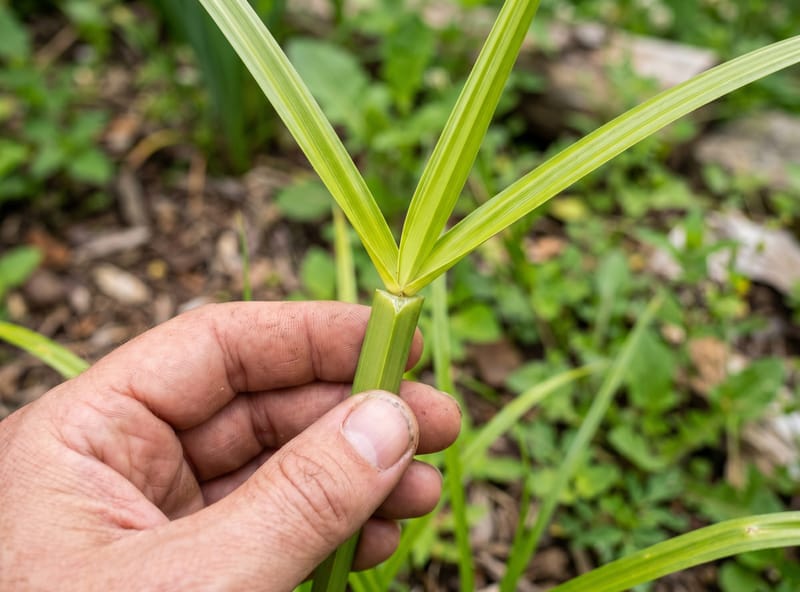
The fastest, most reliable test is the stem. Pluck a stalk and roll it between your fingers:
- Triangular, solid stem. "Sedges have edges" — you'll feel three distinct sides. Grass stems are round and hollow. This one test settles it.
- Leaves in sets of three at the base (grasses are two-ranked), thick, stiff, and waxy/shiny.
- Lighter yellow-green than your turf, and it grows visibly faster — that's why it shoots up above the lawn within days of mowing, especially in summer heat.
Two species cause most lawn trouble. Yellow nutsedge (Cyperus esculentus) grows ~12–16 in tall with light-brown seedheads. Purple nutsedge (Cyperus rotundus) stays under ~6 in with a reddish tinge — and is even harder, because its tubers grow in chains.
The Tuber: Why Pulling Makes It Worse
Here is the engine of your frustration. Nutsedge reproduces mainly from small underground tubers called "nutlets" — and they are built to survive everything you throw at the top of the plant.
- One plant spawns hundreds to thousands of tubers in a season. Each can resprout multiple times (UC IPM: more than 3; Purdue: up to 10–12).
- Tubers survive in soil for years — 1–3 years for most, longer for some — and they don't all wake at once, so a single weeding never clears them.
- Pulling a mature plant snaps off the top and leaves the tubers behind — they immediately resprout, and yanking can scatter nutlets to start new plants. This is why "I pull it and it comes back worse" is the universal nutsedge experience.
The one number that wins the war: a tuber spends about 60% of its energy reserve to grow its first plant and 20% on the second. So if you remove young shoots before they rebuild and form new tubers — every 2–3 weeks — you drain the bank faster than it refills. Persistence is literally starvation warfare. That's the organic mechanism that actually works.
Nutsedge Is a Symptom, Not a Disease
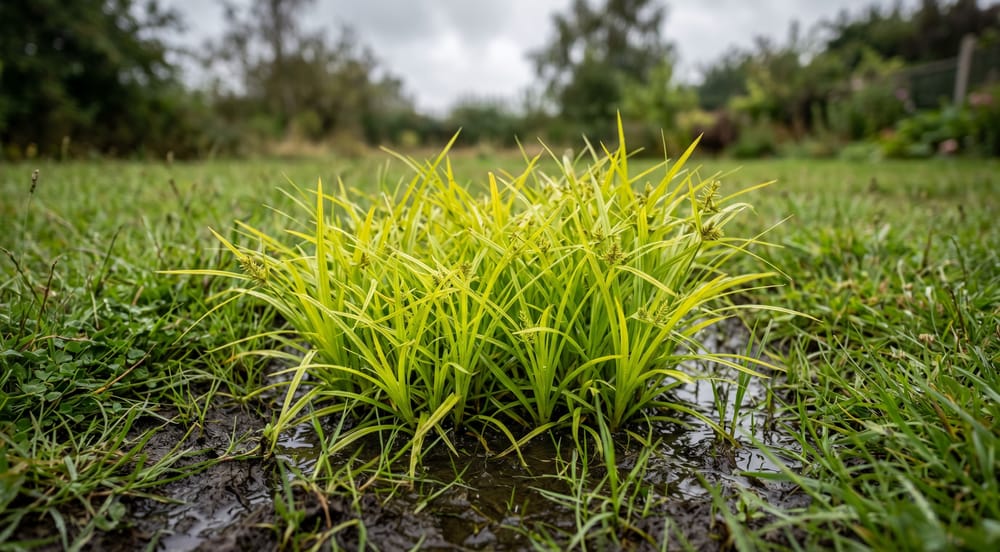
This is the part the chemical brands will never tell you, because it doesn't sell a bottle. Nutsedge doesn't invade healthy, well-drained lawns at random — it colonizes wet ground. Every extension says the same thing: its presence "often indicates that drainage is poor, irrigation is too frequent, or sprinklers are leaky" (UC IPM). It's a tattletale for a water problem.
Which means a synthetic spray is a snooze button. It burns down the blade you can see, the soggy soil stays soggy, and the tubers push new shoots by July — every single year. That's why the retail pages tell you to "re-treat all summer, every summer." Fix the water, and you remove the reason nutsedge is winning. That's the only thing that makes it stop coming back — and it happens to be exactly what an organic, soil-first approach is built around.
The Honest Organic Battle Plan
In order of leverage. None of it is a quick fix — and we won't pretend otherwise — but it's the only approach that ends nutsedge instead of renting it a room.
1. Fix the water first (the root cause)
Correct drainage, fix leaky or over-throwing sprinklers, divert standing water, and switch to deep, infrequent, as-needed watering instead of light daily cycles. Core-aerate compacted soil that holds water. This attacks the cause, not the symptom — and it's the highest-leverage move you can make.
2. Dig young plants every 2–3 weeks
The core organic tactic. Dig (don't yank) young plants with a trowel while they have fewer than ~5 leaves — go deep (8–14 in) to lift the basal bulb. Repeat every 2–3 weeks through summer. You're not trying to win in one pass; you're starving the tuber bank by never letting it rebuild reserves.
3. Mow high, grow dense turf
Keep the mower at its highest setting and build a thick, vigorous stand of grass. Nutsedge is favored by short mowing and thin turf; a dense canopy shades the soil and crowds it out. (A thick lawn is the same thing that prevents crabgrass — see our organic crabgrass guide.)
4. Smother bare patches and beds
In beds, water-permeable landscape fabric (rated — thin plastic gets pierced) blocks light. On bare or fallow ground, cultivate to bring tubers to the surface, then withhold water and let the sun desiccate them; clear-plastic solarization in peak summer adds heat-kill.
Honest timeline: nutsedge is one of the hardest weeds in any lawn. There is no one-and-done organic fix — and no honest chemical one either. Expect a 2-season suppression campaign. The organic advantage is that you fix the drainage cause instead of masking it; the cost is patience and a trowel.
The Southern Version: Purple Nutsedge and Warm-Season Lawns
If your lawn is St. Augustine, bermuda, centipede or zoysia — Texas through the Carolinas and down into Florida — nutsedge plays the same game with two southern twists: the season never lets up, and you are probably fighting the meaner species.
Meet purple nutsedge — the southern one
Up north the fight is mostly yellow nutsedge. In southern lawns, purple nutsedge (Cyperus rotundus) joins in and often dominates. Per the Clemson Extension nutsedge factsheet: darker green leaves that end in an abrupt point (yellow’s taper gradually to a sharp tip), reddish-purple seedheads instead of golden, shorter stature — and tubers strung along the rhizomes in chains, like beads, where yellow grows a single tuber per rhizome tip. The chains are why purple is the harder enemy: dig a plant and any bead left behind restarts the colony. The starvation math from the tuber section still wins — it just demands more repetitions.
The season is longer — stretch the campaign, not the spacing
Southern soil stays warm for most of the year and summer irrigation keeps it moist, so sedges push new shoots from spring deep into fall. Keep the same 2–3-week digging rhythm, but plan on running it well past the point a northern calendar would let you quit — stopping in August in Georgia hands the tuber bank exactly the recovery window it was waiting for.
Southern watering habits are the #1 invitation
Frequent, short irrigation cycles — the default setting on many southern systems — keep the top inch of soil permanently damp, which is precisely the environment sedges colonize. Deep, infrequent watering is even more decisive in warm-season lawns than in northern ones. And density still counts: St. Augustine mowed at the top of its range (about 3–4 inches for standard varieties) shades and crowds sedge seedlings the same way it fights crabgrass.
One honest southern note on the synthetic route: the sedge-specific actives are labeled for warm-season lawns like St. Augustine, centipede, bermuda and zoysia — but the biology does not change. They suppress top growth and leave the tubers to resprout, which is why the retail re-treat cycle never ends. The drainage-and-digging plan above is the same in Mobile as in Minneapolis; the South just runs more laps of it.
What Does NOT Work (Myth-Busting)
Vinegar / horticultural acid: burns the green blade, the tuber shrugs and resprouts. Non-selective, so it scorches your lawn too. No.
Pulling mature plants: leaves every tuber in the ground and can scatter nutlets — actively spreads it. Only digging young plants (before tubers form) helps.
Corn gluten / molasses / sugar: corn gluten is a pre-emergent that does nothing to an established tuber; sugar and molasses are internet folklore with no mechanism against a tuber bank.
One application of anything: tubers don't all wake at once and resprout multiple times. Single treatments — organic or synthetic — never clear it.
Where a non-selective organic herbicide like Salacia legitimately helps: spot-treating nutsedge on bare ground, gravel, paths, or pavement cracks — never in turf, where it kills the lawn too. And be honest with yourself even there: a contact organic burns down top growth only; the tubers survive and resprout, so it's a supporting tactic alongside drainage + repeat digging, not a cure. If you do go that route, Salacia is a granular weed killer you mix to the non-selective rate for those hard-surface spots.
Ready to Take Back Your Lawn?
Salacia™ is the first OMRI-certified selective organic herbicide — kills weeds, not grass. Choose your lawn size:
The Good News: The Weeds You CAN Kill Organically
Here's where that grass-vs-broadleaf biology finally works for you. The same chemistry that can't touch a sedge is exactly what cleanly kills broadleaf weeds in your lawn — without harming the grass, and Pet Friendly. Nutsedge rarely comes alone; the broadleaf weeds in the same lawn are very much in scope:
- Clover and dandelions
- Oxalis and the yellow-flowered weeds
- Chickweed, bittercress, and the white-flowered weeds
- Creeping charlie and the purple-flowered weeds
Salacia is the first OMRI-certified selective organic herbicide. It can't kill your nutsedge — no selective product can, and we'll always tell you that — but for every broadleaf weed stealing space in your lawn, it's exactly the tool, and the dense turf you build to crowd out nutsedge starts with clearing those. Not sure what you've got? Ask Sal.
Keep reading: how to tell grass-like weeds apart.
Broadleaf weeds too?
Grassy invaders take the cultural route — but the broadleaf weeds sharing that lawn can be treated directly. See the best weed killer that won't kill grass for the selective option.

Lawn
Advisor
Not sure which weed you're looking at? Show Sal.
Sal is Lanaturo's lawn-care expert. He doesn't just name the weed — he builds your exact treatment plan and checks whether today is the right day to spray.
Ready to Take Back Your Lawn?
Salacia™ is the first OMRI-certified selective organic herbicide — kills weeds, not grass. Choose your lawn size:
The Honest Bottom Line
Nutsedge is a sedge — a third category that slips past every selective weed killer, ours included. No spray ends it; the synthetic ones just hit snooze. It's a symptom of a wet, compacted lawn, so the cure is to fix the water, build dense turf, and dig the young plants out every few weeks until the tubers starve. It's slow, honest, organic work — and it's the only thing that makes nutsedge actually stop.
Salacia is an OMRI-certified selective organic herbicide for broadleaf weeds. It does not control nutsedge or other sedges in turf. For broadleaf weeds it is designed to be selective at the lawn rate; temporary paling of grass is possible — test a small area first.
Pet Friendly. OMRI certified. Honest about what it does — and doesn't.
This article is for informational purposes. Agronomic guidance references university cooperative-extension sources (UC IPM, Penn State, Purdue, Clemson, Iowa State, University of Maryland). Always follow product label directions. Salacia is OMRI certified organic and labeled Pet Friendly.