
 By Pat Kelly
 Read any fall lawn guide and you will be told two things. Fall is the best time to overseed. Fall is also the best time to kill perennial broadleaf weeds, because they are pulling everything they have down into their roots for winter.
Both of those are true. Nobody ever mentions that they want the same three weeks, and that in the usual way of doing things, choosing one costs you the other.
The short answer: kill the weeds first. Treating first means the seed lands in ground that has been cleared of competition, and it means you are not trying to spray a lawn full of seedlings a month later. The reason most people believe they cannot do it in that order is a waiting period — and whether that waiting period exists at all depends entirely on which kind of product is in the sprayer.
In this guide
- The collision nobody draws
- Why "wait 3 to 4 weeks" is not a chemistry rule
- The two mechanisms, side by side
- How long after weed killer can you plant grass seed?
- Spot treat and you keep both options
- Should you aerate before or after killing weeds?
- How long after weed killer can you fertilize?
- Can you spray weeds in new grass?
- The failure you never find out about
- Which of these does your lawn actually need?
The collision nobody draws
Put the two calendars on top of each other and the problem appears immediately.
Suppose you seed in the first week of September, which is what most guides recommend. Germination takes roughly one to three weeks, depending on the species. First mowing lands around the start of October.
Now the arithmetic turns on you. Young grass needs two to three mowings before it is established enough to take a weed treatment — an interval that is consistent across university extension guidance, and that is measured in mowings rather than dates because what matters is how strong the seedling is, not what the calendar says. Two or three mowings on grass that is winding down for the year carries you into late October, often November. By then the perennial weeds have stopped moving sugars down to their roots. The window is shut.
The consequence, stated plainly: if you seed first in September, you may have spent the best weed-control window of the entire year on grass seed — and the next comparable one is roughly ten months away. The dandelion you were going to deal with is still there, taproot intact, and it will be the first thing out of the ground in March.
This is the trade-off that the checklist format hides. Every fall guide presents five jobs as five things to complete. None of them mention that two of the five are competing for the same weeks.
Why "wait 3 to 4 weeks" is not a chemistry rule
Almost everyone believes there is a mandatory waiting period between treating weeds and putting down seed. Look for the actual number and something strange happens: it will not hold still.
Across mainstream sources and product labels, the interval given for the same broad chemistry ranges from one week to twelve weeks. That is a twelvefold spread for the same decision. A number that varies that much between sources is not a measured value being reported — it is a number being copied from one page to the next.
What the research actually found. Turfgrass researchers at Kansas State University tested seeding intervals directly and found that seeding tall fescue zero to fourteen days after application of several common broadleaf treatments was safe. Their own conclusion notes that some labels call for a longer interval than their results showed was necessary.
That does not mean anyone should ignore a label — the label is the legal instruction for that product and it governs. It means the folk number floating around the internet is not a property of chemistry, and the real reason labels disagree with each other is something more specific.
The two mechanisms, side by side
There are two completely different reasons a product might tell you to wait, and mixing them up is what produced the twelvefold spread. Almost no consumer page separates them.
| Products that stay active in the soil | Products that work on contact | |
|---|---|---|
| What the wait is protecting | The seed itself. Residual activity in the soil suppresses germination — it cannot tell a grass seedling from a weed seedling. | Nothing, before seeding. There is no residual in the soil for a seed to germinate into. |
| When the restriction applies | Before you seed, and it can be long — this is where the multi-week and multi-month intervals come from. | After you seed, because a young seedling is more sensitive than established turf. |
| What decides the length | How long the active remains in the soil. This is a property of the product, and only the label can tell you. | How established the seedling is — measured in mowings, not weeks. |
| Where Salacia sits | — | Contact. It works on what the spray touches and does not persist in the soil to block new plants. |
Salacia is the first OMRI-certified selective organic herbicide, made by Lanaturo. It is naturally derived, it is Pet Friendly, and it kills on contact through rapid osmotic dehydration rather than being absorbed and carried through the plant. That mechanism is why the left-hand column simply does not describe it — and it is also why coverage, not strength, decides the outcome with this product: a weed the spray never physically reached is a weed that was never treated at all, which is far and away the most common reason an application disappoints someone.
At the selective rate it targets broadleaf weeds while being designed to spare grass, though temporary paling or yellowing of the surrounding turf is possible and recovers. Always test a small area of your lawn first.
Ready to Take Back Your Lawn?
Salacia™ is the first OMRI-certified selective organic herbicide — kills weeds, not grass. Choose your lawn size:
How long after weed killer can you plant grass seed?
With Salacia, reseeding the same day is possible. It works on contact and does not persist in the soil to block new plants, so there is no residual interval to sit through. In practice it is usually easier to wait the few days until the treated weeds have visibly died back, because seed makes better contact with soil once the dead material is out of the way. That is a convenience, not a required waiting period.
If you are using something else, the answer is on that product's label and you should follow it. The point of this section is not that waiting is always wrong — it is that the waiting period belongs to the product, not to the job. People carry a number from one product to a completely different one and lose a season to it.
Spot treat and you keep both options
Here is the move that almost no lawn guide mentions, and it dissolves the collision entirely for most lawns.
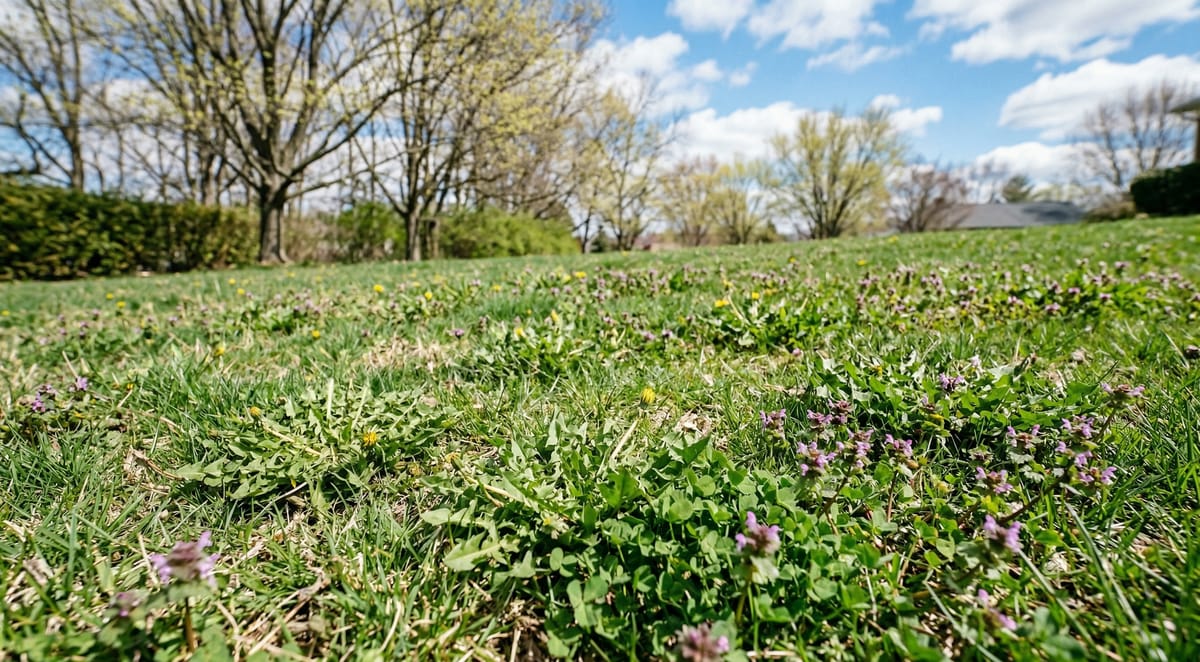
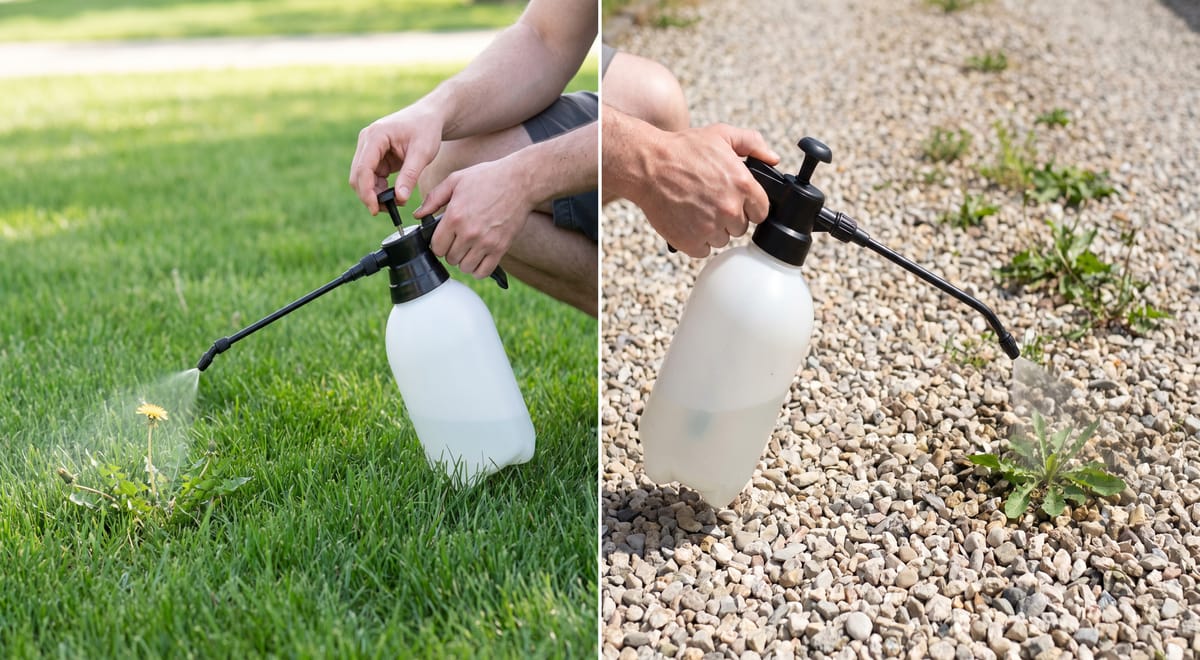
A waiting period applies to the ground you actually treated. Nowhere else. Thirty dandelions scattered through a lawn, spot-treated one at a time, might add up to three percent of the surface — and the other ninety-seven percent was never sprayed, so nothing restricts it.
Nearly every guide skips this, because nearly every guide treats weed control as a single whole-lawn event and then applies the whole-lawn waiting period to a job that never needed one. Scattered weeds do not require that. Spot-treat them and both jobs fit the same window, whatever is in your sprayer.
Should you aerate before or after killing weeds?
After. Aerating a lawn that still has live weeds in it pulls hundreds of plugs of open soil out from underneath plants that are actively dropping seed — which is very close to the ideal conditions for establishing more weeds. Treat first, give the weeds a few days to collapse, then aerate or dethatch. The dead material tills in fine and becomes part of the soil rather than something to rake out.
When people guess at this sequence, they reliably guess it backwards — the instinct is to open the soil first so the treatment can get down into it. That instinct comes from thinking of a weed killer as something that has to reach the roots through the ground. A contact treatment works on the plant it touches, so opening the soil first buys you nothing and costs you the seedbed.
How long after weed killer can you fertilize?
Three to seven days after the application, and never on the same day. Feeding the lawn the same day you treat it means a share of that fertilizer goes into weeds that are still alive to take it up. Waiting a few days puts the food into grass that is about to have the ground to itself. Keep them as separate passes on separate days.
One thing in the sprayer. Salacia and water. Do not add fertilizer or another product to the tank — feeding is its own pass, on its own day.
We do not make grass seed or fertilizer, and we will not point you at a particular brand of either. Choose what suits your region and the grass you already have. What we can speak to with confidence is the sequencing, because that is the part that interacts with the weed treatment.
Can you spray weeds in new grass?
New grass is more sensitive than established turf. That does not mean you are locked out, and it does not mean there is a fixed number of weeks to count — the label sets none.
The approach is precision rather than patience. Test-spray a small area first, watch how it responds, then spot-treat the individual weeds instead of blanket-spraying a lawn full of seedlings. Treat what is actually there, carefully. Always test a small area of your lawn before any full application, new grass or not.
The failure you never find out about
Most guides describe the downside of getting this wrong as "poor results." That undersells one specific failure badly enough to be worth its own section.
When young seedlings take a treatment before they are established, the common outcome is not death. It is distortion. Growth comes in twisted, cupped, stunted; the stand thins; nothing dies dramatically enough to look like a failure — and so you never find out that this is what happened. You blame the seed. Or the soil. Then you reseed next year, into exactly the same mistake.
That is the real argument for treating first and seeding after. Not that the other order is forbidden — plenty of people get away with it. It is that when the other order fails, it fails quietly, and a quiet failure teaches you nothing.
Which of these does your lawn actually need?
Every fall guide hands you the same five jobs as a checklist to complete. Most lawns do not need all five, and doing an unnecessary one in the wrong order costs you a job you did need. Work through it instead of working down it.
Not sure what you are actually looking at? The plan changes completely depending on the answer. A broadleaf weed and a grassy weed in the same lawn call for different treatments, and some grassy weeds cannot be removed selectively from a living lawn at all. Sal will identify it from a photo and tell you which one you have — including when the honest answer is that we are not the right tool for it.
Every weed in our database has a card in the weed control guide, including the ones we cannot control.
Doing it in order
Mow first. Same day is fine. It gets the spray to the plant instead of the top of the grass.
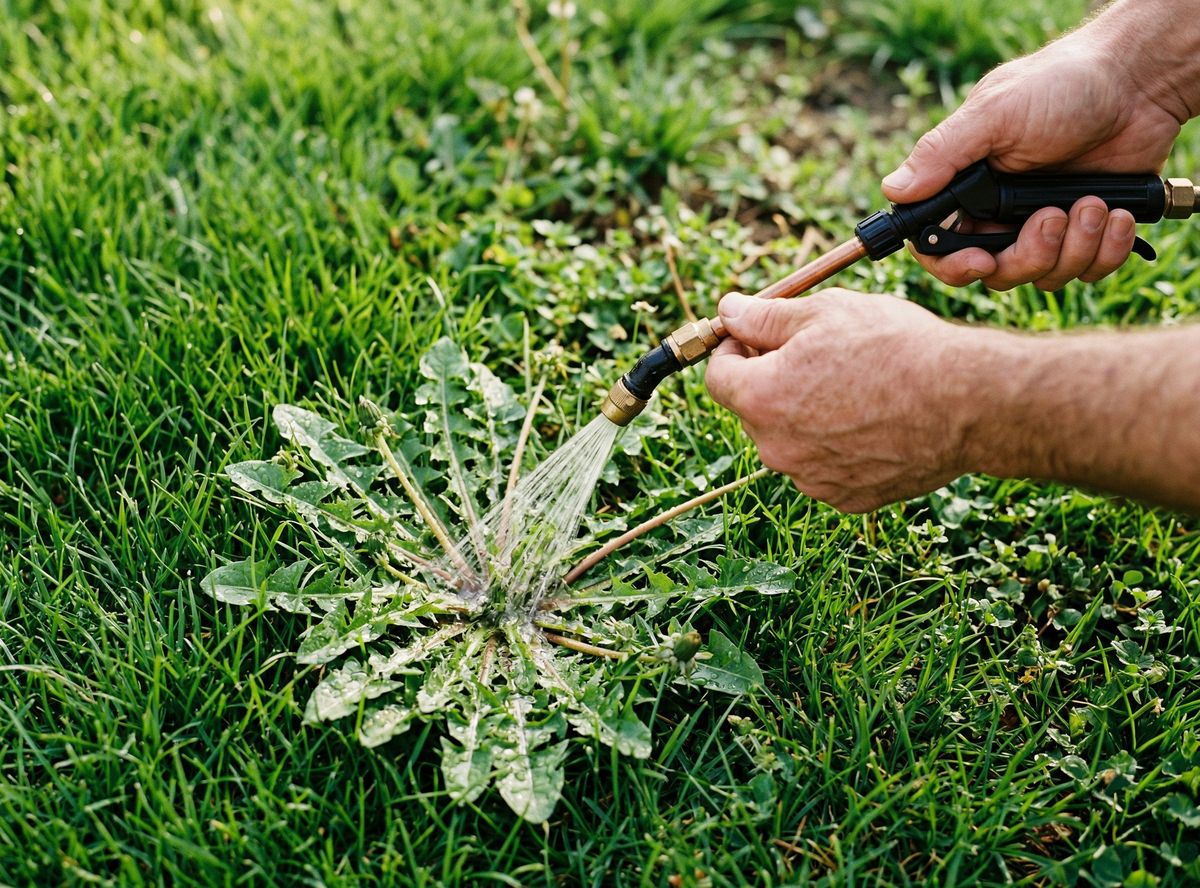
Treat. Early morning or late afternoon rather than midday heat, on a lawn that is healthy and watered rather than drought-stressed. Salacia at the selective lawn rate of 1 lb (about 3 cups) per gallon, drenched to runoff — foliage, stems, and the ring of soil at the base. Always test a small area first. For ground you intend to strip and start over, the non-selective rate is 1.5 lb (about 4 cups) per gallon and it clears what it drenches, grass included. That is the ceiling; there is no stronger third mix. A stubborn weed needs better coverage and a repeat pass, never a heavier scoop.
Keep water off it for 24 hours, and check the forecast first — the label sets a four-hour minimum before rain.
Wait a few days for the weeds to collapse. Then aerate or dethatch, if step 3 above said you needed to.
Seed, then feed three to seven days after the treatment. Mow again once the application has dried fully; the next regular mowing day is fine.
The part that actually ends the cycle
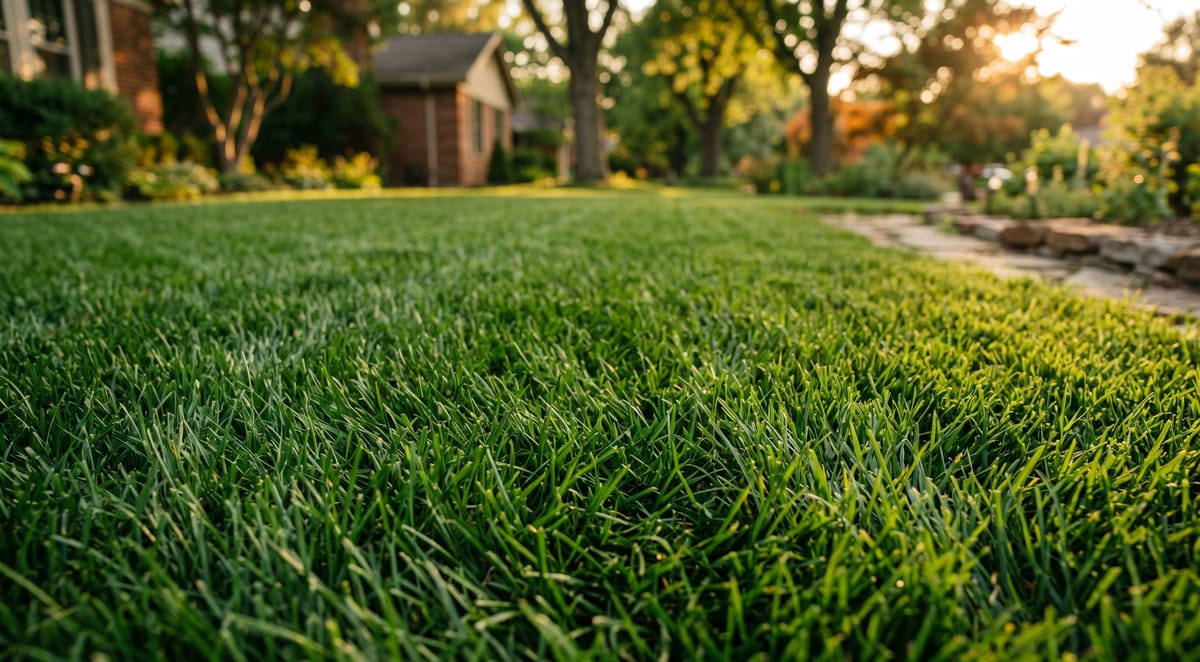
Weeds arrive where there is room for them. That is the whole mechanism — bare ground is an opening, and something will take it. Which means the thin patches are the problem and the weeds are usually the symptom, and it explains why the same lawn grows the same weeds every year no matter what gets sprayed on it.
Doing fall in the right order is how you stop treating the symptom. Clear the competition, then close the ground behind it, and next spring has less to work with. That is also why the sequence matters more than any single product decision in it.
The whole thing, in one breath
Weeds first, always. Spot-treat if they are scattered and the collision never happens. Wait a few days for them to collapse, aerate only if the soil told you to, seed — with Salacia you are not waiting weeks on our account — and feed three to seven days after treating. The ranked look at treatments that spare grass is in our guide to weed killers that won't kill grass, the timing of the application itself is in our guide to when to spray, and the year-round version lives in the full weed control guide.
Ready to Take Back Your Lawn?
Salacia™ is the first OMRI-certified selective organic herbicide — kills weeds, not grass. Choose your lawn size:
You Do Not Have to Pick One
The choice between clearing weeds and growing grass this fall was never a real choice. It came from a waiting period that belongs to a different kind of product — and once that is off the table, both jobs fit in the same season.
OMRI certified organic · Pet Friendly · Always test a small area first
Clear it, then close it.

Lawn
Advisor
Not sure which weed you're looking at? Show Sal.
Sal is Lanaturo's lawn-care expert. He doesn't just name the weed — he builds your exact treatment plan and checks whether today is the right day to spray.
This article is for informational purposes. Agronomic references: Kansas State University Turf & Landscape — Seeding After Herbicide Application and Penn State Extension — Lawn Management Through the Seasons. Always follow product label directions for application rates, timing, and use; where a label and any guidance differ, the label governs.