
 By Pat Kelly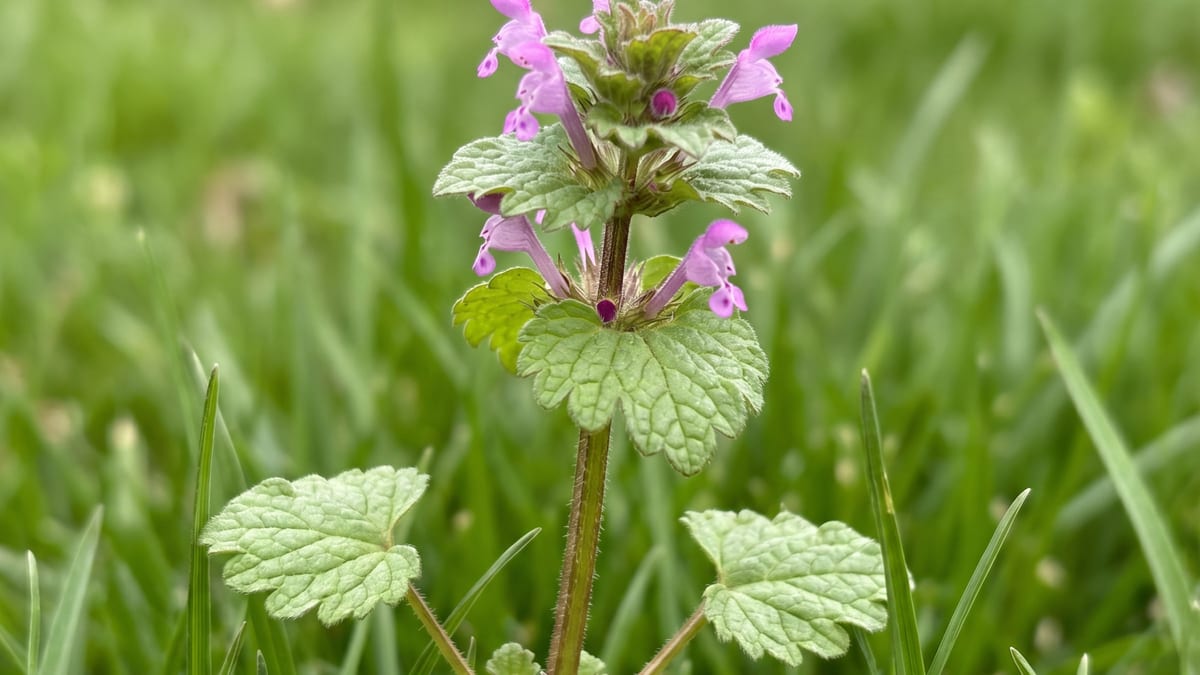
The purple weed you'll curse in April is germinating right now, in fall — while your lawn goes quiet and nobody is watching. That timing mismatch is exactly why henbit keeps winning, and exactly how you beat it. Henbit is a winter annual: it sprouts when fall soil cools, hides low through winter, then bolts upright and blooms pink-purple before most people have touched their lawn gear. By the time it's visible enough to annoy you, it's days away from dropping up to 2,000 seeds per plant.
The short answer: Henbit is a broadleaf winter annual, so a selective treatment kills it without taking your lawn with it. Mix Salacia at the selective lawn rate — 1 lb (about 3 cups) per gallon of water — and drench every plant to runoff: foliage, square stems, the low leaves hiding near the soil, and the soil ring at the base. Treat in fall as seedlings emerge or in early spring before flowers open, and the seed cycle breaks. Grass paling is possible, so always test a small area first.
Not sure it's henbit?
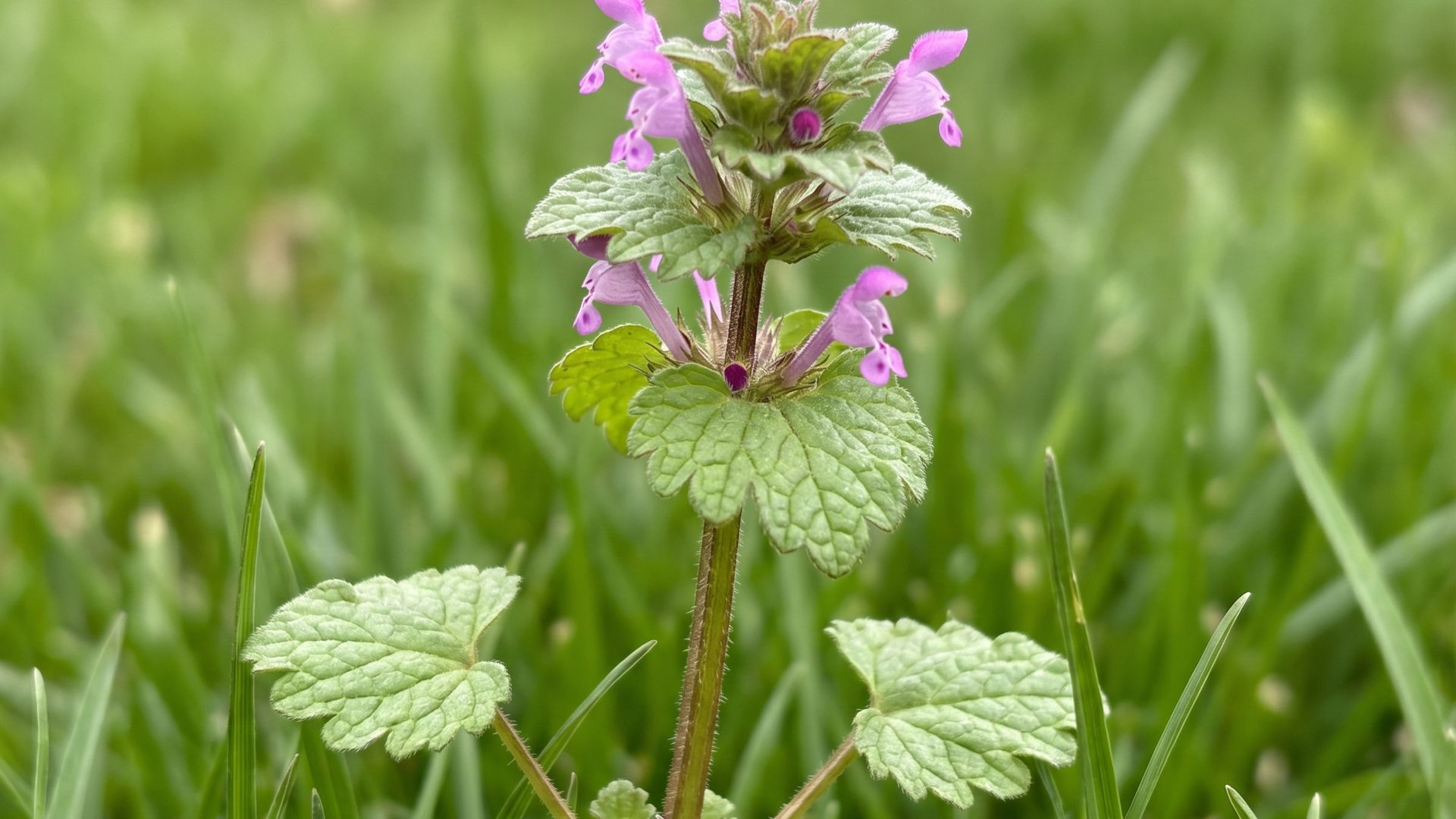
Square stems, rounded scalloped leaves that clasp the stem, pink-purple tubular flowers stacked near the top — that's henbit. Triangular leaves with reddish-purple tops? That's its cousin, purple deadnettle. If you'd rather not squint at stems, snap a photo and send it to Sal, our free weed-ID assistant, right on this page. See how Sal works →
Know Your Enemy: Henbit ID in 30 Seconds
Henbit (Lamium amplexicaule) is a member of the mint family, and it carries the family badge: square stems. Roll a stem between your fingers and you'll feel four flat sides. It grows upright, 6 to 12 inches tall, with rounded, deeply veined, scalloped leaves — the upper ones wrap directly around the stem with no stalk, which is where the "amplexicaule" (stem-clasping) in its name comes from. In late winter and early spring it tops itself with clusters of pink-purple tubular flowers. The common name is honest, too: chickens love pecking at it — hence "hen bit."
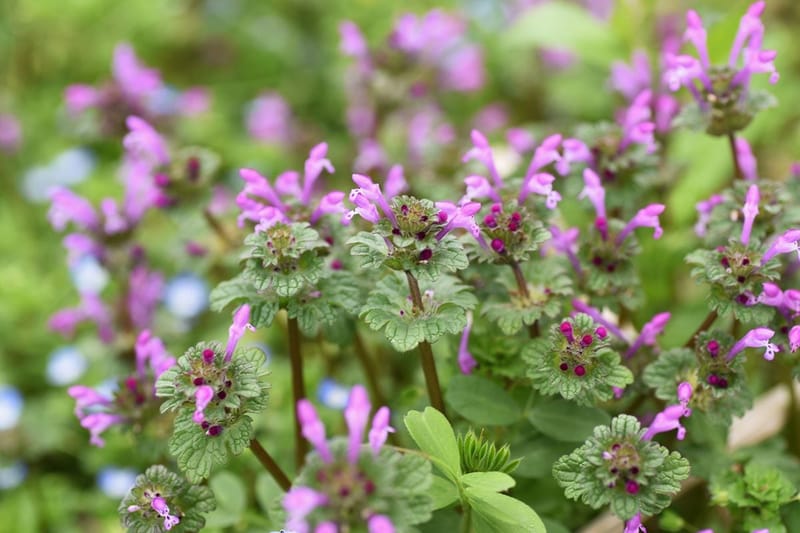
- Square stems, upright growth, 6–12 inches tall
- Rounded scalloped leaves — upper leaves clasp the stem directly, lower leaves have stalks
- Pink-purple tubular flowers clustered near the top of the stem
- Winter annual — appears in fall, blooms in early spring, dies by summer
- Favors thin, bare, disturbed lawn areas — it shows up where the turf is weakest
Its closest lookalike is purple deadnettle, another square-stemmed mint cousin — deadnettle's leaves are triangular and its upper leaves blush reddish-purple. The good news: both are broadleaf winter annuals, and the treatment below handles either one. If your lawn hosts several purple suspects, our visual guide to the four purple lawn weeds sorts them out side by side. Botanical references: UMass Amherst Extension and the NC State Extension plant profile.
The Henbit Calendar (and the Two Kill Windows)
Most weeds are summer enemies. Henbit runs the opposite schedule — and once you see its year laid out, the whole strategy writes itself.
One year in the life of a henbit plant
September–October: Seeds germinate as soil cools. Tiny rosettes tuck into thin and bare spots — nearly invisible in a fading lawn.
November–February: It sits low, green, and patient, quietly building roots on mild days. In southern lawns it grows visibly all winter while warm-season grass sleeps.
February–April: It bolts upright and blooms pink-purple. In the Southeast this show starts as early as February.
April–May: Seed drop — up to 2,000 seeds per plant — and then it dies on its own, mission accomplished.
Summer: No henbit anywhere. The seeds wait underground for fall.
That calendar gives you exactly two smart moments to strike. Window one is fall — the seedlings are small, tender, and easiest to kill, and it's the same window you'd overseed anyway. Window two is late winter to early spring, before flowers open — kill it before seed set and next year's invasion never gets funded. Spraying in May mostly kills a plant that was already dying; by then, the seeds have won. This is the single most common henbit mistake, and our timing guide covers the same logic for every weed on your list.
How to Kill Henbit Without Killing Your Grass
Henbit is a broadleaf weed growing in the middle of grass — which is precisely the situation selective treatment was made for.
1. Mix the selective rate
Stir 1 lb (about 3 cups) of Salacia — the first OMRI-certified selective organic herbicide, made by Lanaturo — into one gallon of water until dissolved. The selective rate targets broadleaf weeds like henbit while it is designed to spare your grass.
2. Drench, don't mist
Henbit works by dehydration on contact, and so does its cure: Salacia kills through rapid osmotic dehydration, which means if the product doesn't touch it, it doesn't kill it. Spray every plant to the point of runoff — all foliage, the square stems, the low leaves hiding near the soil, and the soil ring around the base. Henbit grows in dense patches; don't just wave the sprayer over the tops. Get under the canopy.
3. Pick your window
Fall, as new seedlings appear, or early spring before flowering — those are the two moments the calendar above hands you. Aim for a calm morning with temperatures between 60 and 80 degrees Fahrenheit and no rain in the near forecast, so the spray stays where you put it.
4. Know what regrowth means
One good drenching application kills what it touches. If green shoots appear in the patch one to three weeks later, that is almost always new germination from the seed bank, not the same plant recovering — spot-treat the newcomers. Because henbit is an annual, every plant you kill before seed set is a permanent subtraction: stop the seeds and the population collapses on its own.
Temporary paling or yellowing of grass is possible depending on rate, lawn health, and conditions — always test a small area of lawn first before full application. For henbit in driveways, gravel, and beds — anywhere grass doesn't matter — use the non-selective rate instead: 1.5 lb (about 4 cups) per gallon, full drench.
Ready to Take Back Your Lawn?
Salacia™ is the first OMRI-certified selective organic herbicide — kills weeds, not grass. Choose your lawn size:
Why Your Lawn Invited It
Here's the uncomfortable truth: henbit didn't break into your lawn — it walked through an open door. It germinates where fall sunlight reaches bare soil, which means every thin patch, scalp mark, and neglected corner in September becomes a henbit nursery by March. University extension programs consistently note it's most prevalent in lawns with poor turf density.
So the permanent fix is the boring one: density. Overseed thin areas in early fall — the very same window henbit germinates, so your new grass and the weed are racing for the same light, and a thick stand wins. Mow at the top of the recommended height for your grass so the canopy shades the soil. Feed in fall so the lawn enters winter strong. Kill this year's henbit in its window, close the bare-soil doors, and you've ended the relationship rather than rescheduling it. One honest aside: in a wild corner you don't maintain, henbit is an early nectar stop for pollinators — it's only in the lawn you're fighting for that it needs to go.
Where Henbit Hits Hardest
The Southeast: Henbit blooms early here — February and March — and can form dense purple carpets before spring lawn care even begins. It's a core member of the winter-annual crew that colonizes dormant warm-season turf; if that's your battle, see our guides to weeds in bermuda grass and weeds in St. Augustine grass, where henbit shows up alongside chickweed and Carolina geranium.
The Upper Midwest: Heavy in early spring, especially in thin lawns and disturbed soil — the freeze doesn't save you, because the seeds germinated the previous fall and the rosettes tolerate winter.
The Plains and Mountain West: In drier regions henbit is often the primary purple lawn weed, exploiting bare patches where turf struggles against drought stress.
Wherever you are, the calendar is the same shape — only the dates shift earlier as you go south. Watch the soil, not the thermometer on one warm afternoon.
Henbit rarely travels alone
Its most common partner in crime is chickweed, germinating in the same fall window and hiding in the same thin spots. Not certain which purple weed you're staring at? Start with the purple weeds ID guide. Building the bigger plan? Our guide to weed killers that won't kill grass and the full weed control guide cover the whole broadleaf lineup. Salacia is the first OMRI-certified selective organic herbicide: naturally derived, Pet Friendly, and built exactly for square-stemmed invaders like this one. And if part of your invasion is a grass that looks wrong — light-green tufts seeding at mower height — that's poa annua, a different fight. Ask Sal if you want a second opinion on the ID first.

Lanaturo
Intelligence
Not sure which weed you're looking at? Show Sal.
Sal is the lawn-care brain behind Lanaturo Intelligence. He doesn't just name the weed — he builds your exact treatment plan and checks whether today is the right day to spray.
Where Henbit Grows Most
Henbit is a winter annual, so it maps to mild winters rather than to any one region. It is thickest across the South, the lower Midwest and the mid-Atlantic — Texas, Oklahoma, Arkansas, Tennessee, Kentucky, Missouri, Kansas, the Carolinas, Georgia and Virginia — and reaches well up into the Ohio Valley and the Great Lakes in a mild year.
It germinates in cooling autumn soil, sits low and green through winter while warm-season lawns are dormant, then flowers purple in early spring and dies with the first real heat. That is why it seems to appear overnight in March: it was there all winter, flat and unnoticed against brown turf.
The window that matters is the quiet one. Treating henbit while it is still a small winter rosette is far easier than chasing it in spring, and it removes the plant before it sets the seed that becomes next winter's crop. At the selective lawn rate Salacia targets it while being designed to spare grass; temporary paling or yellowing of nearby turf is possible and recovers. Always test a small area of your lawn first. Not sure what you are looking at? Sal will identify it from a photo.
Ready to Take Back Your Lawn?
Salacia™ is the first OMRI-certified selective organic herbicide — kills weeds, not grass. Choose your lawn size:
The Fall Window Is Open
Henbit wins by working while you're not looking — germinating in fall, seeding before spring really starts. Beat it by stealing its own trick: strike in the window it thinks is safe. Drench, don't mist. Treat before flowers open. Thicken the turf so next fall's seeds land on a closed door.
OMRI certified organic · Pet Friendly · Always test a small area first
This spring, the purple stays out.
This article is for informational purposes. Botanical references: UMass Amherst Extension, NC State Extension. Always follow product label directions for application rates, timing, and use.