

 By Pat Kelly
 Dandelions are the weed that makes people give up on organic lawn care. You spray. The leaves burn. A week later, the rosette is back and bigger than before. The cycle repeats until you reach for something synthetic or stop trying altogether.
The reason is straightforward: the part you can see is not the part keeping the dandelion alive. What keeps it alive is a thick taproot buried deep underground and a dense crown sitting right at the soil surface. Kill the leaves and the crown regenerates them. Kill the crown and the entire plant dies.
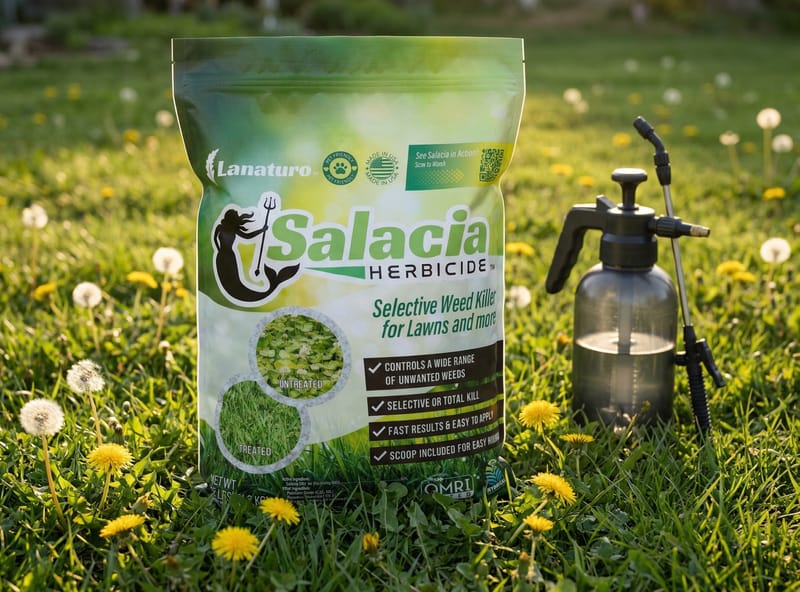
Salacia Organic Weed Control is the first OMRI-certified selective herbicide built for exactly this kind of target. This guide shows you the specific technique that makes it work on dandelions: how to deliver the product directly into the crown so the entire plant dies from the inside out.
Why Dandelions Are Harder to Kill Than Other Weeds
Most broadleaf weeds spread horizontally. Clover creeps along the surface. Ground ivy sends runners across your lawn. You can hit them with a contact herbicide and the aboveground tissue dies because there is no deep reserve to draw from.
Dandelion is vertical. Its taproot drives straight down, often 6 to 10 inches or more into the soil. That root stores energy, water, and nutrients. At the top of that root, sitting at or just below the soil surface, is the crown: a dense, compressed hub where the root meets the leaf rosette.
The crown is the control center. Every leaf on the rosette grows from it. Every nutrient from the root passes through it. If the crown survives treatment, the dandelion survives treatment. New leaves push out from the center and the cycle starts over.
This is what separates dandelions from most other lawn weeds. And it is why most organic products fail against them. Standard contact herbicides burn the leaf surface but never reach the crown. The leaves brown, the homeowner celebrates, and the dandelion quietly regenerates from below.
Salacia works differently. As a selective herbicide, it is designed to be absorbed through the leaf tissue and carried into the plant's vascular system, reaching the crown and disrupting the weed from within rather than just scorching the surface.
But even with the right product, technique matters. Spray casually and you get partial contact. Use the crown technique and you get a complete kill.
The Crown Technique: How to Actually Kill a Dandelion
This is the method that separates a surface burn from an actual kill. It is not complicated, but it is deliberate. Every step is designed to get maximum product into the crown.
Step 1: Mow First
Mow your lawn before treating. This exposes the dandelion rosettes, clears tall grass that would intercept spray, and gives you a clear shot at the crown. Do not mow so low that you scalp the lawn. A standard mowing height is fine.
Step 2: Mix at the Selective Rate
Follow the label dilution for selective lawn application. If you are unsure about the correct rate for your situation, ask Lanaturo Intelligence (the chat assistant on our site) for guidance. The selective rate is formulated to eliminate broadleaf weeds while preserving grass.
Step 3: Spray the Entire Leaf Rosette
Wet every leaf surface until it glistens. The rosette is the delivery system. Product absorbed through the leaves travels into the plant, so more leaf coverage means more product reaching the vascular tissue. Do not just hit one or two leaves. Coat all of them.
Step 4: Target the Crown Directly
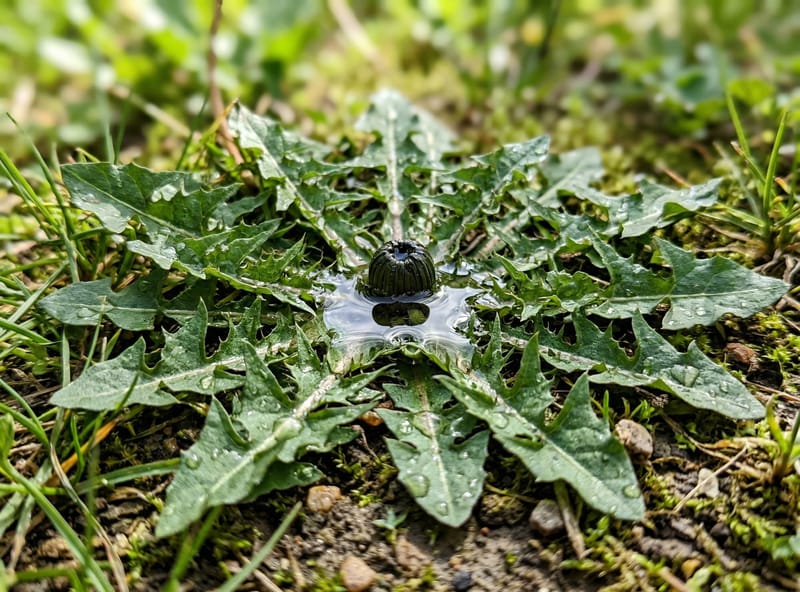
This is the step most people skip and it is the most important one. After spraying the rosette, aim the nozzle directly into the center of the plant, where all the leaves converge. Give it an extra, deliberate dose. You want product pooling in that central crown area. This direct crown contact is what drives the selective action deep into the plant rather than staying on the surface.
Step 5: Walk Away
Don't water or mow. Let the product absorb undisturbed. The longer the product sits on and in the plant tissue without being washed off or disrupted, the more effective the treatment will be.
A note on pets: Salacia is Pet Friendly, but pets are naturally attracted to saline-based solutions. If a pet licks treated leaves before the product absorbs, it disrupts the application on the plant. Keep pets off treated areas until the spray has dried to ensure full efficacy.
Watch It Work
This timelapse shows a dandelion treated with the crown technique. Watch as the leaves begin to wilt and curl, the rosette flattens and collapses, and the crown tissue browns and dies. This is what a complete kill looks like when the product reaches the crown.
What to Expect After Treatment
Dandelion death is not instant. The product works on contact, dehydrating the plant's tissue from the leaves through the crown and root. Here is the progression you should see:
First Signs: Wilting and Curling
The leaves begin to wilt and curl inward. Browning starts at the leaf edges and spreads toward the center of each leaf. The rosette loses its upright posture and starts to flatten. This is the product moving through the vascular tissue.
Collapse: The Rosette Goes Brown
The entire rosette flattens against the ground. Leaves lose all rigidity and turn fully brown. The crown tissue begins to darken visibly. At this stage, the plant has lost its ability to photosynthesize and the crown is being destroyed from within.
Complete Kill: Crown and Root Die
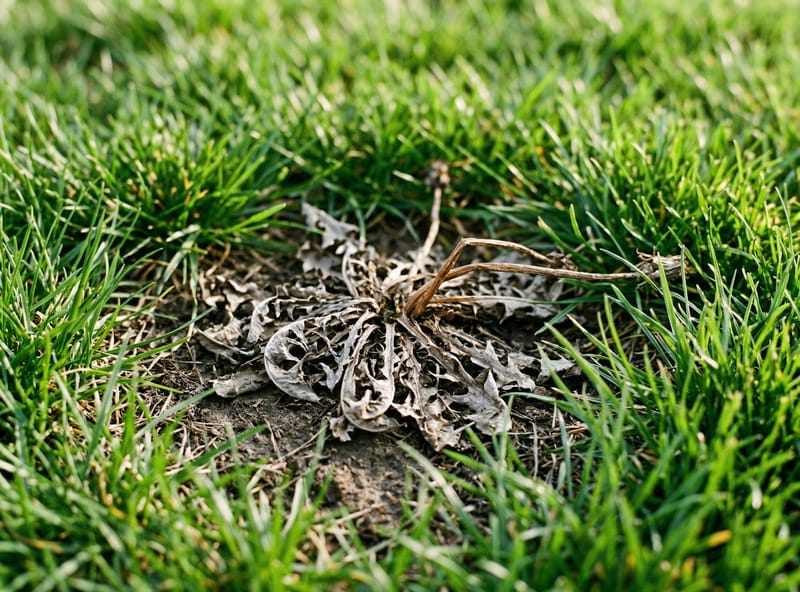
The entire plant is dead. The tissue is dry and brown. The crown is no longer viable, meaning there is no regrowth coming. You can rake out the dead material or let it decompose naturally into the soil.
After Treatment -- Don't Skip This
Once the dandelion is dead, overseed the bare spot. A thick, healthy lawn is the single best defense against future dandelion invasion. Every bare patch is an open invitation for windborne dandelion seeds to establish. Fill those gaps and you dramatically reduce the chance of reinfestation.
When to Treat Dandelions
Timing affects how well the crown technique works. Dandelions are treatable throughout the growing season, but some windows are significantly more effective than others.
Best Window
Early to Mid Fall
Dandelions are actively pulling nutrients down into their roots for winter storage. Product applied to the crown rides that downward flow directly into the taproot. Fall treatment produces the highest complete-kill rate.
Also Effective
Spring After Leaf-Out
Once dandelions have fully leafed out in spring and rosettes are established, the crown technique works well. Wait until leaves are large enough to provide good spray coverage. Treating too early, before the rosette has formed, reduces absorption.
Avoid
Midsummer Heat
Extreme heat causes rapid evaporation, reducing how long the product sits on leaf tissue. Dandelions also go semi-dormant in high heat, slowing their vascular activity and limiting how much product reaches the crown. If you must treat in summer, spray in early morning or evening.
For a deeper look at seasonal timing and temperature considerations, see Best Practices for Timing and Application.
Common Mistakes That Let Dandelions Survive
If your dandelions keep coming back after treatment, one of these three mistakes is almost certainly the reason.
Mistake: You Missed the Crown
You sprayed the leaves but did not target the center of the rosette. The leaves burned but the crown stayed alive, and the plant regenerated. Go back to Step 4 of the crown technique. That deliberate, direct dose into the center is the difference between a surface burn and a complete kill.
Mistake: You Sprayed Too Lightly
A light mist is not enough. The leaves need to be wet to the point of glistening. Under-application means less product enters the vascular system and less product reaches the crown. If you are getting partial leaf burn but the center of the plant stays green, increase your coverage.
Mistake: Those Are New Dandelions, Not the Same Ones
A single dandelion produces up to 15,000 seeds per year, and those seeds can travel miles on the wind. If you killed the original plant but new dandelions appeared nearby, that is reinfestation from seed, not regrowth from the same root. The solution is not re-treatment of the dead plant. It is overseeding bare spots and maintaining a thick lawn to crowd out new seedlings.
Ready to Take Back Your Lawn?
Salacia™ is the first OMRI-listed organic herbicide with true selective action — kills weeds, not grass. Choose your lawn size:
Why Not Just Pull Them?
Hand-pulling dandelions feels productive, but it rarely works. The taproot can extend 6 to 10 inches or more into the soil, and it is brittle. When you pull, the root almost always snaps underground, leaving behind a fragment that contains enough stored energy to regenerate the entire plant.
For a single dandelion in a garden bed, careful hand-pulling with a weeding tool can work if you extract the full root. But for a lawn with dozens or hundreds of dandelions, hand-pulling is impractical and usually makes the problem worse by disturbing the soil and creating more bare spots where seeds can germinate.
The crown technique is more effective for lawn-wide control because it kills the root system through the plant's own vascular network without disturbing the surrounding turf. Your grass stays intact, no soil disruption, no new bare patches for seeds to colonize.
Concerned about treating your lawn with pets around? Read Is Organic Weed Killer Safe for Pets? What You Need to Know for a full breakdown of the Pet Friendly approach.
Selective Rate vs. Non-Selective Rate on Dandelions
Salacia can be mixed at two different concentrations, and which one you use depends entirely on where the dandelions are growing.
Selective Rate
For Lawns
- Kills dandelions and other broadleaf weeds
- Grass remains green and undamaged
- Ideal for lawns, sports turf, and any area where you want to preserve grass
- Use the crown technique for maximum dandelion kill rate
Non-Selective Rate
For Driveways and Hardscapes
- Kills all vegetation on contact
- Higher concentration for total control
- Use on driveways, sidewalks, patios, gravel, fence lines
- No crown technique needed at this rate -- total burndown
This dual-rate capability comes from Salacia's Hybrisal Technology, which allows the same product to function as either a selective or non-selective herbicide depending on the dilution rate. One bottle handles both your lawn and your hardscape. Learn more in Best Practices for Timing and Application.
Read our complete guide: How to Kill Dandelions -- Plus Why You Might Want to Grow and Eat Them
See the Results
Real results, real lawns -- watch Salacia eliminate tough weeds while your grass stays perfectly untouched.
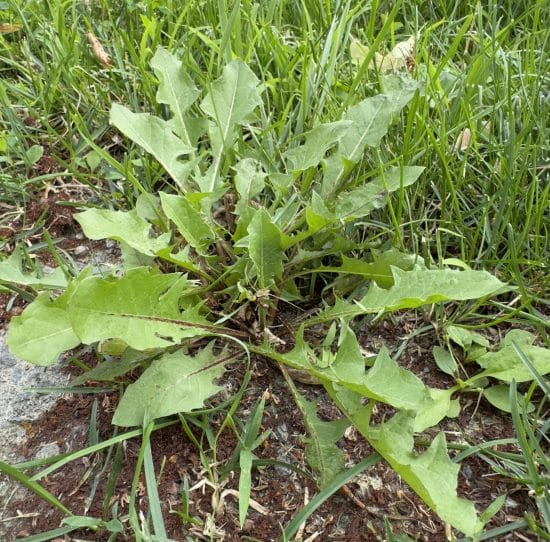
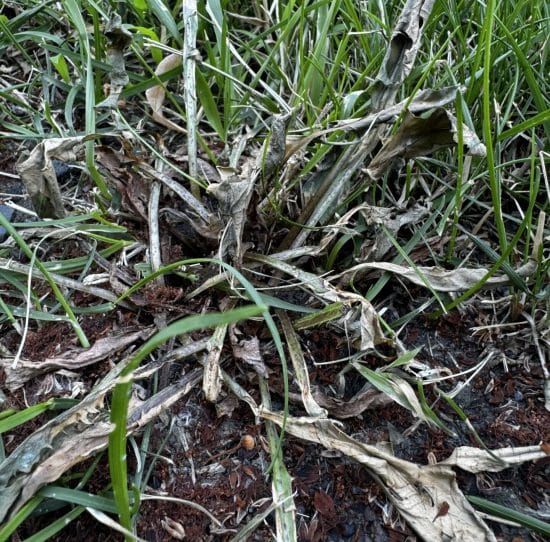
See more before and after results on our Weed Control Guide.

Intelligence
Not Sure About Your Situation? Ask Lanaturo Intelligence.
Snap a photo of your weeds, get an instant species ID, check real-time application conditions for your location, and receive a tailored treatment plan.
Ready to Take Back Your Lawn?
Salacia™ is the first OMRI-listed organic herbicide with true selective action — kills weeds, not grass. Choose your lawn size:
One Technique. One Product. Done.
Dandelions survive most treatments because most treatments never reach the crown. The crown technique changes that. Target the center, saturate the rosette, and let a naturally derived, OMRI-certified selective herbicide do what contact sprays cannot.
No synthetic fallback needed. No re-treatment cycle. Just the right product applied with the right technique.
Pet Friendly -- everything else second.
This article is for educational purposes only and reflects general best practices for organic weed control. Always read and follow the product label before application. Results may vary based on weed species, environmental conditions, and application technique.