
 By Pat Kelly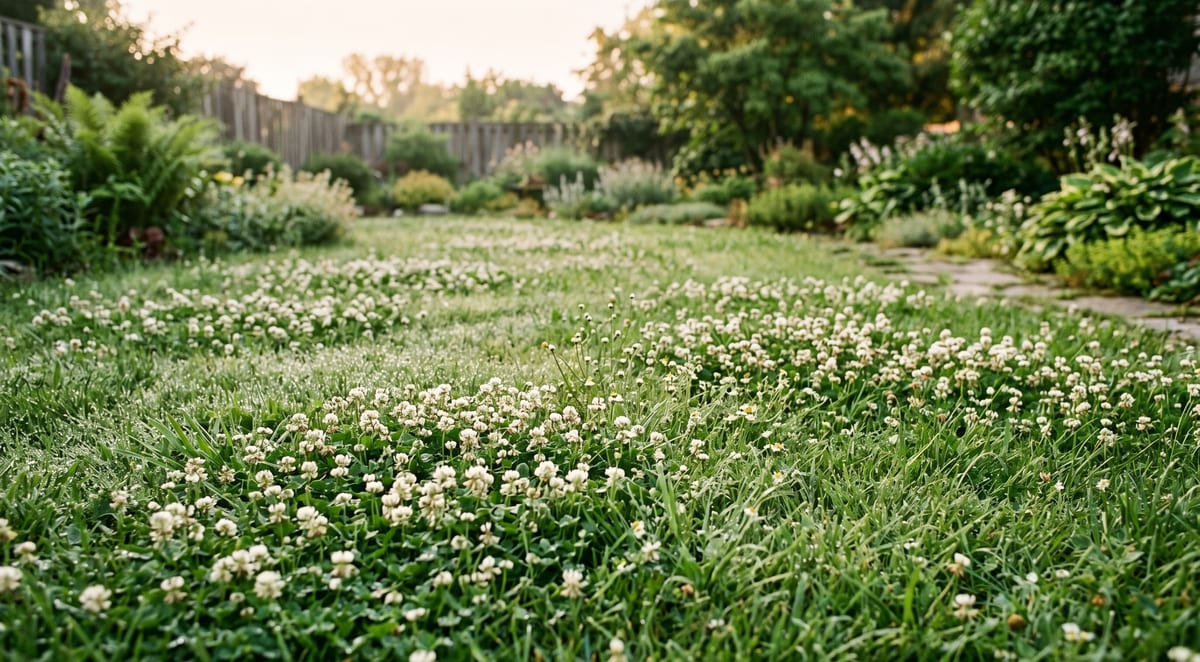
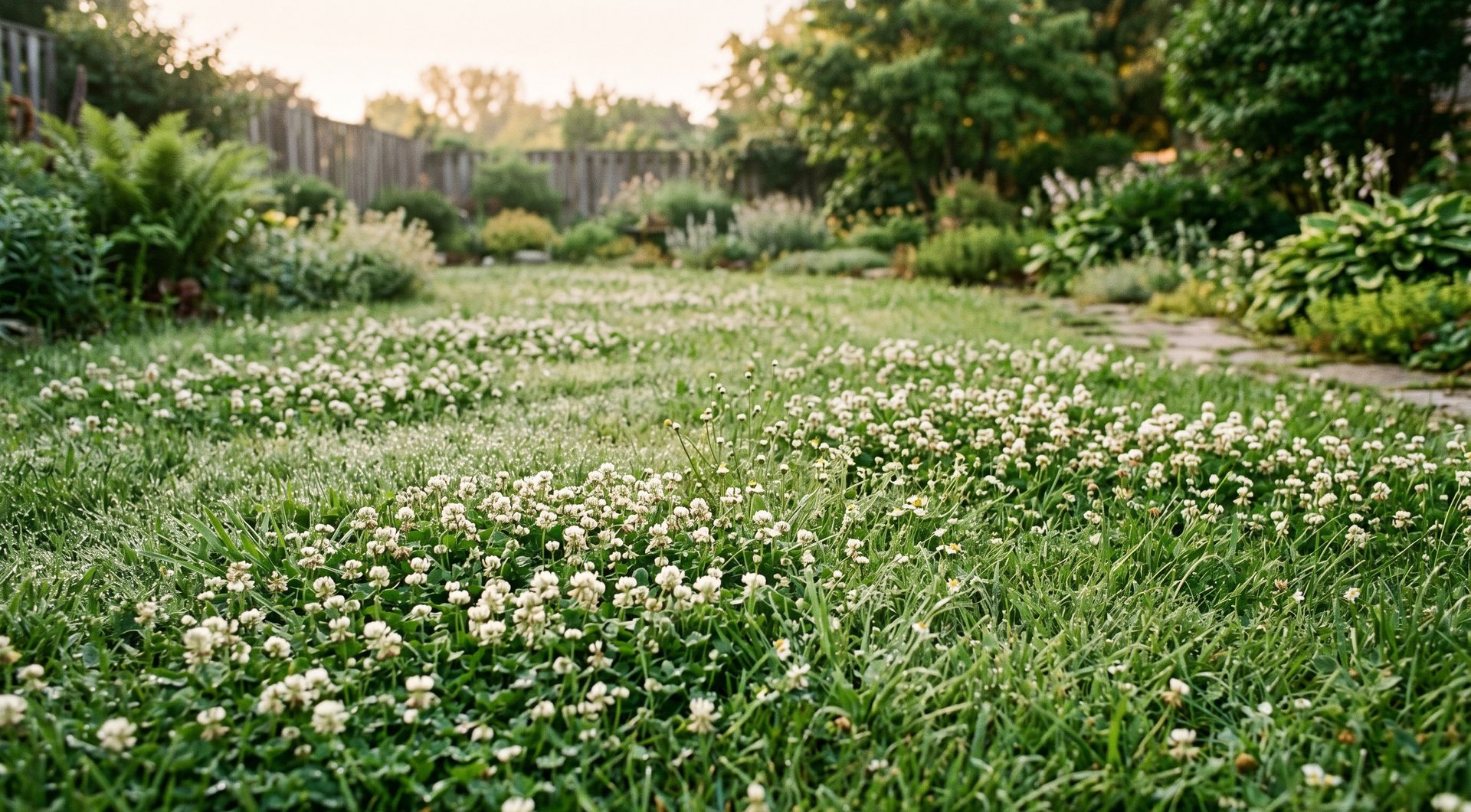
Seventy years ago, the white flowers in your lawn were not a weed problem. They were a selling point — printed right on the seed bag.
White clover was a standard, intentional ingredient in American lawn-seed mixes well into the 1950s. It was prized, not pulled: as a legume it pulls nitrogen out of the air and feeds the grass around it, stays green in drought, and feels soft underfoot. Then the story changed — and it changed for a reason that had nothing to do with the plant. Stick with us, because understanding why clover got "framed" is also the key to dealing with every white-flowered weed in your yard honestly.
The shared fact under all of them: broadleaf. Every white-flowered weed here is a broadleaf plant, which is exactly what a selective herbicide like Salacia is built to target — so you can decide, plant by plant, what stays and what goes.
The short answer: The most common lawn weeds with white flowers are white clover, common chickweed, mouse-ear chickweed, hairy bittercress, daisy fleabane, English daisy, yarrow, wild strawberry, field bindweed, and (in southern lawns) Virginia buttonweed. Every one is a broadleaf weed, so a selective organic herbicide such as Salacia controls them at the lawn rate — though a few, like clover, are worth deciding to keep before you decide to kill.
Not sure which one you have?
Take a close-up photo — leaves and flower in the frame — and send it to Sal, our free weed-ID assistant, right on this page. He names the species, hands you the exact treatment plan, and checks whether today's weather is right to spray. See how Sal works →
First, the Heist: How Clover Became a "Weed"
Before the 1950s, white clover was deliberately blended into quality lawn-seed mixes — university extension records from the Piedmont Master Gardeners (Virginia Cooperative Extension) and the University of Illinois both confirm it was a "standard ingredient." It earned its place: clover is a legume, so it fixes its own nitrogen and quietly fertilizes the grass beside it.
Then came the chemistry. After World War II, selective broadleaf herbicides went mainstream in lawn care — 2,4-D arrived in 1945, and the mecoprop and dicamba "weed-and-feed" products that followed became the suburban standard. There was just one problem: clover is itself a broadleaf plant. The new sprays built to wipe out dandelions and plantain could not tell clover apart from the weeds — so they killed it too.
Rather than give up the convenience of spray-and-walk-away weed control, the industry did the simpler thing: it stopped calling clover a feature and started calling it a weed. The flawless, single-species green carpet became the ideal precisely because it was what the new chemicals could deliver. Clover did not change. The marketing did.
Why an organic brand can tell you this: we are not selling you the spray that framed it. So we can give you both honest endings — the case for keeping clover, and, if you still want it gone, exactly how to do it without poisoning the lawn your pets and kids use.
1. White Clover — The Weed That Was Framed
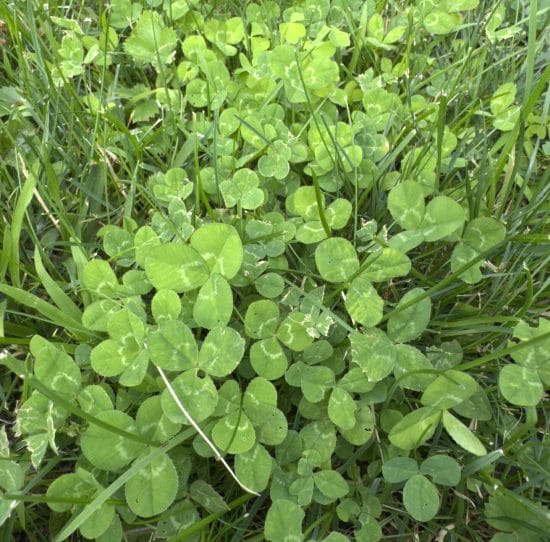
Scientific name: Trifolium repens (white Dutch clover)
The defendant from our opening. White clover spreads by creeping stems (stolons) that root as they go, throwing up round white-to-pinkish flower heads that bees adore. The leaves are the classic three rounded leaflets, usually with a pale crescent "watermark" on each. It thrives where nitrogen is low — which is the honest tell that your grass is underfed, not that your yard is broken.
The tell: Round white flower heads, three rounded leaflets with a pale chevron mark, low creeping mats. Yellow flower instead of white? That is oxalis or hop clover, covered in our yellow-flowered weeds guide.
- Lifecycle
- Perennial
- Spreads by
- Creeping stolons that root at the nodes, plus seed
- Why your lawn
- Low soil nitrogen — clover is a legume and thrives where grass is hungry
- Blooms
- Late spring through summer
Keep it or kill it. Honestly: clover feeds your lawn, stays green in drought, and feeds pollinators — many homeowners are bringing it back on purpose. But if you want a uniform turf or someone in the house reacts to bees, Salacia controls it at the lawn rate. Because it runs by stolons, patch-treat the whole colony, not just the flower heads, and stop at the colony's edge. Clover's waxy leaves and rooting runners mean one pass rarely finishes it — plan a follow-up flush a couple of weeks later to drain the network. Full playbook: how to kill clover in your lawn.
Pets: White clover is not listed as toxic to dogs or cats — no claim either way. The real pet caution is the bees it draws, not the plant.
2. Common Chickweed — The Winter Mat
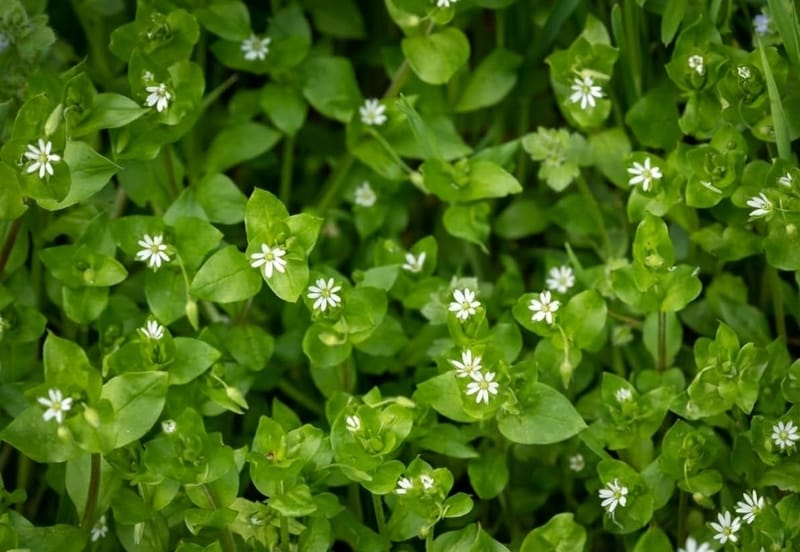
Scientific name: Stellaria media
Common chickweed forms a soft, low mat of small oval leaves and tiny white star-shaped flowers. Each flower has five petals so deeply split they look like ten. It is a cool-season opportunist that fills in thin, shaded turf over fall and winter and is going strong before your grass wakes up in spring.
The tell vs. mouse-ear chickweed: Rub the leaves. Common chickweed is nearly smooth, with just a single line of hairs running down one side of the stem (it switches sides at each node). Mouse-ear is hairy all over (next entry).
- Lifecycle
- Winter annual
- Spreads by
- Prolific seed (and stems that root where they touch)
- Why your lawn
- Cool, moist, shaded, thin turf
- Blooms
- Roughly April–October, with a cool-season surge
Salacia verdict — controls it. Broadleaf and treatable; drench the mat. Because it is a winter annual, treating in fall catches it young, before it sets the next round of seed.
Pets: No authoritative dog or cat toxicity listing — no claim either way.
3. Mouse-Ear Chickweed — The Fuzzy Double
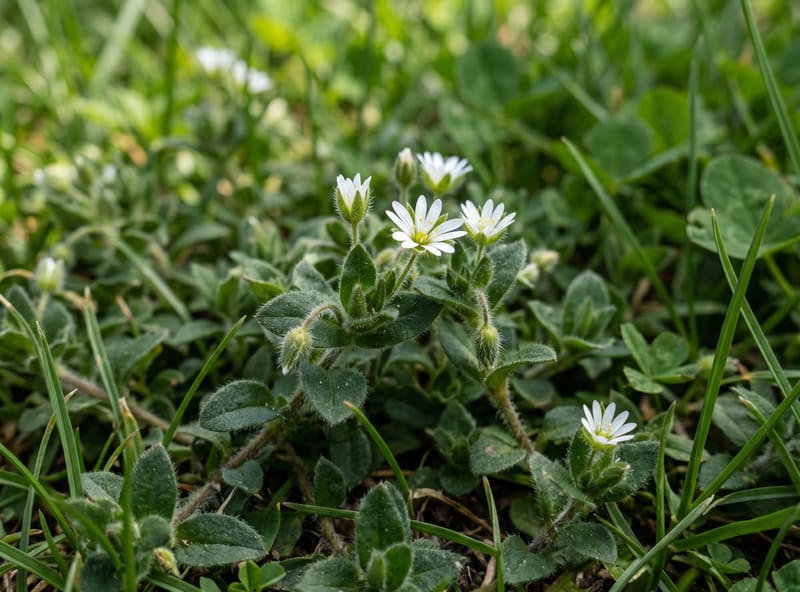
Scientific name: Cerastium fontanum
Mouse-ear chickweed is common chickweed's fuzzy, tougher double. The flowers look nearly the same — small, white, with deeply notched petals — but the whole plant is densely hairy, and unlike its annual cousin it is a perennial that roots at the nodes to form persistent mats.
The tell: Hairy all over (the "mouse-ear" felt) and it roots at the nodes as a perennial. Smooth-with-one-hairy-stem-line = common chickweed; fuzzy-everywhere = mouse-ear.
- Lifecycle
- Perennial
- Spreads by
- Seed plus prostrate stems rooting at the nodes
- Why your lawn
- Compacted, moist, low-fertility turf; tolerates close mowing
- Blooms
- April–October, spring peak
Salacia verdict — controls it. Broadleaf; because it is a node-rooting perennial, treat the whole mat and check for survivors rather than dabbing only the flowering tips.
Pets: No authoritative dog or cat toxicity listing — no claim either way.
4. Hairy Bittercress — The One That Shoots Back
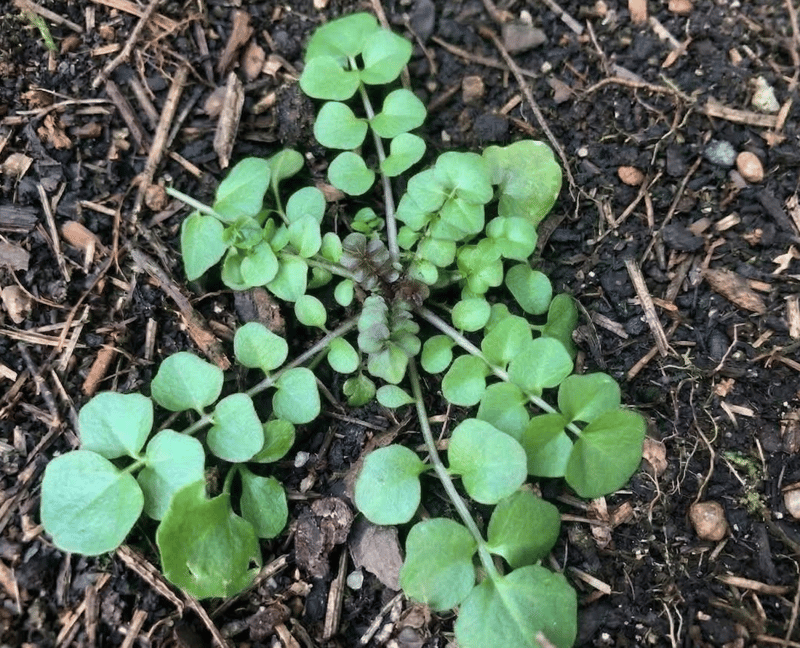
Scientific name: Cardamine hirsuta
Hairy bittercress grows as a small basal rosette of compound leaves, then sends up thin stalks topped with tiny white four-petaled flowers and slender upright seed pods. Here is the detail homeowners never forget: when a ripe pod is touched, it explodes. The pod valves coil violently and catapult seeds up to several feet — a single plant can fling six hundred or more. That is why brushing a mature plant, or yanking it carelessly, plants next year's crop for you.
The tell: A flat rosette, four-petal white flowers (mustard family), upright seed pods held above the flowers — and pods that snap and scatter when touched.
- Lifecycle
- Winter annual
- Spreads by
- Explosive seed dispersal (ballistic pods)
- Why your lawn
- Cool, moist, shaded, thin or disturbed soil; mulch and bed edges
- Blooms
- Late winter through spring
Salacia verdict — controls it. Broadleaf and treatable. The trick is timing: hit the rosette before the seed pods form, so you are not the one triggering the launch. Treating in late winter and early spring catches it young.
Pets: No authoritative dog or cat toxicity listing — no claim either way.
5. Daisy Fleabane — The Hundred-Petal Daisy
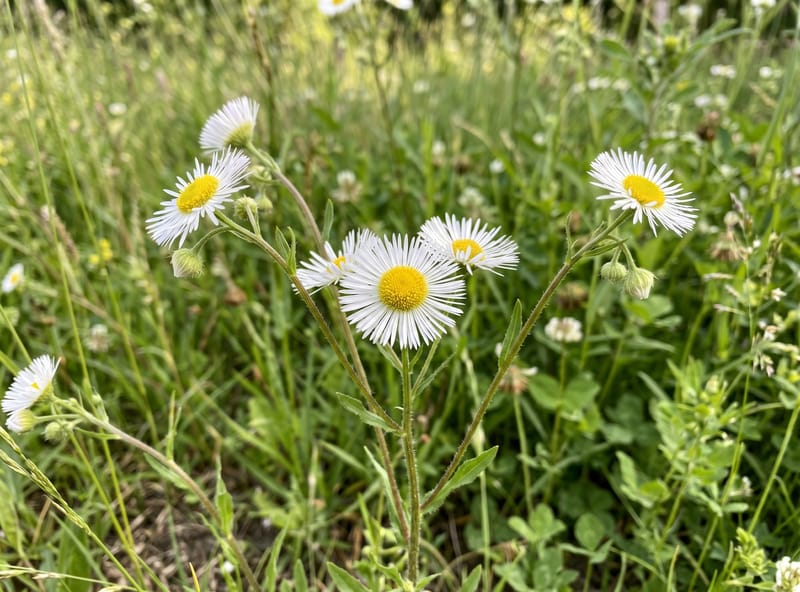
Scientific name: Erigeron annuus
Daisy fleabane looks like a daisy that overdid it. Each small head has a yellow center ringed by dozens to over a hundred hair-thin white-to-faint-pink rays — far more, and far thinner, than a true daisy's. It bolts up on tall branching stems that bend over in a shepherd's-crook when budding, from a rosette of coarsely toothed leaves.
The tell vs. English daisy: Fleabane is a tall, multi-stemmed annual with toothed leaves up the stem and 50–100+ thread-thin rays; English daisy is a low ground-hugging perennial with broad spoon-shaped basal leaves and far fewer, wider petals.
- Lifecycle
- Summer annual
- Spreads by
- Prolific seed
- Why your lawn
- Thin, under-fertilized, low-maintenance turf
- Blooms
- May into late summer
Salacia verdict — controls it. Broadleaf; as a seed-only annual, treat before bloom and you stop the seed bank from refilling.
Pets: Fleabane is listed by the ASPCA (genus Erigeron) as mildly toxic to dogs and cats — mild stomach upset if eaten.
6. English Daisy — The Lawn Daisy
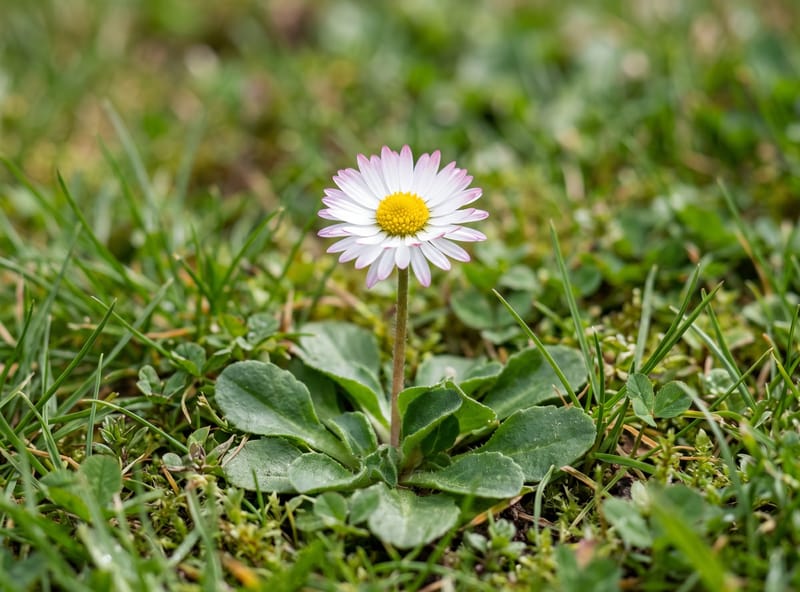
Scientific name: Bellis perennis
The storybook lawn daisy: a low rosette of spoon-shaped leaves hugging the ground, with single white (often pink-tipped) flower heads on short leafless stalks held just above the grass. It forms spreading clumps via short rhizomes and shrugs off close mowing, which is exactly why it persists in turf the mower never quite removes.
The tell: Low basal rosette of broad spoon-shaped leaves, single short-stalked daisy flowers, white with pink-tipped/reddish-backed petals — the ground-hugging opposite of the tall fleabane.
- Lifecycle
- Perennial
- Spreads by
- Seed plus short rhizomes forming clumps
- Why your lawn
- Moist, cool, fertile turf; tolerates close mowing
- Blooms
- Spring, peaking April–June
Salacia verdict — controls it. Broadleaf and treatable; spot-treat the rosettes during active growth and re-check the clumps, since rhizomes can push new plants.
Pets: No ASPCA dog/cat listing; one extension source rates the plant generally mild-to-moderate if eaten in quantity, so treat as a mild caution rather than a confirmed pet toxin.
7. Yarrow — The Feather-Leaf Colonizer
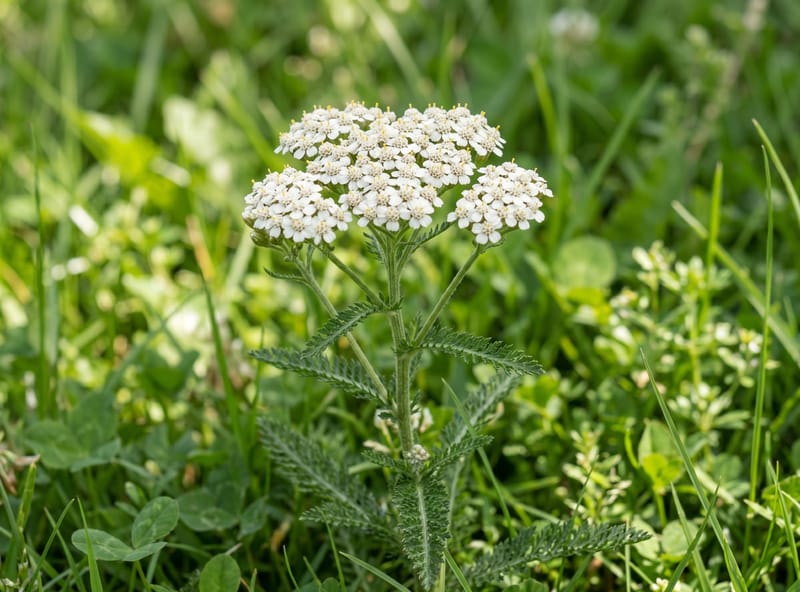
Scientific name: Achillea millefolium
Yarrow gives itself away by its leaves: soft, feathery, fern-like, and finely divided, with a spicy medicinal smell when crushed. The white flowers cluster in flat-topped heads of many tiny florets. It runs by underground rhizomes into drought-tough, low-fertility patches and can form near-monoculture colonies where grass has thinned.
The tell vs. wild carrot: Both have lacy foliage — but crush a leaf. Yarrow smells spicy/medicinal and makes a flat cluster of tiny daisy florets spreading by rhizome; wild carrot (Queen Anne's lace) smells like carrot and makes a lacy umbel on a single tall stalk. (Never taste to ID — wild carrot has a deadly poison-hemlock look-alike.)
- Lifecycle
- Perennial
- Spreads by
- Aggressive rhizomes plus seed
- Why your lawn
- Full sun, dry, poor, low-fertility soil; drought-stressed turf
- Blooms
- June–September
Salacia verdict — controls it. Broadleaf; because it colonizes by rhizome, treat the whole patch and plan a follow-up on any rhizome regrowth.
Pets: Yarrow is listed as toxic to dogs and cats by the ASPCA (vomiting, drooling, diarrhea if eaten).
8. Wild Strawberry — The Runner That Rarely Fruits in a Lawn
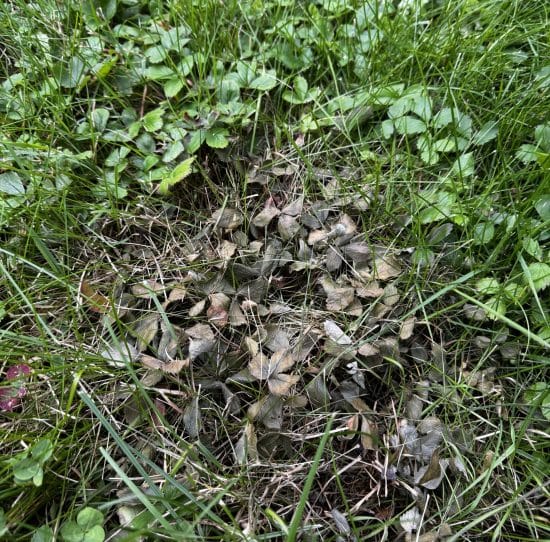
Scientific name: Fragaria virginiana (and the yellow-flowered mock strawberry, Potentilla indica)
Wild strawberry creeps through turf on runners, with three toothed leaflets and five-petaled white flowers. True wild strawberry (the wild parent of the cultivated berry) can set a small edible fruit, but in a regularly mowed lawn it rarely gets the chance; the common mock strawberry impostor has yellow flowers and a dry, flavorless red fake berry. Either way, the runners let one plant colonize a wide patch fast.
The tell: Three toothed leaflets (not five — that's cinquefoil), five white petals, and strawberry-style runners. Yellow flower instead of white = mock strawberry or cinquefoil.
- Lifecycle
- Perennial
- Spreads by
- Runners (stolons) that root at the nodes, plus seed
- Why your lawn
- Thin turf, sun to part shade; runners exploit any opening
- Blooms
- Spring into early summer
Salacia verdict — controls it. Broadleaf; trace the runners and treat the whole patch so no rooted node is left behind to restart it.
Pets: No authoritative dog or cat toxicity listing — no claim either way.
9. Field Bindweed — The White Trumpet Vine
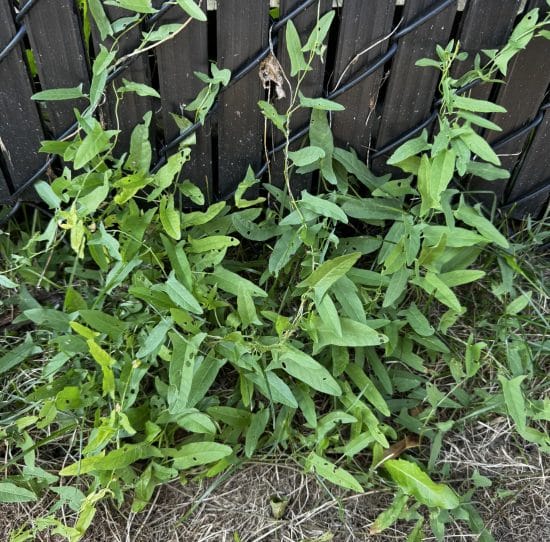
Scientific name: Convolvulus arvensis
Field bindweed is the white-to-pink funnel-shaped flower riding a twining vine with arrowhead leaves. It is the toughest customer on this list because of what it does underground: a root system that can run many feet deep and resprout from fragments. Above ground it twists through and over the turf, choking it.
The tell: Morning-glory-style white/pink trumpet flowers and arrowhead leaves on a twining stem. (It is sometimes called "wild morning glory.")
- Lifecycle
- Perennial
- Spreads by
- Deep persistent roots (resprout from fragments) and seed that stays viable for decades
- Why your lawn
- Sunny, disturbed, dry ground; thin turf and edges
- Blooms
- Late spring through summer
Salacia verdict — controls it, with realistic expectations. The top growth is broadleaf and treatable, but bindweed's deep root reserve means honest expectations: a contact treatment knocks down what it touches, and the deep roots can push new shoots. Treat each flush as it appears to keep draining the root — this is a persistence game, and we would rather say so than promise a one-spray kill. Related vine playbook: how to get rid of bindweed.
Pets: No authoritative dog or cat toxicity listing — no claim either way.
10. Virginia Buttonweed — The Southern Sprawler
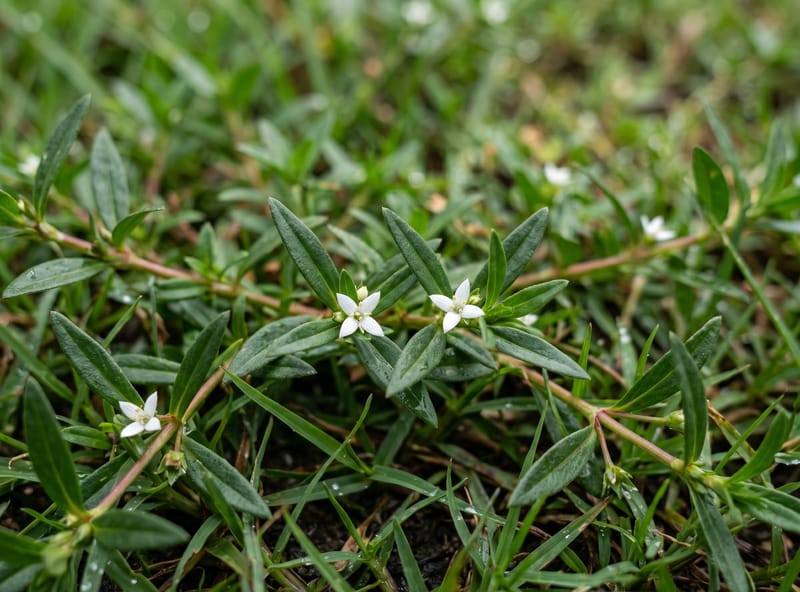
Scientific name: Diodia virginiana — mostly a southern-lawn problem
In warm-season lawns across the Southeast, Virginia buttonweed is the white-flowered weed homeowners curse most. It sprawls into mats from a central crown, with opposite lance-shaped leaves and small white four-pointed star flowers tucked in the leaf axils. It is notoriously hard to pull because it regrows from rhizomes and from stem fragments that a mower or string-trimmer scatters.
The tell: Four-pointed white star flowers in the leaf axils, opposite stalkless leaves, low sprawling mat in a wet or over-irrigated spot.
- Lifecycle
- Warm-season perennial
- Spreads by
- Rhizomes, scattered stem fragments, and seed (even below-ground seed)
- Why your lawn
- Moist to wet, poorly drained or over-irrigated turf; southern lawns
- Blooms
- June through first frost, worst by late summer
Salacia verdict — controls it, with persistence. Broadleaf and treatable, but its rhizomes and fragment-spreading make it a repeat-treatment weed. Treat the mat, avoid scattering fragments by mowing it right after, and re-hit regrowth. Easing off over-irrigation removes the conditions it loves.
Pets: No authoritative dog or cat toxicity listing — no claim either way.
The Whole List, at a Glance
One product, one scan. Every weed here is broadleaf, so Salacia controls all of them — what changes is whether you want it gone, how you apply, and when.
| Weed | The one tell | How to apply | Bloom window | Pets (dogs/cats) |
|---|---|---|---|---|
| White clover | Round white heads, 3 leaflets, chevron mark | Keep, or patch-treat the colony | Late spring–summer | Not listed toxic |
| Common chickweed | Smooth, one hairy stem-line | Drench the mat (treat in fall) | Apr–Oct, cool surge | Not listed |
| Mouse-ear chickweed | Hairy all over, perennial | Treat whole mat + recheck | Apr–Oct | Not listed |
| Hairy bittercress | Pods that explode when touched | Treat rosette before pods form | Late winter–spring | Not listed |
| Daisy fleabane | 50–100+ thread-thin rays, tall | Spot-treat before bloom | May–late summer | Mildly toxic (ASPCA) |
| English daisy | Low rosette, single short-stalk flowers | Spot-treat rosettes | Apr–June | Mild caution |
| Yarrow | Feathery leaves, spicy smell, flat clusters | Treat the patch + rhizome regrowth | June–Sept | Toxic (ASPCA) |
| Wild strawberry | 3 leaflets, white flower, runners | Trace runners, treat whole patch | Spring–early summer | Not listed |
| Field bindweed | White trumpet flower, twining vine | Treat each flush, multi-pass | Late spring–summer | Not listed |
| Virginia buttonweed | 4-point white star, southern wet spots | Treat mat, re-hit regrowth | June–frost | Not listed |
Can't name the white flower in your grass? You don't have to.
They are easy to mix up — that is half the reason clover got "framed" in the first place. What matters: all ten are broadleaf weeds, and Salacia controls every one of them at the selective lawn rate. Identifying the species tells you whether to keep it and how to time it — and Sal will name it from a photo in seconds.
Salacia is designed to be selective at the lawn rate, but temporary paling or yellowing of grass is possible depending on lawn health, irrigation, application rate, and conditions. Test a small area first.
Ready to Take Back Your Lawn?
Salacia™ is the first OMRI-certified selective organic herbicide — kills weeds, not grass. Choose your lawn size:
Keep It or Kill It — and How
Because we are not the brand that framed clover, we will say the quiet part out loud: not every white flower has to die. Clover feeds your lawn and the bees; English daisy is harmless and even charming to some. The decision is yours, weed by weed. But when you do decide something has to go, the method matters as much as the choice.
The problem these weeds share is that they grow inside the lawn. A non-selective spray burns a bare patch into the turf and invites the next invader. The answer is selective control. Salacia — the first OMRI-certified selective organic herbicide — works by rapid osmotic dehydration, pulling moisture out of broadleaf tissue on contact. The selective lawn rate is 3 cups per gallon; a non-selective 4 cups per gallon clears beds and hardscape.
Grass-safety note: Salacia is designed to be selective at the lawn rate, but temporary paling or yellowing of grass is possible depending on lawn health, irrigation, application rate, and conditions. Test a small area first.
Match the method to the weed
Scattered individuals (fleabane, English daisy, bittercress) — spot-treat. Drench each plant to runoff during active growth. For bittercress, treat before the seed pods can launch.
Mats and colonies (clover, chickweed, yarrow, wild strawberry, buttonweed) — patch-treat. Wet the entire colony, follow the runners and rhizomes, and stop at the colony's edge — there is no reason to blanket healthy grass.
The honest part: field bindweed and Virginia buttonweed run deep roots and resprout, so they are multi-pass, sometimes multi-season weeds. Treat each flush as it appears to keep draining the root. That persistence is the price of doing it without synthetic chemistry — and it is the price that keeps your lawn safe to walk on barefoot the same day.
For timing by season and region see the timing and application guide; for the science, read how selective herbicides work. Fighting other colors? See weeds with yellow flowers and weeds with purple flowers.
See the Results
Real lawns, real white-flowered weeds — Salacia clears the broadleaf weed while the surrounding grass keeps growing.
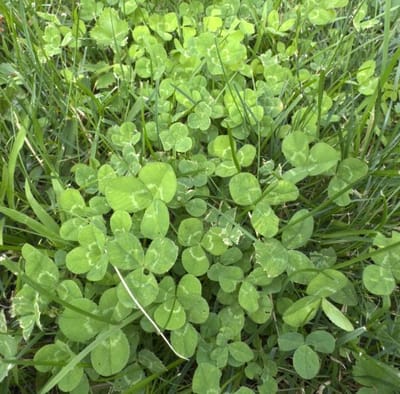 BEFORE
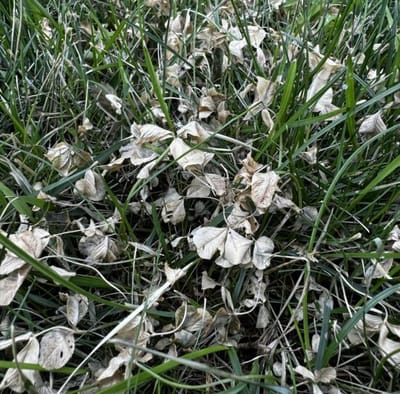 AFTER
AFTERWHITE CLOVER
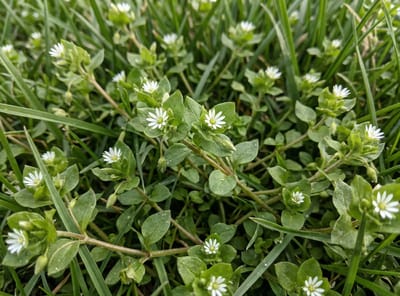 BEFORE
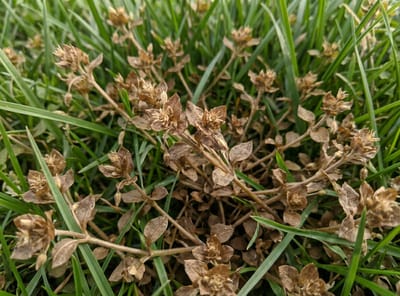 AFTER
AFTERCOMMON CHICKWEED
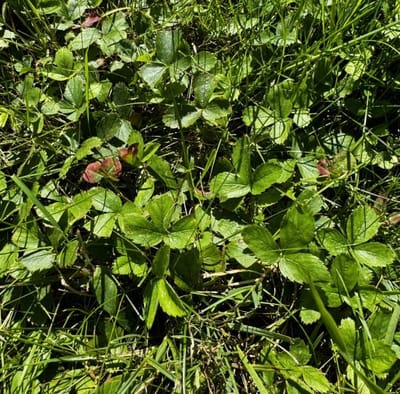 BEFORE
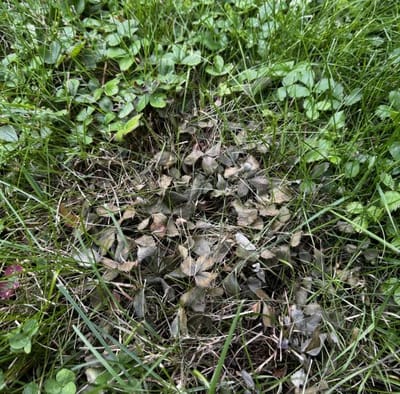 AFTER
AFTERWILD STRAWBERRY
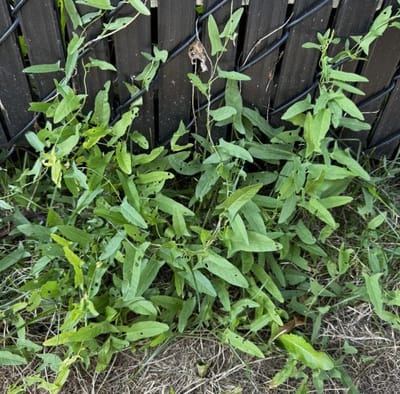 BEFORE
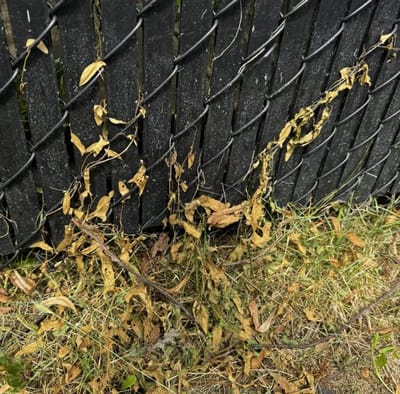 AFTER
AFTERFIELD BINDWEED
Browse every weed Salacia controls, with ID photos and before-and-after sets, in the complete Weed Control Guide.
Identified your weed?
Every broadleaf weed in this guide responds to the same selective approach. The next step is our ranked guide to the best weed killer that won't kill grass.

Lawn
Advisor
Not sure which weed you're looking at? Show Sal.
Sal is Lanaturo's lawn-care expert. He doesn't just name the weed — he builds your exact treatment plan and checks whether today is the right day to spray.
Ready to Take Back Your Lawn?
Salacia™ is the first OMRI-certified selective organic herbicide — kills weeds, not grass. Choose your lawn size:
Your Lawn, Your Verdict
Clover was framed once. You do not have to take the industry's verdict on the white flowers in your grass — you get to decide which ones stay and which ones go. When you decide something has to go, a selective organic approach treats it as exactly what it is, a broadleaf weed, and leaves the lawn your family actually uses standing and safe.
Salacia is designed to be selective at the lawn rate, but temporary paling or yellowing of grass is possible depending on lawn health, irrigation, application rate, and conditions. Test a small area first.
Pet Friendly. OMRI certified. The first selective organic herbicide — built for exactly this.
This article is for informational purposes. Always follow product label directions for application rates, timing, and use. Salacia is OMRI certified organic and labeled Pet Friendly. Historical and pet-toxicity notes reference university cooperative-extension sources and the ASPCA Animal Poison Control plant database; consult your veterinarian for specific concerns.