
 By Pat Kelly
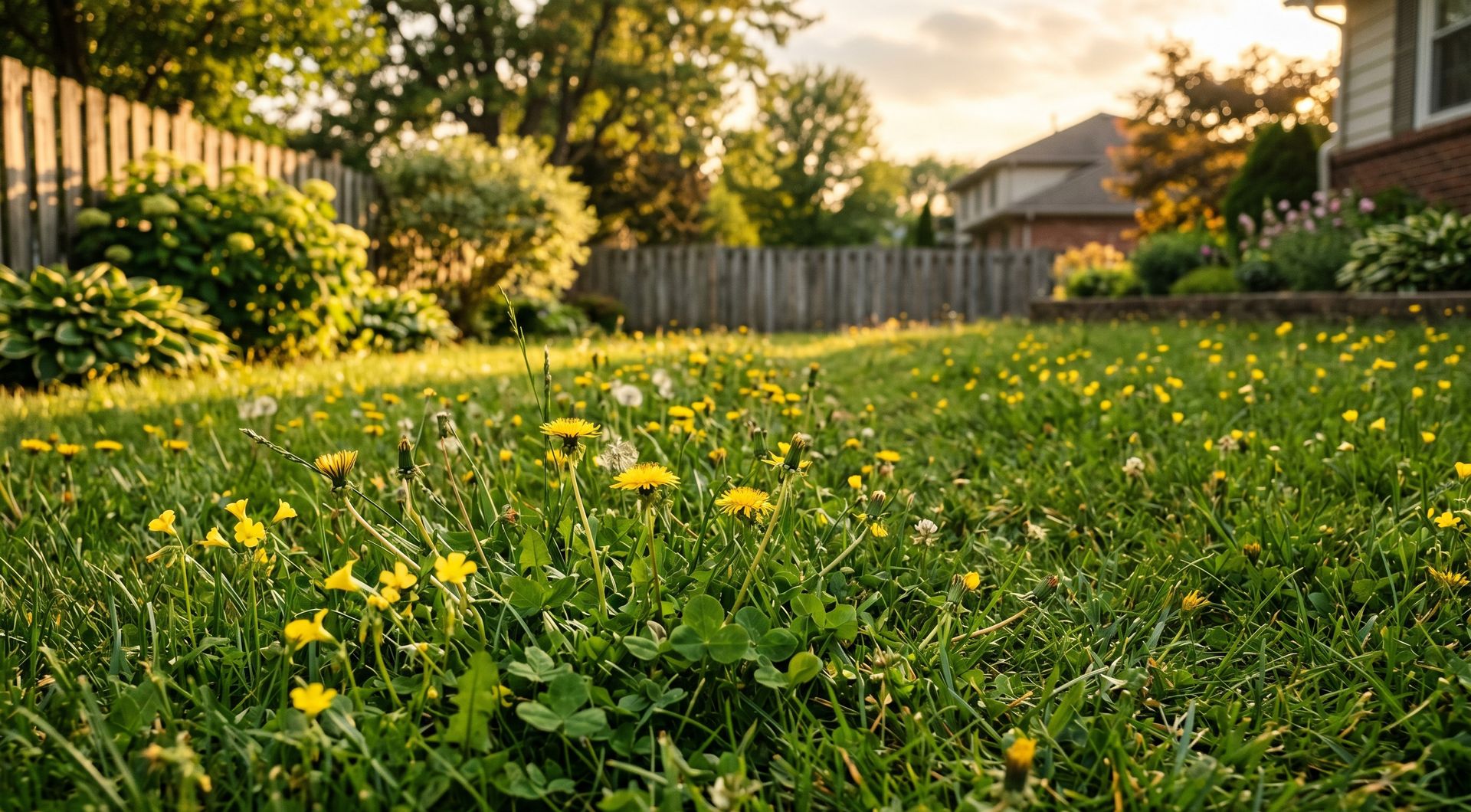
That dandelion you have been fighting all summer? There is a decent chance it is not a dandelion at all — and that is exactly why it keeps winning.
Most homeowners file every yellow flower in the lawn under one name: dandelion. But four or five different weeds are wearing that disguise, and they are not the same plant. Cat's-ear, hawkweed, sow thistle — each spreads differently, blooms on a different schedule, and shrugs off the wrong approach. Misidentify the suspect and you spray at the wrong time, with the wrong method, and the weed walks free until next spring.
So this is a lineup. We are going to put twelve yellow-flowered lawn weeds against the wall, show you the one tell that separates each impostor from the real dandelion, and give you the takedown that actually works on each one. Here is the part that makes it winnable: every single one of these is a broadleaf weed — and that is their shared weakness. A selective herbicide like Salacia treats every broadleaf in the grass as the target while leaving the lawn standing.
The short answer: The most common weeds with yellow flowers in a lawn are dandelion, cat's-ear, yellow hawkweed, sow thistle, oxalis (yellow wood sorrel), black medic, hop clover, creeping cinquefoil, creeping buttercup, yellow rocket, lesser celandine, and common groundsel. Every one is a broadleaf weed, so a selective organic herbicide such as Salacia controls them at the lawn rate — but the look-alikes spread differently, so identifying the right one tells you the right timing.
Not sure which one you have?
Take a close-up photo — leaves and flower in the frame — and send it to Sal, our free weed-ID assistant, right on this page. He names the species, hands you the exact treatment plan, and checks whether today's weather is right to spray. See how Sal works →
1. Dandelion — The One Everyone Blames
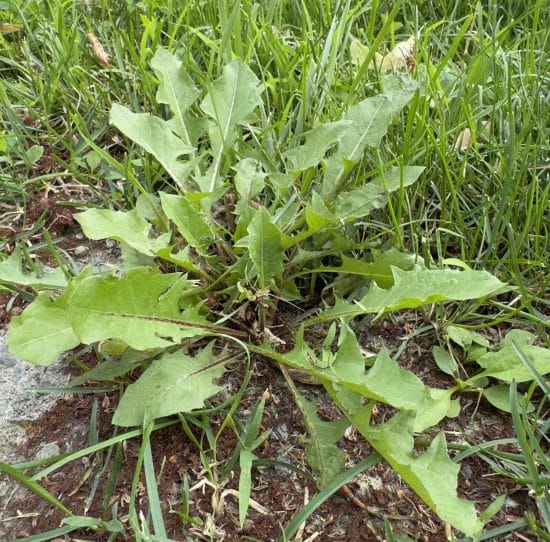
Scientific name: Taraxacum officinale
Start with the real suspect, because everything else in this lineup is measured against it. The true dandelion carries one flower head on one hollow, leafless stalk. Snap that stalk and it bleeds milky sap. The leaves are hairless and deeply, raggedly toothed — the name comes from dent de lion, "lion's tooth." Below ground sits the famous taproot, and UC IPM notes it can regrow from as little as an inch of root left behind, which is why pulling almost never finishes it.
The tell: ONE head, ONE hollow stalk, hairless toothed leaves. If the stem branches or carries several flowers, or the leaves are hairy — you are not looking at a dandelion. Keep reading.
- Lifecycle
- Perennial — lives for years from the taproot
- Spreads by
- Wind-borne seed (the puffball) and root regrowth
- Why your lawn
- Compacted soil and thin, open turf give the taproot its opening
- Blooms
- Heavy flush in spring, sporadic through fall
Salacia verdict — controls it. Dandelion is broadleaf, the textbook selective-control target. Treat actively-growing plants and re-hit any regrowth from the taproot. Full walkthrough: how to kill dandelions in your lawn.
Pets: Dandelion is not listed as toxic to dogs or cats; the only documented hazard is herbicide residue on a treated plant — another reason an OMRI-certified, Pet Friendly product matters.
2. Cat's-Ear — The Impostor in Chief
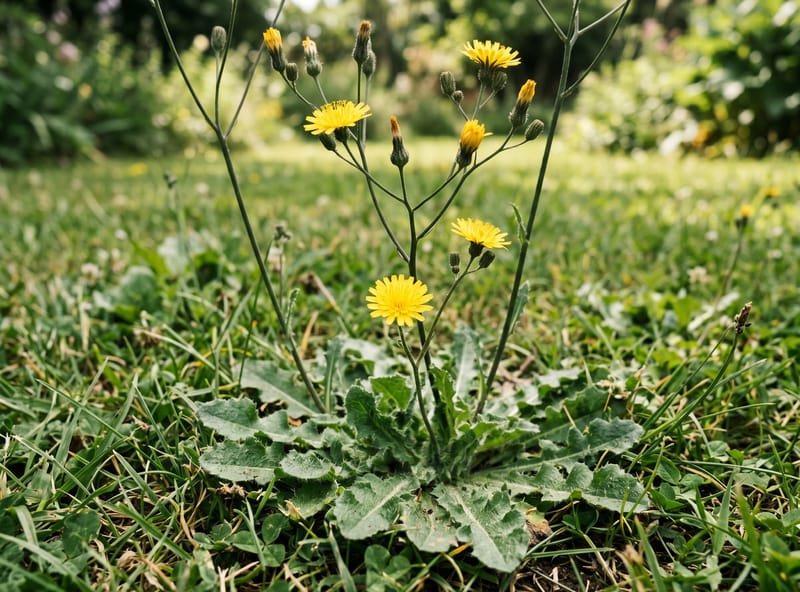
Scientific name: Hypochaeris radicata — also called false dandelion or flatweed
This is the weed most people are actually fighting when they think they are losing to dandelions. From across the yard the yellow heads look identical. Up close, cat's-ear gives itself away: the flower stalks are wiry and branched, each one carrying several heads instead of a single bloom, and the leaves are covered in coarse hairs on both sides — the felty texture that earns the "cat's-ear" name. Clemson Cooperative Extension notes it flowers all summer and peaks in September, long after the dandelion flush has faded — so a dandelion-timed treatment misses it entirely.
The tell vs. dandelion: Dandelion = one head, one smooth hollow stalk, hairless leaves. Cat's-ear = several heads on a branched, solid, wiry stalk, with hairy leaves. That branching is the fastest way to catch the impostor.
- Lifecycle
- Perennial, from a deep forked taproot
- Spreads by
- Wind-borne seed; regrows from the crown if mowed high
- Why your lawn
- Thin, low-fertility turf; tolerates drought and compaction — and mowing actually makes it flower more
- Blooms
- All summer, heaviest in September
Salacia verdict — controls it. Broadleaf and treatable. Because it persists from a crown and taproot, treat actively-growing rosettes and expect to re-hit survivors; thickening the turf afterward closes the door.
Pets: Cat's-ear is listed by the ASPCA as a concern for horses only (it can cause "stringhalt"); it is not listed as toxic to dogs or cats.
3. Yellow Hawkweed — The Cluster-Headed Copycat
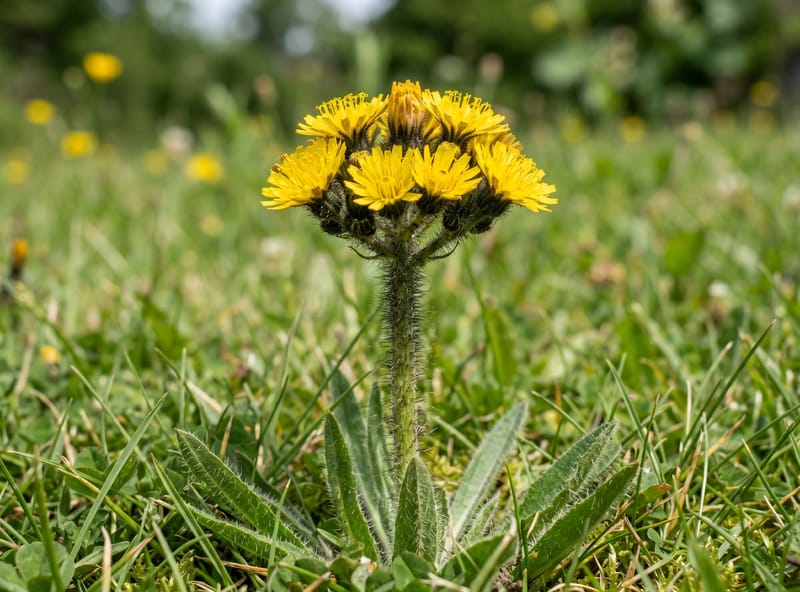
Scientific name: Hieracium caespitosum (meadow / yellow hawkweed)
The third yellow impostor takes a different shortcut: instead of one head, it bunches a tight cluster of small dandelion-like heads at the top of a bristly stem — and the plant sends up many such stems at once. The leaves are narrow, unlobed, and bristly-hairy, sitting in a basal rosette. It is a triple-threat spreader, and that is what makes it dangerous in turf.
The tell: MANY small heads clustered at the top of a hairy stem (dandelion has exactly one), and narrow unlobed hairy leaves rather than the dandelion's smooth jagged ones.
- Lifecycle
- Perennial
- Spreads by
- Wind-borne seed PLUS above-ground runners PLUS underground rhizomes — it forms dense mats
- Why your lawn
- Poor, low-fertility, well-drained soil; neglected turf and edges
- Blooms
- Mid-May into July
Salacia verdict — controls it. Broadleaf and treatable, but because hawkweed runs by rhizome and stolon, treat the whole colony — not just the flowering centers — and plan on a follow-up pass on the mat.
Pets: No authoritative toxicity listing for dogs or cats — we will not claim a hazard that the references do not establish.
4. Sow Thistle — The Tall One with the Soft Spines
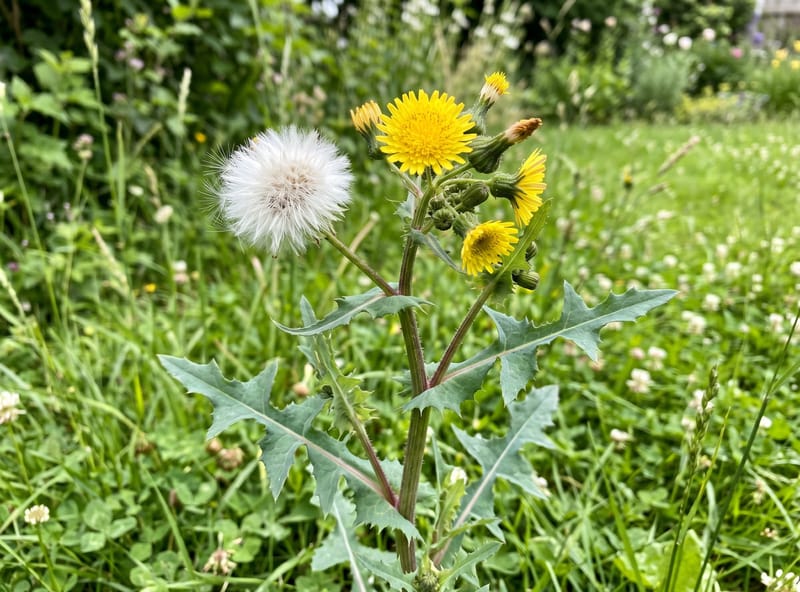
Scientific name: Sonchus oleraceus
Sow thistle is the impostor that gives itself away by standing up. While the others hug the ground in rosettes, sow thistle bolts into a tall, branched, leafy stem — up to four feet — carrying many small yellow heads that open into white puffballs. The bluish-green leaves are deeply lobed with soft, weakly prickly margins and clasp the stem with pointed, arrowhead bases. Break it and it bleeds milky sap, the family signature of the dandelion tribe.
The tell: A tall, leafy, branched plant with many heads — not a stemless rosette with one. Its look-alike is spiny sow thistle (Sonchus asper), which has rounded clasping leaf-lobes and much spinier margins.
- Lifecycle
- Annual (winter or summer)
- Spreads by
- Wind-borne seed only
- Why your lawn
- Disturbed, moist, fertile ground; thin turf, garden edges
- Blooms
- Late spring through fall, heaviest into October
Salacia verdict — controls it. Broadleaf and, as an annual that spreads only by seed, very satisfying to stop: treat it before the puffballs form and you cut off next year's crop at the source.
Pets: No authoritative dog or cat toxicity listing — no claim either way.
5. Oxalis — The Clover That Turned Yellow
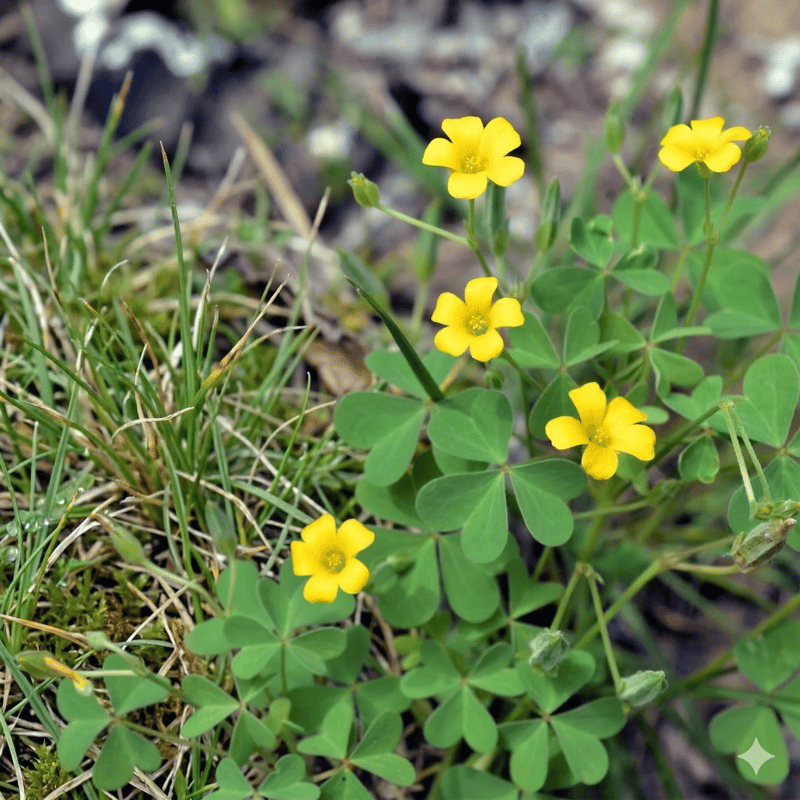
Scientific name: Oxalis stricta
Now the lineup shifts from the dandelion impersonators to the yellow weeds people mix up with clover. Oxalis is the most common of them. It looks like clover until it blooms, then betrays itself with tiny five-petaled yellow flowers. The leaflets are heart-shaped and notched — true clover leaflets are rounded — and they fold down at night and in heat. UC IPM notes its seed pods fling seed several feet when they dry and split, which is how one plant becomes a dozen.
The tell vs. clover: Yellow flower, not white or pink; heart-shaped notched leaflets, not rounded ones; okra-shaped seed pods pointing upward.
- Lifecycle
- Perennial (behaves like an annual in cold zones)
- Spreads by
- Explosive seed pods and creeping stems
- Why your lawn
- Thin, warm, open turf — it germinates whenever soil is warm
- Blooms
- Late spring through fall
Salacia verdict — controls it. Broadleaf and treatable. Salacia works by drawing moisture out of the leaf on contact, so it handles oxalis's waxy surface well — drench the patch thoroughly.
Pets: Oxalis contains soluble oxalates and is listed as mildly toxic to dogs and cats by the ASPCA if eaten in quantity — a real reason to keep grazing pets off it.
6. Black Medic — The Low-Nitrogen Tattletale
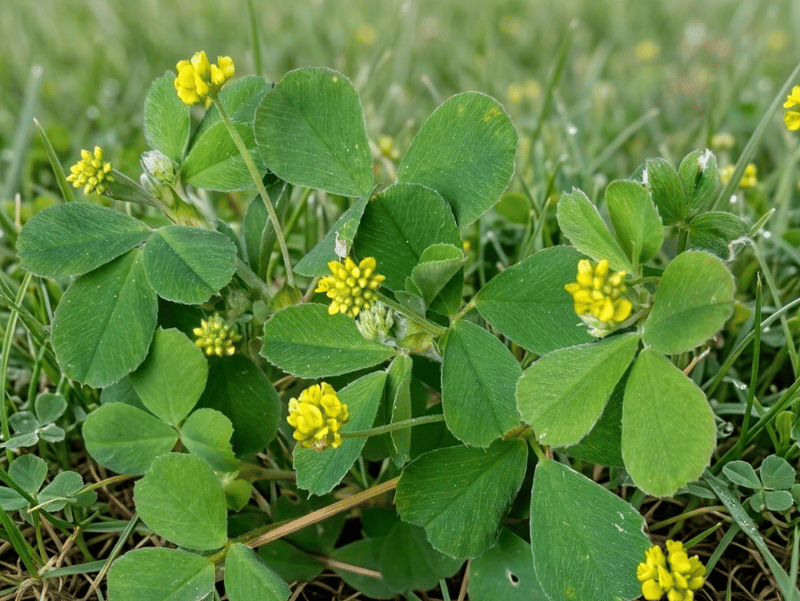
Scientific name: Medicago lupulina
Black medic sprawls flat and packs its tiny yellow flowers into tight round heads smaller than a pea. It is a legume, and University of Wisconsin Horticulture notes its arrival is a message: black medic thrives where soil nitrogen is low, so a flush of it is your lawn confessing it is underfed.
The tell vs. hop clover: black medic's seed pods coil and turn black (that is the name), and each leaflet carries a tiny tooth at its tip. Hop clover never blackens — its faded yellow flower heads simply drape papery brown over the seed.
- Lifecycle
- Annual (sometimes short-lived perennial)
- Spreads by
- Seed, from a central taproot
- Why your lawn
- Low nitrogen, thin and compacted turf — a classic underfed-lawn indicator
- Blooms
- Late spring through summer
Salacia verdict — controls it. A broadleaf legume, so it is a selective target — though like all legumes it is tougher than a dandelion; treat actively-growing plants and be ready for a second pass. Feeding the lawn afterward removes the reason it showed up.
Pets: No authoritative dog or cat toxicity listing — no claim either way.
7. Hop Clover — The Tiny Yellow Carpet
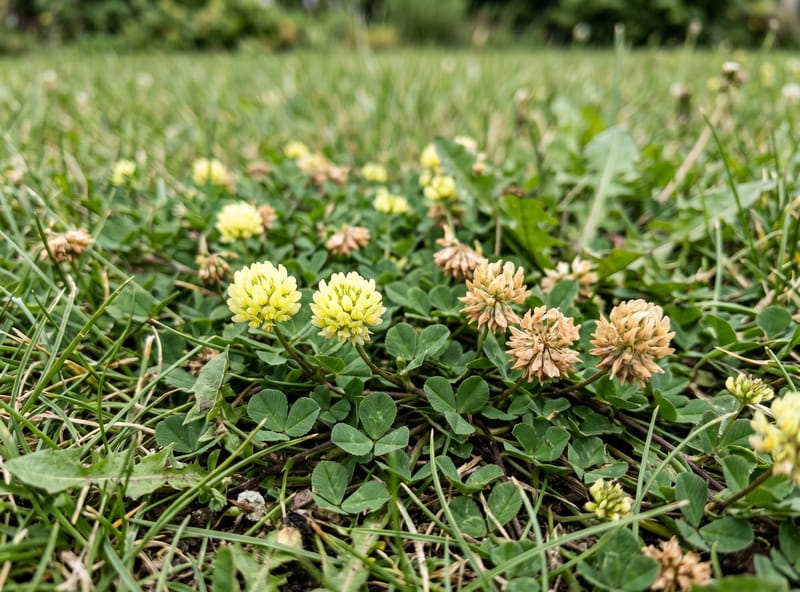
Scientific name: Trifolium dubium (and the larger Trifolium campestre)
Hop clover knits itself into low, dense patches that look like a miniature clover wearing yellow. Each pale-yellow head is a small dome that fades to a papery, hop-like tan as it goes to seed. Like black medic, it is a low-nitrogen legume — where it carpets, the turf is thin and hungry.
The tell: Three small clover-leaflets with the center one on a tiny stalk; round pale-yellow heads that dry to brown "hops." Distinguish from black medic by the seed (draped brown flower vs. coiled black pod).
- Lifecycle
- Annual
- Spreads by
- Seed
- Why your lawn
- Low-nitrogen, dry, compacted, thin turf
- Blooms
- May through October, peaking early summer
Salacia verdict — controls it. Broadleaf and treatable; as another legume, give it a thorough drench and expect a possible follow-up. The white-clover playbook overlaps — see how to kill clover in your lawn.
Pets: No authoritative dog or cat toxicity listing — no claim either way.
8. Cinquefoil — The Strawberry Impersonator
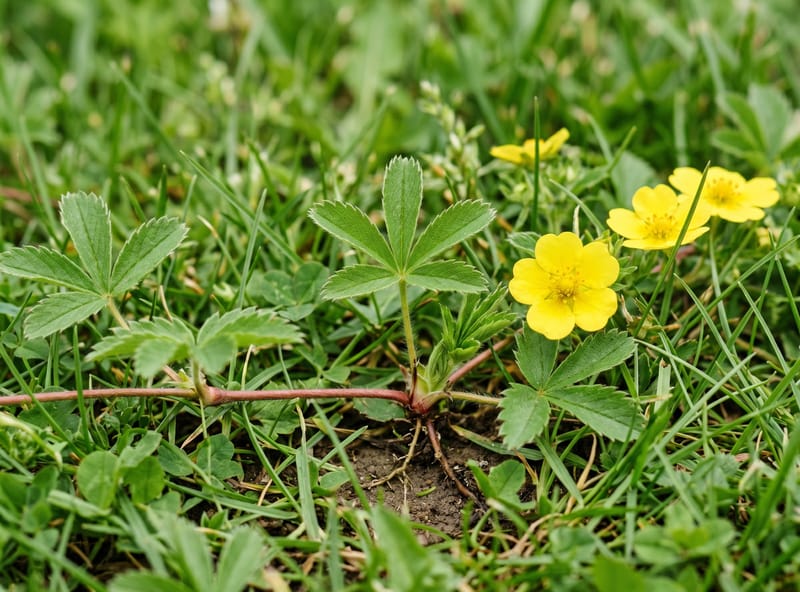
Scientific name: Potentilla spp. (creeping P. reptans; the common native P. simplex)
Cinquefoil gets mistaken for a wild strawberry because the leaves are divided into toothed leaflets and it creeps by runners that root at the nodes. The bloom settles it: bright-yellow five-petaled flowers, where a true wild strawberry blooms white.
The tell: Count the leaflets. Cinquefoil shows five fingers; strawberry shows three. Yellow flower = cinquefoil or mock strawberry; white flower = true wild strawberry.
- Lifecycle
- Perennial
- Spreads by
- Runners that root at the nodes, plus seed and a deep taproot
- Why your lawn
- Dry, compacted, low-fertility soil; thin turf the taproot can out-drink
- Blooms
- Late spring into late summer
Salacia verdict — controls it. Broadleaf. Because it spreads by rooting runners, treat the whole patch, not just the flowering crowns, so nothing is left to re-root — and check back for survivors.
Pets: No authoritative dog or cat toxicity listing — no claim either way.
9. Creeping Buttercup — The Glossy Wet-Spot Weed
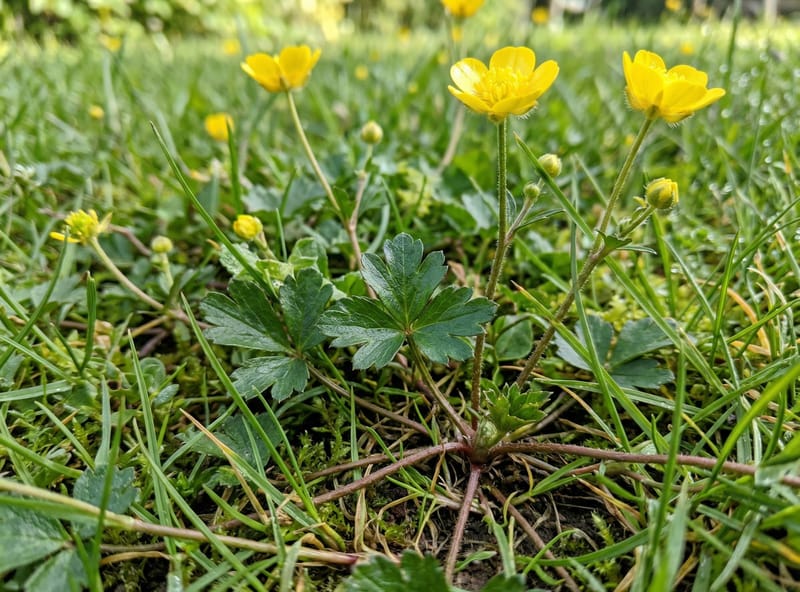
Scientific name: Ranunculus repens
Creeping buttercup is the one with the lacquered look — petals so glossy they almost shine. It claims the soggy, low-drainage corners where grass struggles, spreading by both seed and rooting runners. The leaves are deeply three-lobed, usually with pale blotches.
The tell: Varnished-looking five-petal yellow flowers and three-lobed spotted leaves, always in the wet, compacted part of the yard. The bloom shine is the giveaway.
- Lifecycle
- Perennial
- Spreads by
- Creeping runners that root at the nodes, plus seed
- Why your lawn
- Wet, poorly drained, compacted soil — it is a drainage tattletale
- Blooms
- Late spring into summer
Salacia verdict — controls it. Broadleaf and treatable. Since it flags a drainage problem, fixing the wet spot afterward is what keeps it from returning.
Pets: Buttercups contain protoanemonin and are listed as toxic to dogs and cats by the ASPCA (mouth and stomach irritation) — worth clearing where pets graze.
10. Yellow Rocket — The Tall Spring Flag
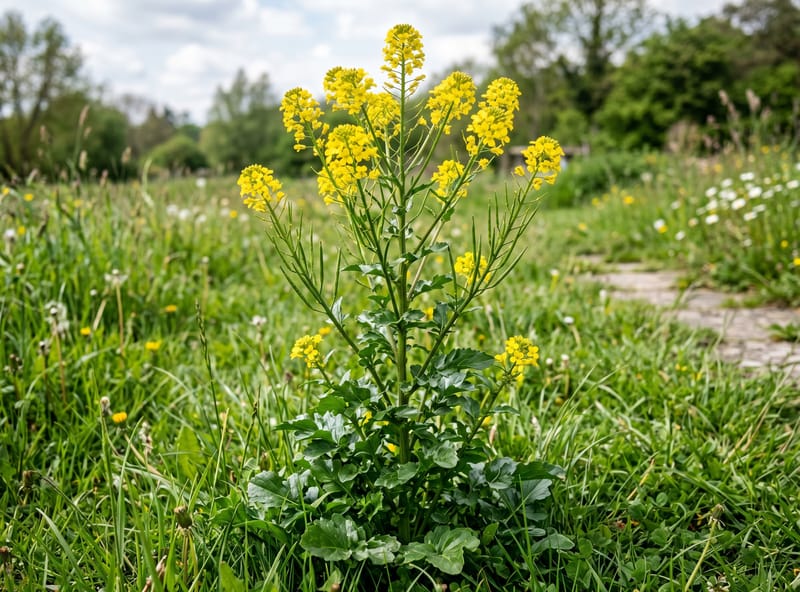
Scientific name: Barbarea vulgaris
Yellow rocket is the one that suddenly stands a foot or two above the lawn in spring and lights up whole roadsides gold. It is a mustard, and the flower proves it: small, four-petaled, in a cross. It grows from a rosette of glossy, dark-green lobed leaves and is one of the earliest yellow bloomers of the year.
The tell: Four petals in a cross (mustard family) and slender upright seed pods — not the many-petaled heads of the dandelion tribe. Its look-alike, butterweed, has daisy-type ray flowers instead of the four-petal cross.
- Lifecycle
- Winter annual / biennial
- Spreads by
- Seed
- Why your lawn
- Moist, fertile, disturbed, poorly drained low spots and edges
- Blooms
- April–May, the early-spring flush
Salacia verdict — controls it. A broadleaf mustard, so a selective target. Treat the rosette before the seed pods mature to stop the next generation.
Pets: The ASPCA lists yellow rocket as non-toxic to dogs and cats (toxic to horses only).
11. Lesser Celandine — The Spring Ghost
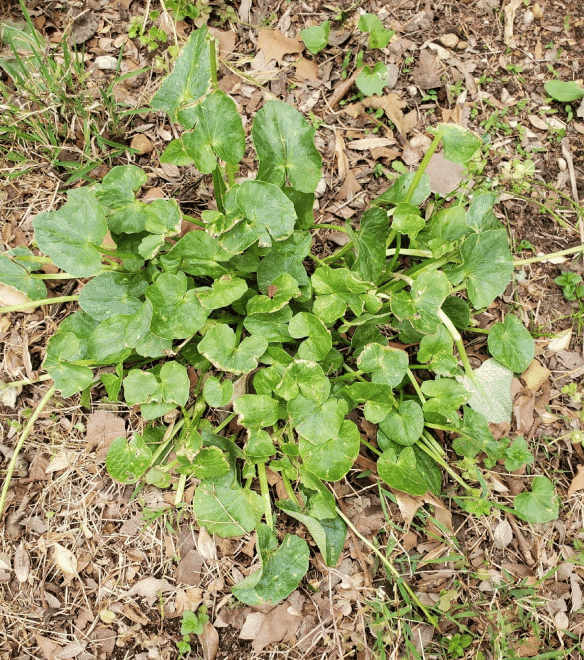
Scientific name: Ficaria verna (formerly Ranunculus ficaria) — also called fig buttercup
Lesser celandine is the spring ghost: it carpets damp, shaded ground with glossy kidney-shaped leaves and butter-yellow flowers in early spring, then vanishes underground by June. The flowers have seven to thirteen petals — more than a true buttercup's five — and it stores itself underground as tiny tubers and bulbils. It is invasive in much of the country.
The tell: Glossy heart/kidney-shaped leaves, flowers with far more than five petals, and a habit of appearing and disappearing in a single spring. The pale bulbils tucked in the leaf axils are diagnostic.
- Lifecycle
- Perennial spring ephemeral — dormant underground by early summer
- Spreads by
- Mostly tubers and bulbils (vegetative), some seed
- Why your lawn
- Moist to wet, shaded or part-shaded low areas
- Blooms
- March–May, gone by June
Salacia verdict — controls it, with realistic expectations. This is the hardest customer in the lineup: waxy leaves, a narrow early-spring window, and tuber reproduction mean a single pass usually suppresses rather than eradicates. Treat in early spring while it is actively growing, before bloom, and plan on repeating across seasons. Honesty over hype: celandine is a multi-season campaign, not a one-spray win.
Pets: As a Ranunculus-family plant it carries protoanemonin and is listed low-severity toxic to dogs and cats by NC State Extension.
12. Common Groundsel — The Flower That Never Opens
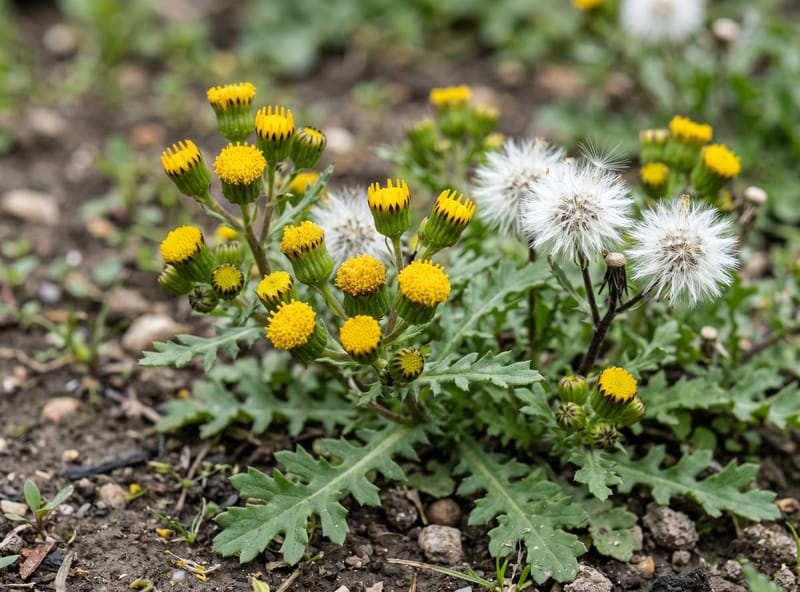
Scientific name: Senecio vulgaris
Common groundsel closes the lineup with a trick: its yellow flowers look like they never open. The small heads are rayless — cylindrical clusters of disc florets with black-tipped bracts — that go straight to a silky white puffball. It is fast, going seed-to-seed in as little as five weeks and running several generations a year.
The tell vs. butterweed: Groundsel is small and its flowers lack spreading petals (rayless); butterweed is taller with showy yellow rays and a hollow purple stem.
- Lifecycle
- Winter annual (germinates spring and fall too)
- Spreads by
- Prolific wind-borne seed
- Why your lawn
- Moist, fertile, cool, disturbed ground; thin turf and bed edges
- Blooms
- Nearly year-round in mild zones; peaks early spring and fall
Salacia verdict — controls it. Broadleaf and treatable. Because it cycles so fast, hit it early and watch for the next flush — stopping it before the puffball is the whole game.
Pets: Groundsel contains pyrrolizidine alkaloids and is listed as toxic to dogs and cats by the ASPCA (cumulative liver effects); acute poisoning is rare but it is one to clear.
The Whole Lineup, at a Glance
One product, one scan. Every weed here is broadleaf, so Salacia controls all of them — the column that changes is how you apply and when.
| Weed | The one tell | How to apply | Bloom window | Pets (dogs/cats) |
|---|---|---|---|---|
| Dandelion | One head, one hollow stalk | Spot-treat + re-hit taproot regrowth | Spring, sporadic to fall | Not listed toxic |
| Cat's-ear | Branched stalk, hairy leaves | Spot-treat rosettes; expect re-treat | All summer, peak Sept | Horses only |
| Yellow hawkweed | Cluster of heads, hairy stem | Treat the whole mat | Mid-May–July | Not listed |
| Sow thistle | Tall, leafy, many heads | Spot-treat before puffballs | Late spring–fall | Not listed |
| Oxalis | Heart-shaped notched leaflets | Drench the patch | Late spring–fall | Mildly toxic (ASPCA) |
| Black medic | Coiled black seed pods | Drench + feed the lawn after | Late spring–summer | Not listed |
| Hop clover | Pale heads drying to "hops" | Drench the carpet | May–Oct | Not listed |
| Cinquefoil | Five leaflets (not three) | Treat the whole patch | Late spring–late summer | Not listed |
| Creeping buttercup | Glossy varnished petals, wet spot | Treat patch + fix drainage | Late spring–summer | Toxic (ASPCA) |
| Yellow rocket | Four-petal cross, tall | Treat rosette before seed pods | April–May | Non-toxic (ASPCA) |
| Lesser celandine | 7–13 petals, spring-only | Early spring, multi-season | March–May | Low toxic (NC State) |
| Common groundsel | Rayless heads, never "open" | Hit early, before puffball | Nearly year-round | Toxic (ASPCA) |
Can't pick the suspect out of the lineup? You don't have to.
Homeowners mix these up constantly — that is the whole point of an impostor. Here is what actually matters: all twelve are broadleaf weeds, and Salacia controls every one of them at the selective lawn rate. Identifying the species only tells you the best timing — it does not change the tool. And if you want the species named in seconds, that is exactly what Sal is for.
Salacia is designed to be selective at the lawn rate, but temporary paling or yellowing of grass is possible depending on lawn health, irrigation, application rate, and conditions. Test a small area first.
Ready to Take Back Your Lawn?
Salacia™ is the first OMRI-certified selective organic herbicide — kills weeds, not grass. Choose your lawn size:
How to Take Them Down Without Killing Grass
The whole problem with yellow-flowered weeds is that they grow inside the lawn. Spray a non-selective product and you burn a bare patch into the turf — which just invites the next weed. The answer is selective control.
Salacia is the first OMRI-certified selective organic herbicide. It works by rapid osmotic dehydration — pulling moisture out of broadleaf weed tissue on contact — which is why it handles waxy, glossy leaves like buttercup, oxalis, and celandine. The selective lawn rate of 3 cups per gallon targets broadleaf weeds in turf; a non-selective 4 cups per gallon clears everything on hardscape and beds.
Grass-safety note: Salacia is designed to be selective at the lawn rate, but temporary paling or yellowing of grass is possible depending on lawn health, irrigation, application rate, and conditions. Test a small area first.
Match the method to the suspect
Scattered individuals (dandelion, cat's-ear, sow thistle, yellow rocket) — spot-treat. Mix the lawn rate and drench each plant to the point of runoff during active growth. For taprooted perennials, fresh growth at one to three weeks is your cue to spot-treat again and exhaust the root.
Dense colonies and runners (hawkweed, cinquefoil, buttercup, hop-clover carpets) — treat the whole patch. Follow the runners and wet the entire colony, not just the flowering centers, so nothing is left to re-root. Stop at the colony's edge — there is no reason to blanket healthy grass.
The honest part: the legumes (black medic, hop clover) and lesser celandine are genuinely tougher and may need a second pass or a second season. That is not the product failing — it is a stubborn root system spending down its reserves. The elbow grease is the price of doing it without synthetic chemistry, and it is a price worth paying.
For timing by season and region see the timing and application guide; for the science of how a selective herbicide separates weeds from grass, read how selective herbicides work. Fighting other colors too? See our guides to weeds with purple flowers and weeds with white flowers.
See the Results
Real lawns, real yellow-flowered weeds — Salacia clears the broadleaf weed while the surrounding grass keeps growing.
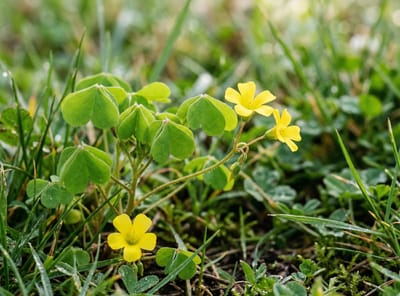 BEFORE
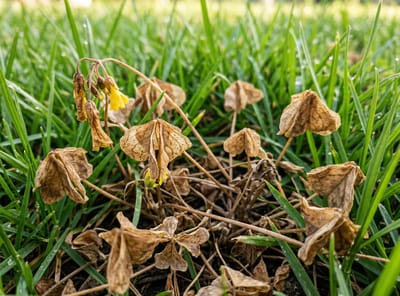 AFTER
AFTEROXALIS
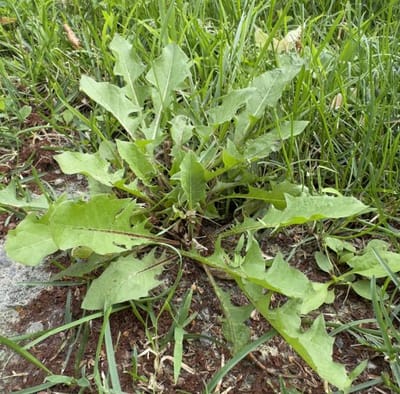 BEFORE
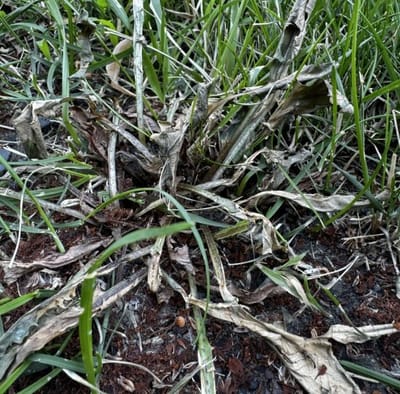 AFTER
AFTERDANDELION
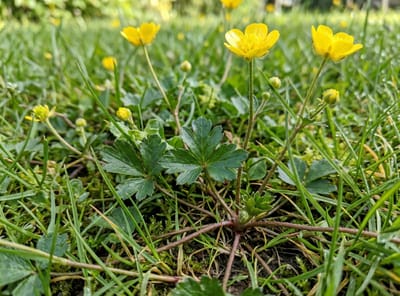 BEFORE
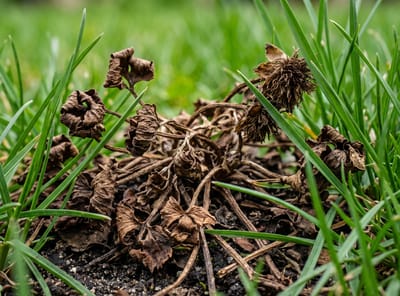 AFTER
AFTERCREEPING BUTTERCUP
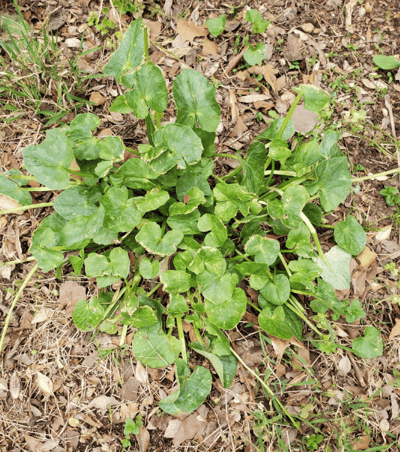 BEFORE
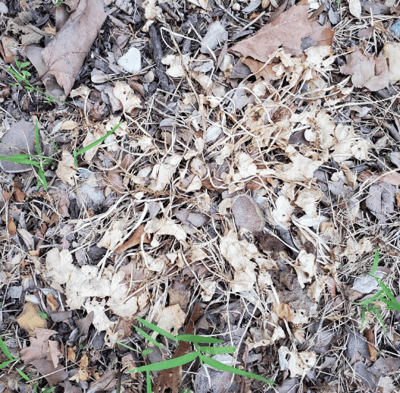 AFTER
AFTERLESSER CELANDINE
Browse every weed Salacia controls, with ID photos and before-and-after sets, in the complete Weed Control Guide.
Keep reading: grassy weeds and their lookalikes.
Identified your weed?
Every broadleaf weed in this guide responds to the same selective approach. The next step is our ranked guide to the best weed killer that won't kill grass.

Lawn
Advisor
Not sure which weed you're looking at? Show Sal.
Sal is Lanaturo's lawn-care expert. He doesn't just name the weed — he builds your exact treatment plan and checks whether today is the right day to spray.
Ready to Take Back Your Lawn?
Salacia™ is the first OMRI-certified selective organic herbicide — kills weeds, not grass. Choose your lawn size:
Case Closed
The yellow flowers in your lawn are not one weed — they are a lineup of impostors, each spreading on its own schedule. But they share a weakness: every one is a broadleaf, and that is the opening. Name the suspect to time it right, then let a selective approach treat it as exactly what it is — while the grass keeps doing its job.
Salacia is designed to be selective at the lawn rate, but temporary paling or yellowing of grass is possible depending on lawn health, irrigation, application rate, and conditions. Test a small area first.
Pet Friendly. OMRI certified. The first selective organic herbicide — built for exactly this.
This article is for informational purposes. Always follow product label directions for application rates, timing, and use. Salacia is OMRI certified organic and labeled Pet Friendly. Pet-toxicity notes reference the ASPCA Animal Poison Control plant database and NC State Extension; consult your veterinarian for specific concerns.