
 By Pat Kelly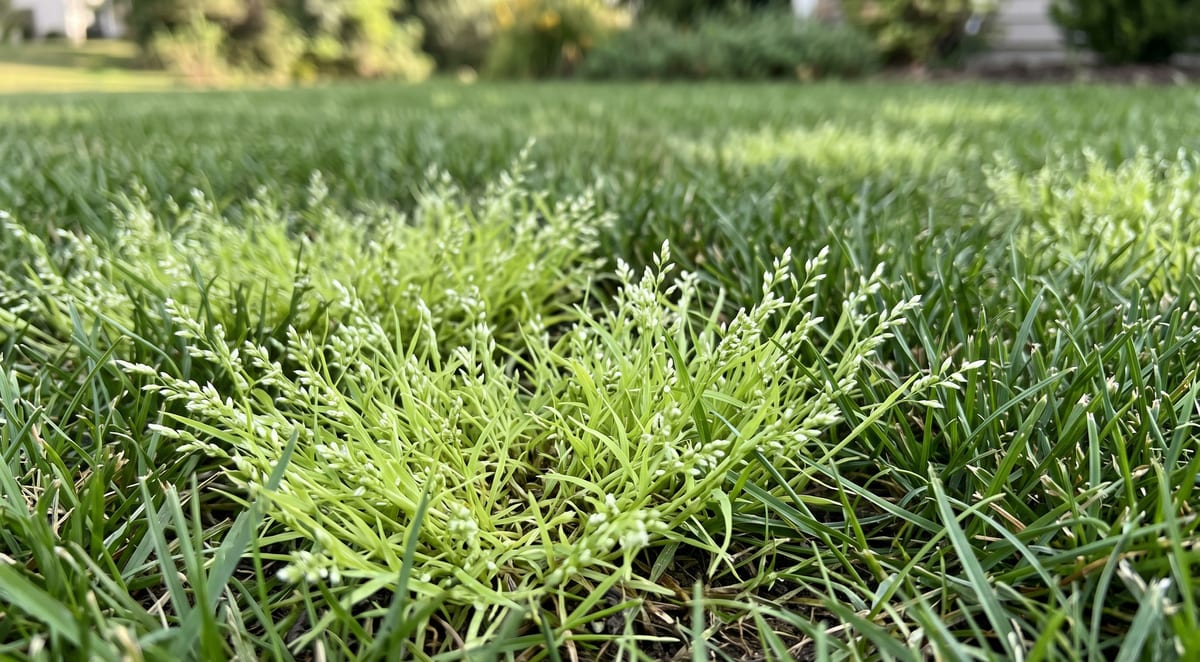
Poa annua is the weed most weed killers pretend they can handle. It's a grass growing inside your grass — lighter green, seeding at mowing height, gone by summer, back by Halloween. And here's the sentence most product pages will never print: you cannot spray one grass out of another with a selective lawn treatment — organic or otherwise from our shelf. We sell a weed killer, and we're telling you that plainly. What actually beats poa annua is a calendar and a plan, and late summer — right now — is when the plan starts.
The short answer: Poa annua is a grassy weed, so the selective lawn rate of Salacia — built for broadleaf weeds like dandelion and clover — is not the tool for it. What works: deny it the fall germination window with a dense, overseeded lawn; hand-pull scattered tufts (it's shallow-rooted); and for dense patches, do a small spot renovation — mow low, drench the patch with Salacia at the non-selective rate of 1.5 lb (about 4 cups) per gallon until the soil is soaked, repeat as the seed bank re-germinates, then reseed thick. The non-selective rate kills grass too — that's the point of a renovation, so keep it strictly inside the patch.
Not sure it's poa annua?
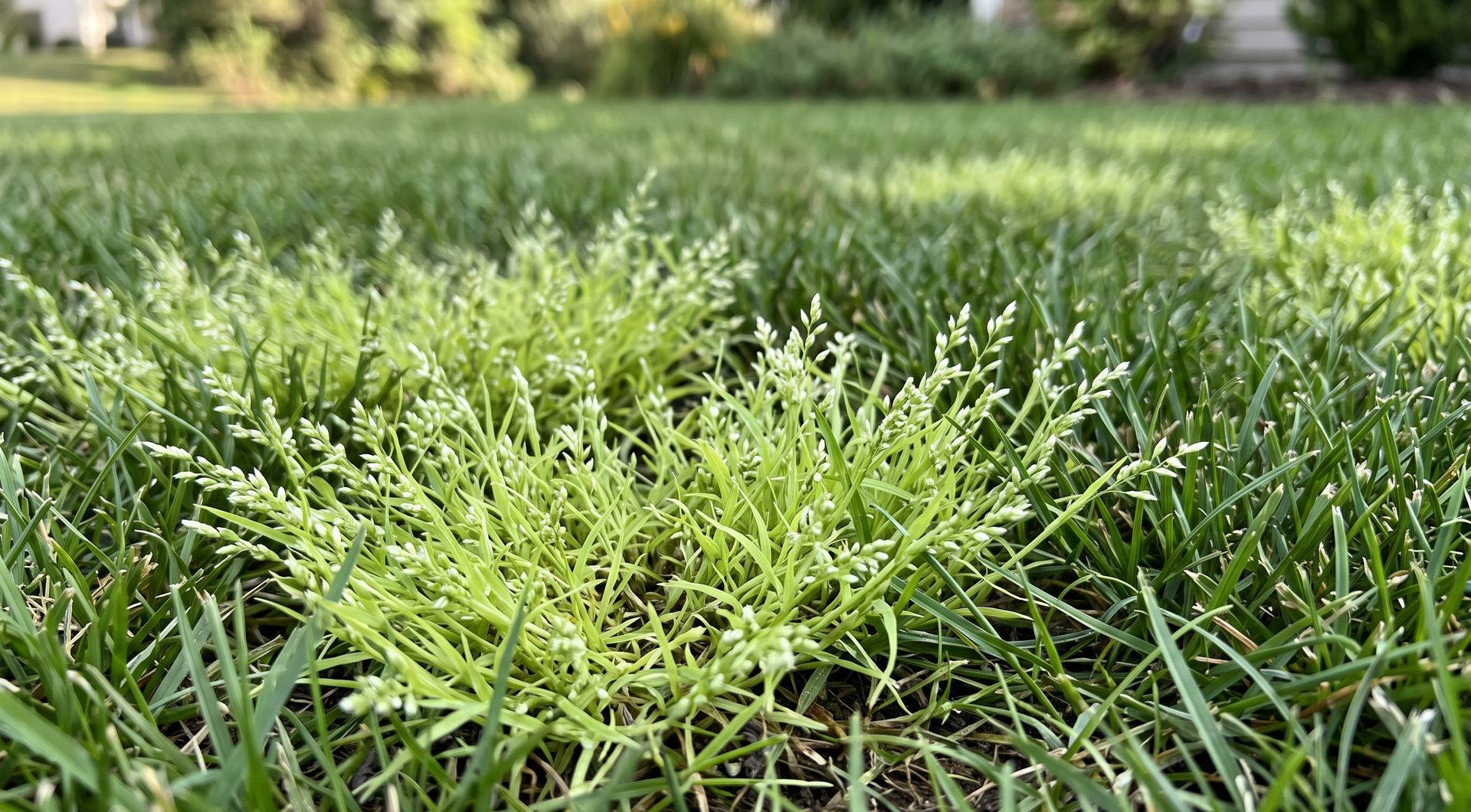
Low tufts noticeably lighter than the rest of the lawn, a boat-shaped tip on every blade, and whitish seed heads that show up even right after mowing — that's poa annua. If your invader looks different, it may be another of the nine grass lookalikes — or snap a photo and send it to Sal, our free weed-ID assistant, right on this page. See how Sal works →
Poa Annua ID in 30 Seconds
Poa annua (Poa annua, annual bluegrass — also called winter grass) hides in plain sight because it is grass. Three tells give it away. First, color: it grows in low tufts of a light, almost lime green that reads a shade too bright against the rest of the lawn. Second, the leaf tip: like all bluegrasses, each blade ends in a distinctive boat-shaped tip, curved up at the end like the prow of a canoe. Third — the giveaway — the seed heads: small, whitish, and stubborn, appearing at or below mowing height, so the lawn looks speckled white days after you mowed it. It's shallow-rooted, which matters later: individual tufts pull up easily, especially from damp soil.
- Light, lime-green tufts that stand out against darker turf
- Boat-shaped leaf tips — the bluegrass family signature
- Whitish seed heads at mowing height, even on a freshly cut lawn
- Winter annual — germinates as soils cool in late summer and fall, thrives in the cool months, dies in summer heat
- Shallow roots — tufts hand-pull easily when the soil is moist
If yours doesn't match, run it past our guide to the nine weeds that look like grass — crabgrass, nutsedge, and quackgrass each get mistaken for poa constantly, and each demands a different plan. Botanical references: the NC State Extension plant profile and the UMass Amherst Extension weed herbarium.
The Poa Calendar (Why Fall Decides Everything)
Poa annua is a winter annual: it lives its whole life in the school year, not the summer. Lay the calendar out and the strategy writes itself.
One year in the life of a poa annua plant
Late August–October: Seeds germinate as soils cool — into every thin spot, scalp mark, and compacted strip your lawn is carrying out of summer.
Winter: It grows happily in the cool months. In southern lawns it's the bright-green invader spreading across dormant, tan warm-season turf — impossible to miss and, in a living lawn, impossible to spray out selectively.
Early spring: Seed-head season. Whitish tips at mowing height, each one restocking the soil — poa annua is a prolific seeder, and mowing short does not stop it.
Late spring–summer: Heat kills it. The tufts fade to tan and thin out — leaving bare pockets and a reloaded seed bank, both waiting for fall.
Read that twice and you'll see the trap most homeowners fall into: they notice poa in spring, fight it while it's already dying, then celebrate a "win" summer was going to hand them anyway. The seeds don't care. The real contest happens in late summer and fall, at germination — which is why the two moves that follow are a fall renovation and a fall lawn-thickening program, not a spring spray. Our timing and application guide covers the same when-beats-what logic for every weed on your list.
The Only Direct Kill That Works: Spot Renovation
Honesty first: a selective treatment removes broadleaf weeds from grass because they're built differently from grass. Poa annua is grass. No organic product can pull one grass out of another selectively — ours included — and anything promising that with a casual spray deserves your suspicion. So the direct-kill play accepts a trade: you take out the patch, weed and turf together, and rebuild it. Worth it for dense, established colonies; overkill for scattered tufts, which you simply hand-pull after rain and reseed.
1. Mow the patch low first
Don't waste product on long stems. Cut the patch short so the spray reaches crowns and soil instead of riding on top of the canopy.
2. Drench at the non-selective rate
Mix Salacia at 1.5 lb (about 4 cups) per gallon of water — the non-selective rate — and drench the patch until the soil is soaked. Salacia works by rapid osmotic dehydration on contact: if the spray doesn't touch it, it doesn't kill it. Poa annua is shallow-rooted, so a soil-soaking drench reaches the whole root zone and the plant responds fast. Pick a calm morning between 60 and 80 degrees Fahrenheit with no rain in the near forecast.
3. Expect two to three rounds
The patch you killed sits on a seed bank, and cool soil will keep germinating it. When new seedlings appear, drench again. Two to three applications, each catching the next wave young, is the realistic plan — not a one-and-done.
4. Reseed thick, immediately
A bare patch in fall is a poa annua invitation with your name on it. As soon as the last wave stops emerging, rough up the soil and overseed heavily with your lawn's grass — the new stand and any remaining poa seeds are now racing for the same light, and a thick stand wins.
The non-selective rate kills whatever vegetation it touches — grass included. That is what makes a renovation work; keep it strictly inside the patch you're resetting, and shield turf you want to keep. For poa annua in driveways, gravel, patios, and beds, the same rate is the whole answer: drench, let it collapse, sweep it out. No reseeding, no trade-offs.
Ready to Take Back Your Lawn?
Salacia™ is the first OMRI-certified selective organic herbicide — kills weeds, not grass. Choose your lawn size:
Build a Lawn Poa Annua Can't Enter
Every poa annua plant in your spring lawn walked through a door your lawn left open last fall: a thin spot, a compacted strip, a scalped edge, bare soil catching light. Close the doors and the invasion has nowhere to land. The prevention program is ordinary lawn care — aimed at the right season:
Overseed in early fall — the exact window poa germinates, so your new grass competes with it for every opening. Mow at the top of the recommended height for your grass type, so the canopy shades the soil surface where poa seeds wait. Feed in fall, so the lawn thickens going into the cool season instead of thinning. Aerate compacted areas — poa annua loves compacted, damp edges where better grass struggles. And through spring seed-head season, never let a dense patch keep seeding: poa makes seed heads below mowing height, so the mower alone won't stop the restock — that's what the renovation above is for.
None of this is glamorous. All of it compounds: each fall with fewer open doors means a thinner poa year, a smaller seed bank, and a lawn that defends itself. Density is not a tip — for poa annua, it's the whole war.
Where Poa Annua Hits Hardest
The South: This is poa annua's showcase. Bermuda, St. Augustine, zoysia, and centipede lawns go tan and dormant in winter — and poa stays bright green on top of them, turning dormant lawns into speckled patchworks. The one mercy: on a fully dormant lawn the fight is simpler, because there's no living turf to protect inside the patch. If winter weeds in warm-season grass are your battle, our guides to weeds in bermuda grass and weeds in St. Augustine grass map the whole winter crew.
The transition zone and North: Poa blends into cool-season lawns until it betrays itself twice — whitish seed heads in spring, then tan die-off patches in summer heat that make a green lawn look moth-eaten in July. Those summer bare spots are next fall's germination sites; treat the die-off as a to-do list for September overseeding.
Everywhere: irrigated edges, compacted paths, shaded damp corners. Wherever your best grass is weakest, poa annua is strongest.
Poa annua never invades alone
The same thin fall lawn that admits poa also admits the broadleaf winter annuals — henbit and chickweed germinate in the very same window. Those, unlike poa, are exactly what a selective treatment is for: Salacia is the first OMRI-certified selective organic herbicide, naturally derived and Pet Friendly, and at the selective lawn rate it takes out the broadleaf invaders while being designed to spare your grass — always test a small area first. Sorting out which of your weeds is which? The grass-lookalike guide and our guide to weed killers that won't kill grass cover both sides of the line, the full weed control guide covers the whole lawn — or just ask Sal with a photo.

Lanaturo
Intelligence
Not sure which weed you're looking at? Show Sal.
Sal is the lawn-care brain behind Lanaturo Intelligence. He doesn't just name the weed — he builds your exact treatment plan and checks whether today is the right day to spray.
Ready to Take Back Your Lawn?
Salacia™ is the first OMRI-certified selective organic herbicide — kills weeds, not grass. Choose your lawn size:
Win It in the Window
Poa annua doesn't lose to a spray in spring — it loses to a lawn that shut the door in September. Renovate the dense patches. Pull the stragglers. Overseed every opening in early fall, and let summer finish whatever's left. A year from now the white seed heads are someone else's problem.
OMRI certified organic · Pet Friendly · Always test a small area first
Honest answers beat easy promises.
This article is for informational purposes. Botanical references: NC State Extension, UMass Amherst Extension. Always follow product label directions for application rates, timing, and use.