
 By Pat Kelly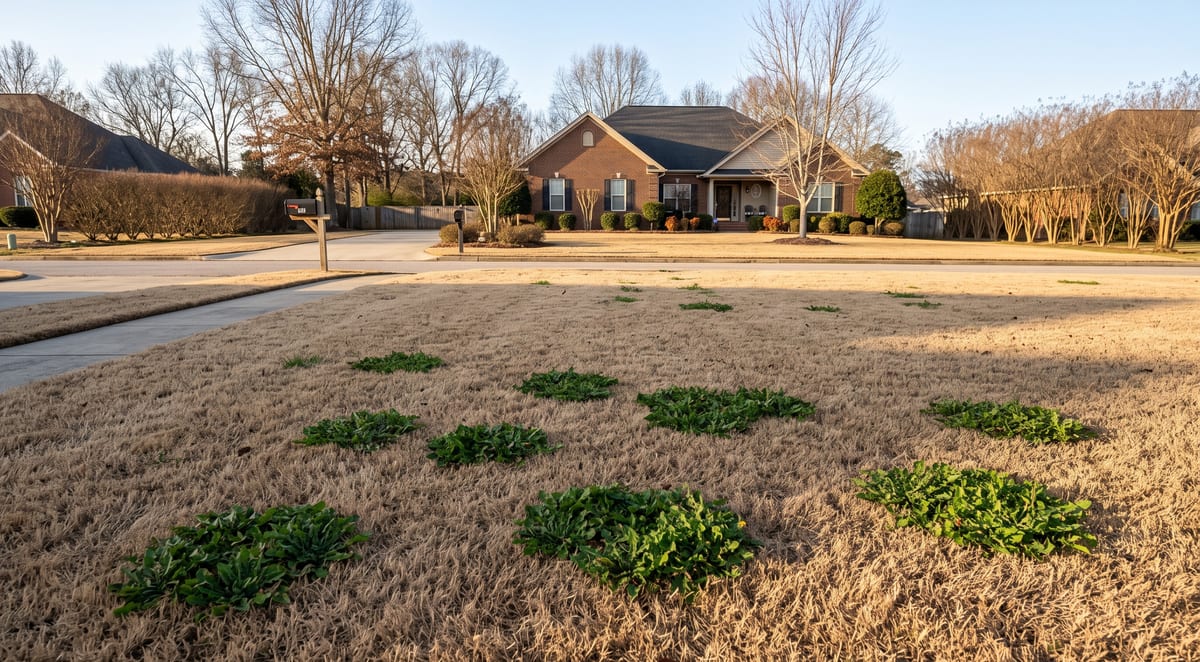
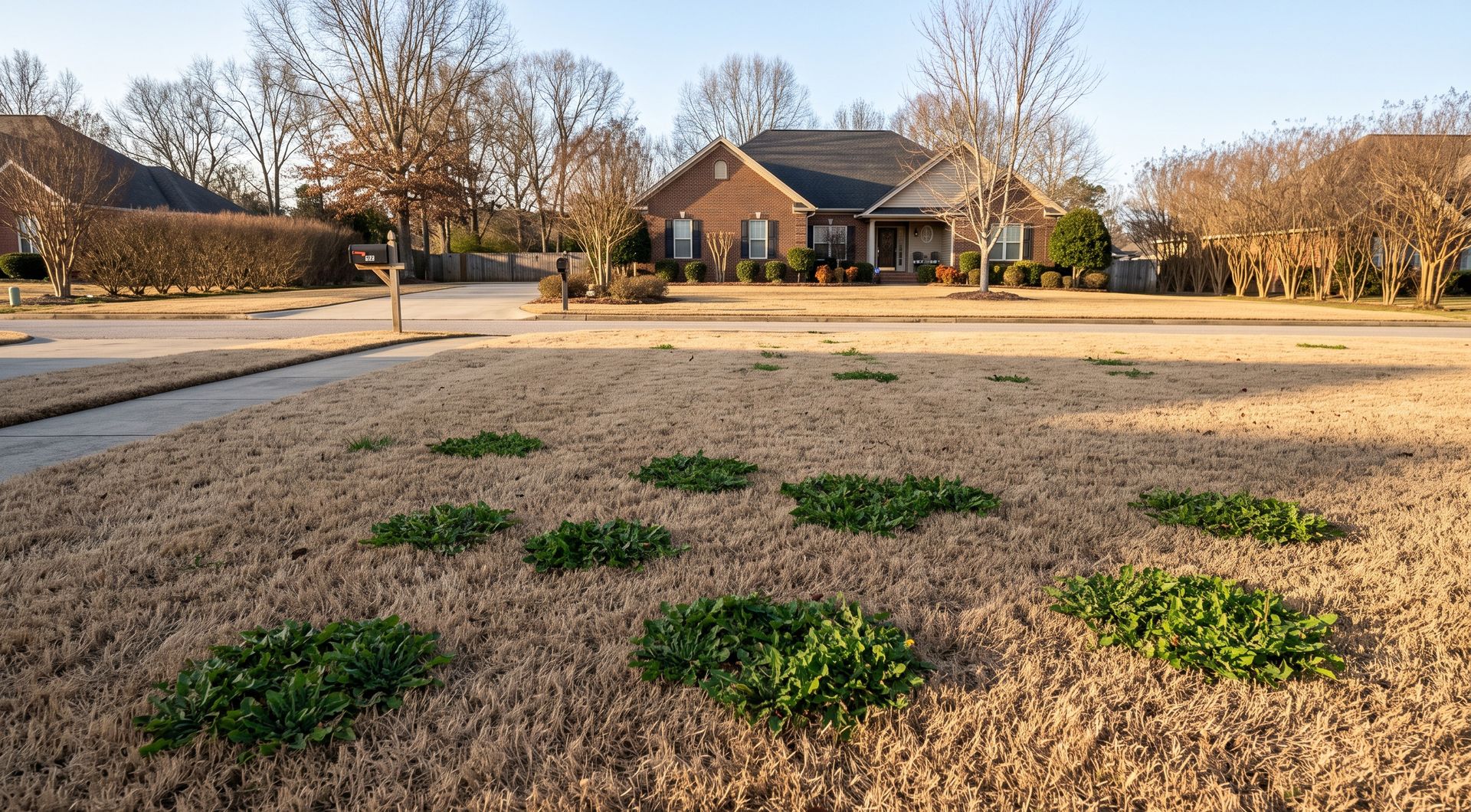
In July, your bermuda lawn is a fortress. Mowed low, fed right, running on rhizomes and stolons, it outmuscles almost anything that tries to move in. Then November comes, the bermuda goes brown and dormant — and every weed in the neighborhood gets four months of empty, undefended real estate. That's why the picture above exists in a million southern front yards each winter: a tan lawn polka-dotted with defiantly green weeds.
Understanding that rhythm is the entire game with bermuda. Its weed calendar is inverted: the season you're outside looking at the lawn is the season it needs you least, and the months you ignore it are when the invasion happens.
The short answer: Bermuda's weed problem is mostly a winter problem. Cool-season annuals — henbit, chickweed, Carolina geranium, purple deadnettle, annual bluegrass — germinate in fall and grow all winter on the dormant turf. The broadleafs among them can be treated with a selective organic herbicide on mild days (and they're the easiest targets of the year — anything green on a brown lawn is a weed); prevention is a dense summer lawn plus a fall pre-emergent window in late September to early October. Summer's short list — spurge, oxalis, crabgrass, nutsedge — mostly signals thin or stressed spots in the turf.
Green spots on your brown lawn?
Winter is the easiest ID season you'll ever get. Photograph one of those green patches and send it to Sal, our free weed-ID assistant, right on this page — he'll name it and hand you the honest treatment plan. See how Sal works →
The Inverted Calendar: Why Winter Is Bermuda's Weed Season
Growing season (roughly May–September): bermuda at full speed is one of the most competitive lawns on earth. Dense, low, aggressive — most weeds simply lose the fight for light. Whatever shows up in summer is exploiting a thin spot, a scalp mark, or a drainage issue.
Dormancy (roughly November–March): the grass shuts down, browns out, and stops competing entirely. Meanwhile the winter annuals germinated back in fall are wide awake, growing in full sun with zero opposition. By February the lawn is a brown canvas with green paint splattered across it.
The pivot points are fall and green-up. What you do in late September (prevention) and how you handle the green patches of winter decide whether April's lawn opens clean or choked.
The Winter Lineup: Green-on-Brown Giveaways
These are the cool-season invaders that own dormant bermuda across the South — per the Clemson bermudagrass maintenance calendar, the classic set is henbit, chickweed, and their traveling companions:
| Weed | Winter tell | Broadleaf? | Our guide |
|---|---|---|---|
| Henbit & purple deadnettle | Square stems, purple flower tops by late winter | Yes | The purple invasion |
| Common chickweed | Bright-green sprawling mats, tiny white star flowers | Yes | Chickweed guide |
| Carolina geranium | Lacy, deeply cut rosettes on reddish stems | Yes | Carolina geranium guide |
| Clover | Green trifoliate patches that never went dormant | Yes | Clover guide |
| Annual bluegrass (Poa annua) | Lime-green grassy tufts with whitish seedheads | No — a grass | Grass-like weeds |
| Wild garlic / onion | Upright hollow green spears in clumps | No — dig them | Hand-dig, bulbs and all |
Here's the silver lining nobody mentions: dormant season is the easiest targeting you will ever get. There's no "is that a weed or is that lawn?" — if it's green in January, it's not your bermuda. Identification, spot-treating, and hand-pulling are all at their most foolproof exactly when the weeds think they're winning.
The Summer Lineup: What Breaks Through a Healthy Bermuda
When bermuda is awake, weeds need an opening. The ones that find it:
- Spotted spurge — flat mats in hot thin edges and scalped spots. Broadleaf; see the spurge guide.
- Oxalis (wood sorrel) — clover-lookalike with yellow flowers, loves thin turf. Broadleaf; covered in weeds with yellow flowers.
- Lespedeza — the wiry mat that thrives where the lawn is hungry and compacted. Broadleaf.
- Crabgrass & dallisgrass — grasses; no selective product, organic or synthetic, pulls one grass from another. Prevention calendar in the crabgrass guide.
- Nutsedge — the drainage tattletale; a sedge, not a grass. The nutsedge guide is the drainage-first plan.
Notice the pattern: summer weeds in bermuda are diagnostics. Spurge says "thin and hot," lespedeza says "hungry and compacted," nutsedge says "wet." Fix the condition and the weed loses its lease.
Treating Weeds in Bermuda, Honestly
1. Broadleafs: selective organic, on the right day
Every broadleaf above sits in the category a selective organic herbicide is built for. Salacia — the first OMRI-certified selective organic herbicide, made by Lanaturo — mixes at the selective lawn rate (1 lb / 3 cups per gallon) and gets sprayed to wet the weed to runoff. Pick a calm, mild day in the 60–80°F window with no rain expected for at least 4 hours — southern winters serve up plenty of them — and always test a small area first; temporary paling of grass is possible. Full conditions in our timing guide.
2. Know why the synthetic route is touchy here
An honest note from the extension literature: bermuda is sensitive to some common synthetic broadleaf actives — Clemson's calendar flags 2,4-D specifically, advising reduced rates and caution, especially during spring green-up when the turf is most vulnerable. It's one more reason the dehydration-not-poisoning route, tested on a small area first, is a comfortable fit for this grass.
3. Prevention: the late-September window
The winter invasion is decided in fall. Clemson's calendar puts the pre-emergent window for winter annuals at late September to early October, once air temperatures hold 65–70°F for about four straight days. Whatever your prevention strategy, that's the date that matters — plus a dense, well-fed lawn going into dormancy, which is prevention that costs nothing.
4. Grasses and sedges: culture, not spray
Poa annua, crabgrass, dallisgrass and nutsedge don't have an organic spray answer in turf, and we won't pretend otherwise — the honest playbooks are in their guides above. Wild garlic gets the trowel.
Ready to Take Back Your Lawn?
Salacia™ is the first OMRI-certified selective organic herbicide — kills weeds, not grass. Choose your lawn size:
The Bermuda Advantage: Density as a Weapon
Bermuda gives you something St. Augustine and centipede owners only dream about: a turf that, at full health, does most of the weeding for you. The maintenance that gets it there:
- Mow low, often, and consistently — bermuda thrives at heights most grasses can't survive (roughly 1–2 inches for common types), and frequent mowing at its proper height is what builds the density that closes doors on weeds.
- Feed it in season — bermuda is a heavy feeder during summer growth. A hungry bermuda lawn thins, and thin is where spurge and lespedeza move in.
- Repair fast — scalp marks, grub damage and traffic paths are weed nurseries. Bermuda spreads aggressively; water and feed it into closing its own gaps in summer.
- Respect dormancy — a brown bermuda lawn isn't a dead one. It's asleep. The weeds are the intruders, and winter is when you can see every single one of them.
The Rest of the Southern Lineup
Bermuda country overlaps chamberbitter country, geranium country and crabgrass country. If your green-on-brown patches turn out to be the summer crew instead, we've profiled the whole southern parade: chamberbitter, Carolina geranium, the Texas tour, and the ranked guide to the best weed killer that won't kill grass.
Salacia is the first OMRI-certified selective organic herbicide: naturally derived, Pet Friendly, and built for the broadleaf side of your bermuda lawn's ledger. Send Sal a photo of any green intruder and get the ID plus the honest answer in seconds.

Lanaturo
Intelligence
Not sure which weed you're looking at? Show Sal.
Sal is the lawn-care brain behind Lanaturo Intelligence. He doesn't just name the weed — he builds your exact treatment plan and checks whether today is the right day to spray.
Ready to Take Back Your Lawn?
Salacia™ is the first OMRI-certified selective organic herbicide — kills weeds, not grass. Choose your lawn size:
Fight the Winter War, Enjoy the Summer Peace
A bermuda lawn rewards anyone who learns its inverted calendar. Build density all summer, hit the late-September prevention window, and treat winter's green intruders while they're the only green thing on the lawn. Do that one full cycle and next winter's polka dots get sparse — while the July fortress takes care of itself.
Salacia is OMRI certified organic and labeled Pet Friendly. Designed to be selective at the lawn rate; temporary paling of grass is possible — always test a small area first and follow label directions.
Pet Friendly. OMRI certified. Honest about what it does — and doesn't.
This article is for informational purposes. Agronomic guidance references the Clemson Cooperative Extension bermudagrass maintenance calendar and related extension resources. Always follow product label directions.