
 By Pat Kelly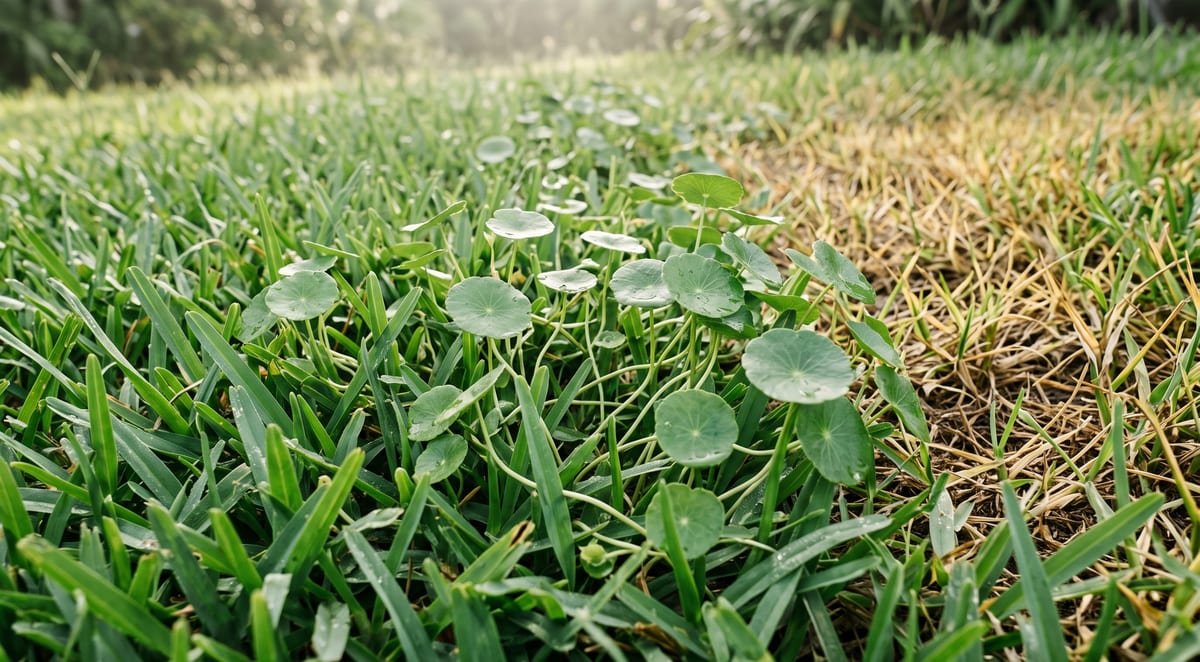
St. Augustine owners live a specific tragedy: the weed shows up, they grab a bottle that worked fine on a cousin's fescue up north — and two weeks later the weed looks bruised while the lawn looks dead. St. Augustine is the most herbicide-sensitive major lawn grass in the South. Fighting weeds in it starts with respecting that fact, because here the wrong product routinely does more damage than the weed ever would.
The short answer: Weeds in St. Augustine follow openings — chinch-bug patches, shade-thinned areas, scalp marks, and chronically wet ground. Read the weed as the diagnosis (dollarweed and sedges = too much water; spurge and oxalis = hot thin spots), fix the opening, and treat the broadleafs with a product you have verified against your grass — checking the label matters more on St. Augustine than on any other southern lawn. A selective organic route applied to a small test area first, on a mild calm day, is the careful way in.
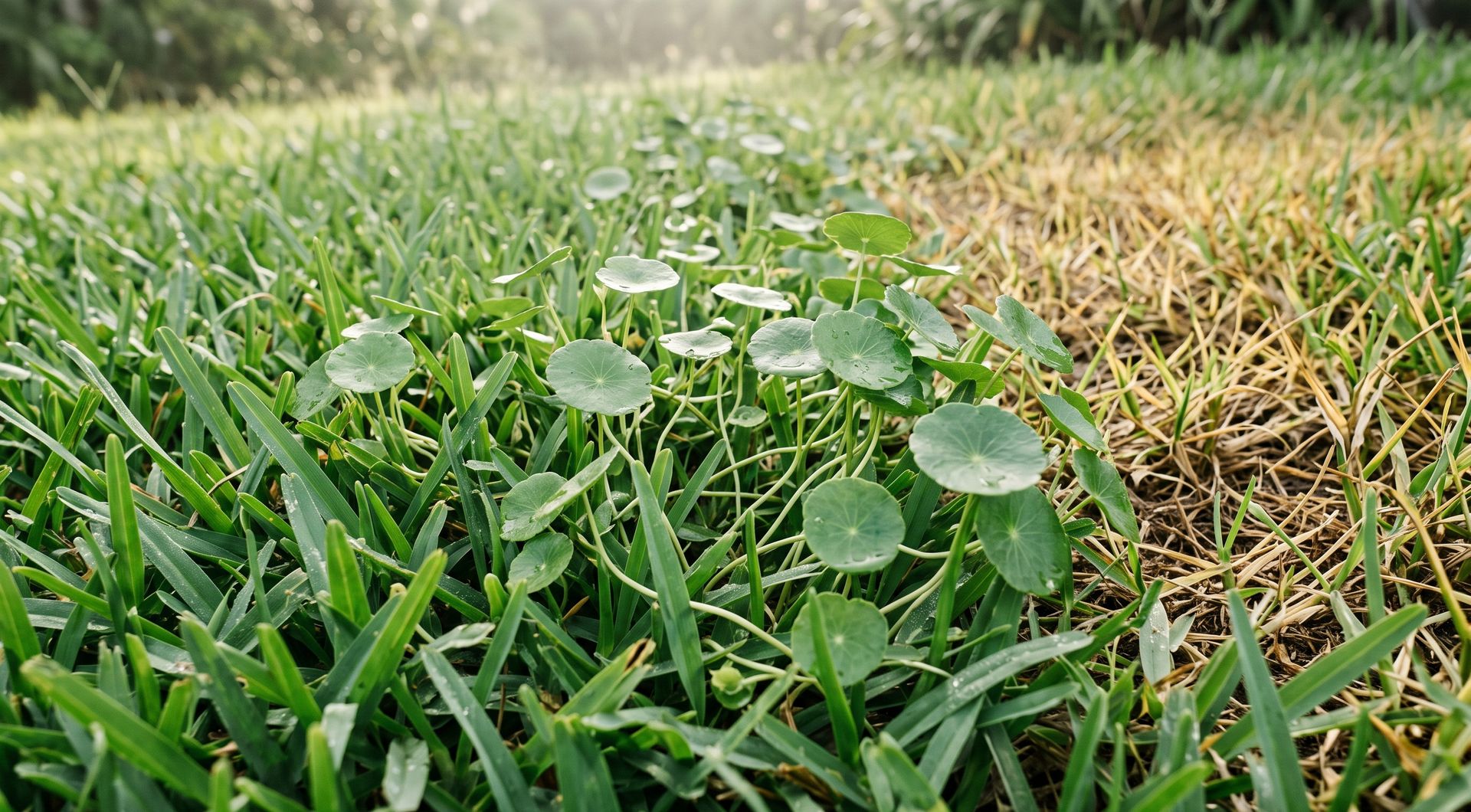
Round leaves marching through your lawn?
That's probably dollarweed — the signature invader of overwatered St. Augustine. Photograph it and send it to Sal, our free weed-ID assistant, right on this page, for the ID and the honest treatment plan. See how Sal works →
Why St. Augustine Is Different: The Sensitivity Problem
Every herbicide aisle is written for the average lawn. St. Augustine is not the average lawn. The UF/IFAS St. Augustinegrass guide flags its sensitivity to common synthetic actives like 2,4-D — the backbone of most "weed and feed" and combination broadleaf products — and even atrazine, the active most associated with St. Augustine lawns, carries temperature restrictions on popular varieties (not for use above roughly 85°F on Floratam, which in the Gulf South rules out most of the summer).
The practical rule: on St. Augustine, the label is not fine print — it's the whole decision. Before anything touches this grass, confirm your exact species (and ideally variety) is listed, and respect every temperature and rate restriction on the label.
It's also why the organic route fits this grass so naturally: a selective organic herbicide that works by dehydration rather than synthetic growth-regulator chemistry, applied first to a small test area on a mild day, lets you verify how your lawn responds before you commit — instead of finding out the hard way across the whole yard.
The Openings Principle: Chinch Bugs, Shade, and Scalping
A dense, healthy St. Augustine lawn is a thick, coarse carpet that few weeds penetrate. Weeds get in where the carpet opens — and St. Augustine has three signature ways of opening:
1. Chinch bug patches
The southern chinch bug is St. Augustine's number-one insect enemy — UF/IFAS documents it producing irregular yellow-to-brown dead patches, usually starting in hot, sunny, drought-stressed areas near pavement. Every patch it kills becomes open real estate, and weeds move in while you're still diagnosing the bug. If dead patches precede your weed problem, solve the chinch bugs first or the weeds will keep re-renting the space.
2. Shade thinning
St. Augustine is the most shade-tolerant of the warm-season lawns — but "most tolerant" isn't "immune." Under heavy tree canopy it thins, and shade-tolerant weeds fill the gaps. Raising the mowing height toward the top of its range in shaded zones (roughly 3–4 inches for standard varieties) gives the grass the leaf area it needs to hold ground.
3. Scalping
Cut St. Augustine short like a bermuda lawn and it doesn't get denser — it gets injured. Scalped St. Augustine thins, browns, and opens the canopy at soil level, which is precisely the light signal weed seeds wait for. Keep it tall; the height IS the weed control.
The Wet-Lawn Crew: Dollarweed & Friends
St. Augustine country — Florida, the Gulf Coast, coastal Texas — is irrigation country, and chronically damp lawns grow a specific gang:
- Dollarweed (pennywort) — the round, coin-shaped leaves on slender stalks in the photo above, and the single most reliable sign of an overwatered lawn. It's a broadleaf, it's treatable, and your watering schedule is half the cure: our full dollarweed guide covers both halves.
- Nutsedge — the glossy fast spikes in soggy ground; a sedge, not a grass, and a walking drainage report. The nutsedge guide is the drainage-first plan.
- Virginia buttonweed — the sprawling mat with small white star flowers that loves wet Gulf-South turf; among the toughest lawn weeds in the region, and a reason in itself to fix chronic moisture.
- Doveweed — a grass-looking weed that's actually a monocot in the dayflower family, thriving in the same soggy openings. No selective product, ours included, can single it out of turf — moisture control and hand removal are the honest tools.
The shared fix: deep, infrequent watering only when the lawn shows it needs it — footprints that stay visible, folded blades — instead of a daily timer. Half this list quietly disappears when the top inch of soil stops being permanently damp.
The Broadleaf Lineup and How to Treat It
Beyond the wet crew, St. Augustine hosts the familiar southern broadleafs: clover, oxalis and the yellow-flowered set, spotted spurge in hot thin edges, chamberbitter once early-summer soil warms, and in the cooler months — because even semi-dormant St. Augustine thins in winter — chickweed, henbit and Carolina geranium.
Treating them, the careful way
Broadleaf weeds are what a selective organic herbicide is built for. Salacia — the first OMRI-certified selective organic herbicide — mixes at the selective lawn rate (1 lb / 3 cups per gallon) and gets sprayed to wet the weed to the point of runoff, on a calm day in the 60–80°F window with no rain expected for at least 4 hours. On St. Augustine above all lawns, honor the golden rule from the sensitivity section: test a small area first and watch how your grass responds before treating wide — temporary paling or yellowing is possible on any lawn, and this grass has earned its reputation for telling you its opinion. Full conditions in the timing guide.
Ready to Take Back Your Lawn?
Salacia™ is the first OMRI-certified selective organic herbicide — kills weeds, not grass. Choose your lawn size:
Grasses and Sedges: The Honest List
Same truth we publish everywhere: no selective product — organic or synthetic — can pull one grass out of another. In St. Augustine that covers crabgrass (prevention calendar), dallisgrass and the other impostors (ID first), torpedograss along the coast (a renovation-level invader — containment and patch replacement, not spray), and the sedges above. The upside is St. Augustine's own aggression: given height, food and sane watering, it closes openings faster than most lawns — the repairs are how you win the ground back.
The Rest of the Southern Lineup
Running bermuda out back or reading for a neighbor? The same inverted-southern logic with different specifics lives in our bermuda grass weed guide, the full Florida lawn weed lineup, the Texas regional tour, and the ranked guide to the best weed killer that won't kill grass.
Salacia, by Lanaturo, is the first OMRI-certified selective organic herbicide — naturally derived, Pet Friendly, and made for the broadleaf side of the ledger. Send Sal a photo of whatever is moving into your St. Augustine and get the ID plus the honest answer in seconds.

Lanaturo
Intelligence
Not sure which weed you're looking at? Show Sal.
Sal is the lawn-care brain behind Lanaturo Intelligence. He doesn't just name the weed — he builds your exact treatment plan and checks whether today is the right day to spray.
Ready to Take Back Your Lawn?
Salacia™ is the first OMRI-certified selective organic herbicide — kills weeds, not grass. Choose your lawn size:
Protect the Carpet, Read the Weeds
St. Augustine rewards a different mindset: the weeds are messengers, the label is law, and the lawn itself — kept tall, fed, watered deeply and seldom — is the best herbicide you own. Fix the openings the messengers point to, treat the broadleafs carefully with a small test area first, and let the coarse carpet do what it does best: close.
Salacia is OMRI certified organic and labeled Pet Friendly. Designed to be selective at the lawn rate; temporary paling of grass is possible — always test a small area first and follow label directions.
Pet Friendly. OMRI certified. Honest about what it does — and doesn't.
This article is for informational purposes. Agronomic guidance references UF/IFAS and Clemson Cooperative Extension resources on St. Augustinegrass. Always follow product label directions.