
 By Pat Kelly
 If you are searching for a weed killer safe for dogs, you are asking the right question — because most weed killers are not. The peer-reviewed evidence is clear: common lawn herbicides are directly linked to increased cancer risk in dogs, and the exposure pathways are more insidious than most pet owners realize.
This is not speculation. Researchers at Tufts University, Purdue University, and the University of Wisconsin have published studies connecting lawn chemical exposure to canine lymphoma, bladder cancer, and measurable DNA damage in dogs. The chemicals involved — 2,4-D, dicamba, glyphosate — are in the most popular weed killers on store shelves right now.
This guide breaks down what the science actually says, how dogs get exposed even when you follow the label, and what to look for in a weed killer that is genuinely safe for your dog — not just marketed as one. If you want the broader how-to on keeping a lawn weed-free, start with our weed control guide.
What University Research Says About Dogs and Weed Killers
Three landmark studies have shaped what we know about lawn chemicals and canine health. Every dog owner should understand them.
Tufts University — Canine Malignant Lymphoma
The Tufts Cummings School of Veterinary Medicine study (2012) examined the relationship between lawn chemical use and canine malignant lymphoma (CML) — one of the most common cancers in dogs. Key findings:
- Dogs in homes using professionally applied lawn care chemicals had a 70% higher risk of developing malignant lymphoma.
- The risk was significant even when accounting for other variables like breed, age, and geographic location.
- Self-applied chemicals showed elevated risk as well, though the association was strongest with professional applications — likely due to higher concentrations and broader coverage.
Purdue University — Herbicide Detection in Dog Urine
The Purdue comparative oncology study went further by directly measuring herbicide metabolites in dogs. Researchers found:
- Herbicide chemicals were detected in the urine of dogs from treated lawns — confirming that dogs absorb these compounds.
- Chemicals were detectable even in dogs whose owners kept them off treated areas during the recommended waiting period.
- Certain breeds — particularly Scottish Terriers — showed higher rates of bladder cancer correlated with herbicide exposure.
University of Wisconsin — DNA Damage
A University of Wisconsin study (Tindle et al., 2025) examined the genotoxic effects of 2,4-D and glyphosate on canine blood cells. The research demonstrated that these common lawn herbicides can cause DNA damage in dog cells, providing direct evidence of genotoxicity at the cellular level.
The Pattern Is Consistent
Three independent research institutions. Different methodologies. Same conclusion: common lawn herbicides pose measurable health risks to dogs. The question is not whether dogs are affected — it is how to maintain your lawn without exposing them.
How Dogs Actually Get Exposed
Understanding exposure pathways explains why "just keep them off the lawn for 24 hours" is not enough.
Paw Absorption
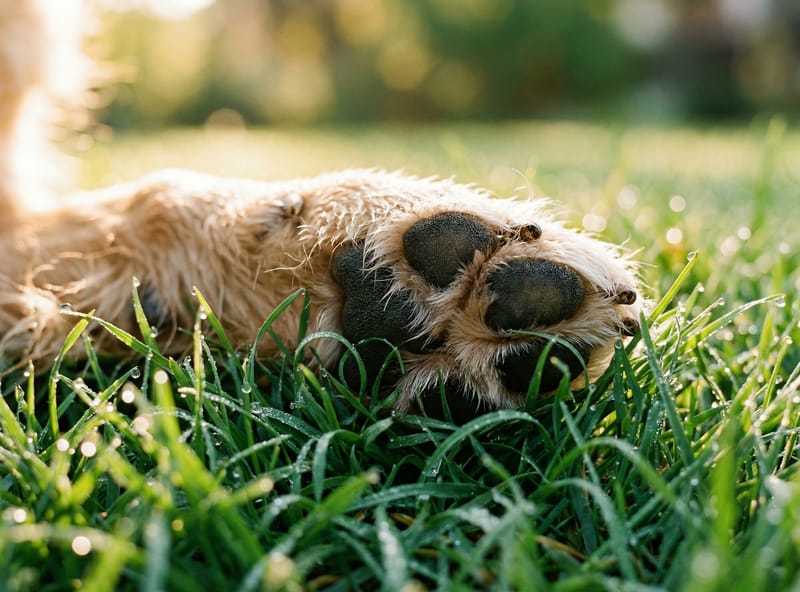
Dog paw pads are highly vascular and permeable. When dogs walk on treated grass, herbicide residues absorb directly through the paw pad tissue and enter the bloodstream. The Purdue study confirmed this pathway — herbicide metabolites appeared in dog urine even when direct contact with wet product was avoided.
Oral Ingestion
Dogs groom their paws after every walk. Chemical residue picked up from grass transfers from paws to mouth. Dogs also eat grass, roll in it, and press their faces into it. Every one of these behaviors is a direct ingestion route.
Dermal Contact
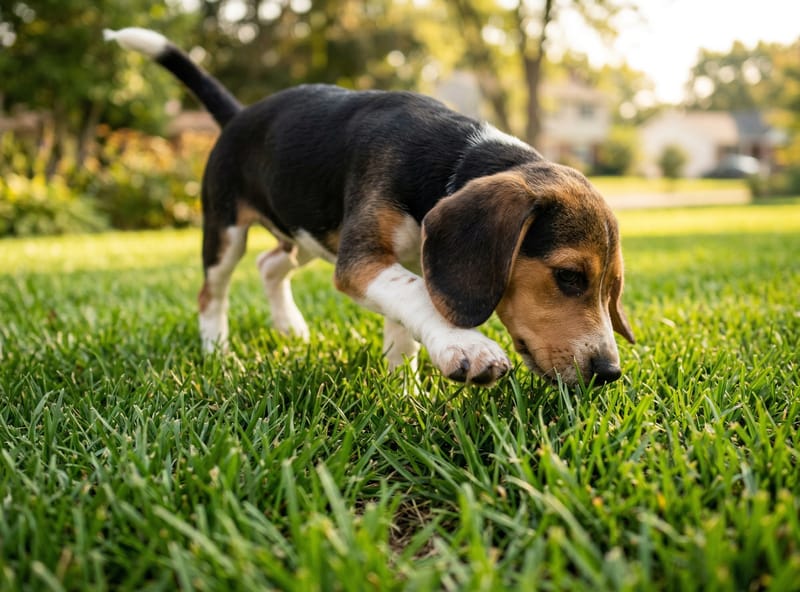
Dogs that lie on treated grass absorb chemicals through their skin — especially on their bellies, where fur is thinnest. Puppies and small dogs, with their lower body clearance, have proportionally greater skin contact with the ground.
Indoor Tracking
Herbicide residues tracked indoors on paws and shoes settle into carpets, rugs, and floors where dogs rest. A NIEHS study found that pesticide residues persisted in household dust for weeks after outdoor application. Dogs sleeping on these surfaces face prolonged, low-level exposure.
This is why the type of herbicide matters more than the waiting period. A product that leaves synthetic chemical residue in your lawn will continue exposing your dog through multiple pathways long after the "safe to re-enter" window passes.
Common Lawn Chemicals and Their Risks to Dogs
The herbicides most commonly found in residential weed killers each carry specific risk profiles for dogs:
| Chemical | Found In | Risk to Dogs |
|---|---|---|
| 2,4-D | Most "weed & feed" products and broadleaf lawn herbicides | Linked to canine malignant lymphoma (Tufts study), DNA damage (Wisconsin study) |
| Glyphosate | Non-selective herbicides and broad-spectrum formulations | IARC classified as probable carcinogen (2015). Detected in dog urine post-exposure |
| Dicamba | Combination broadleaf herbicide products | Associated with increased lymphoma risk in the Tufts study |
| MCPP (Mecoprop) | Combination broadleaf herbicide products | Persists in soil, contributes to cumulative chemical load |
| Triclopyr | Brush killers and woody plant herbicides | Moderate toxicity to animals, persistent in water systems |
These are not obscure agricultural chemicals — they are in the most recognizable consumer weed killer brands on the market. If you are using a conventional broadleaf herbicide on your lawn, there is a high probability it contains at least one of these active ingredients.
For the full environmental and health picture, read our in-depth analysis: The Hidden Costs of Synthetic Herbicides.
Types of Weed Killers: Are They Safe for Dogs?
Dog owners searching for safe products often compare specific brands. Here is what you need to know about the most common ones:
Conventional Synthetic Herbicides
- Glyphosate-based products: The International Agency for Research on Cancer classified glyphosate as a probable carcinogen in 2015. These are non-selective — they kill grass along with weeds. Manufacturers typically recommend keeping pets off treated areas for 24 to 72 hours.
- 2,4-D and dicamba products: The most common active ingredients in broadleaf lawn herbicides. These are the chemicals directly implicated in the Tufts canine lymphoma study. Selective (they save grass) but synthetic, with documented residue persistence.
- Weed-and-feed combination products: Combination fertilizer-herbicide granules that typically contain 2,4-D. Applied broadly across the entire lawn, which maximizes the exposure area for pets.
Non-Selective Natural Herbicides
- Burn-down herbicides: Non-selective organic products that kill everything they contact — grass included. They work on contact but do not differentiate between weeds and turf. Suitable for driveways and patios, not lawns.
The pattern is clear: conventional synthetic herbicides use chemicals linked to canine health risks. Most natural alternatives avoid those chemicals but kill your grass along with the weeds. Neither category solves the problem a dog-owning homeowner actually has: kill the weeds, save the grass, do not harm the dog.
Ready to Take Back Your Lawn?
Salacia™ is the first OMRI-certified selective organic herbicide — kills weeds, not grass. Choose your lawn size:
What Actually Makes a Weed Killer Dog-Friendly
A truly dog-friendly weed killer needs to meet three criteria simultaneously. Most products meet one or two at best.
1. Dual-Action Technology
Hybrisal Technology means one product, two modes — selective at the lawn rate, non-selective at the higher rate. Naturally derived formula that works through dehydration, not poisoning. No synthetic residue in your soil.
2. Third-Party Certification
OMRI certification verifies that ingredients are naturally derived — not just a marketing claim on the label. Independent verification matters.
3. Selective Action
Kills weeds without killing grass. If your weed killer destroys your lawn, you will need to replace it — exposing bare soil where dogs walk and dig.
Salacia: All Three in One Product
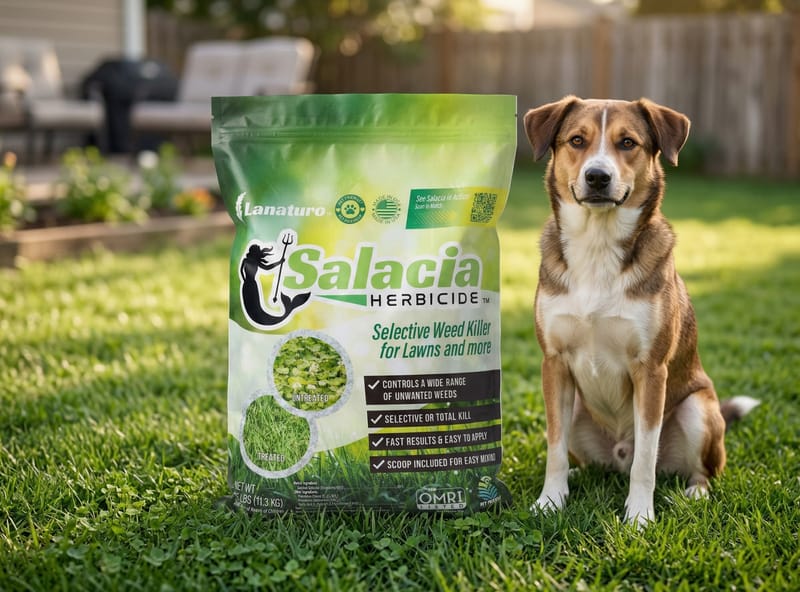
Salacia by Lanaturo is the first OMRI-certified selective herbicide. It checks every box:
- Hybrisal Technology: Dual-action — selective at the lawn rate, non-selective at the higher rate. One product, two modes. Naturally derived formula that works through dehydration, not poisoning.
- OMRI certified organic: Third-party verified, not self-declared. The certification covers the entire formulation, not just individual ingredients.
- Selective: Kills broadleaf weeds — dandelions, clover, ground ivy, wild violet, and more — while preserving grass at the selective mixing rate.
- Pet Friendly: Salacia is Pet Friendly. Let the treated area dry before allowing pets back — not because of safety concerns, but because animals may be attracted to lick the product, which could affect results on the weeds. Always follow label directions.
The mechanism matters more than the marketing. A product that works through dehydration of plant tissue is fundamentally different from one that introduces synthetic chemicals into the lawn ecosystem. One leaves residue; the other does not.
Related: For the broader regulatory and legal context behind why homeowners are switching — and what makes a glyphosate-free weed killer meaningfully different from "natural" alternatives that still carry hazard warnings — read our deep guide.
Organic Weed Killers: Not All Are Equal
The word "organic" does not automatically mean safe or effective for lawns. Understanding the distinction between organic options prevents expensive mistakes.
Non-Selective Organic Herbicides
These products use natural ingredients but kill everything they contact — grass included. They are burn-down herbicides that destroy all foliage on contact. Useful for driveways, sidewalk cracks, and garden paths. Useless for controlling weeds in your lawn because they will leave dead grass patches everywhere you spray.
Selective Organic (Salacia)
Selective organic herbicides target broadleaf weeds based on the biological differences between broadleaf plants and grasses. The broadleaf weed absorbs the treatment and dehydrates; the grass — with its different leaf structure — is unaffected. This is the only organic approach that actually works in a lawn without destroying the lawn itself.
For a deeper comparison, read: Does Organic Weed Killer Work? and Selective vs Non-Selective: The Third Option.
How Long to Keep Dogs Off Lawn After Weed Killer
This depends entirely on the type of product you use:
| Product Type | Recommended Wait | Why |
|---|---|---|
| Synthetic herbicides (2,4-D, glyphosate, dicamba) | 24-72 hours minimum | Genuine toxicity risk. Residues persist in grass and soil. Research shows detection in dog urine even after waiting period. |
| Non-selective organic sprays | Until dry | Generally low toxicity once dry. Non-selective — kills grass along with weeds. |
| Salacia (OMRI-certified selective) | Until dry | Always follow label directions. Let the treated area dry before allowing pets back — not because of safety concerns, but because animals may be attracted to lick the product, which could affect results. Always follow label directions. |
The critical takeaway: with synthetic herbicides, the waiting period exists because of genuine toxicity. With Salacia, the waiting period exists because of product efficacy — you want the product to work on the weed before your dog reduces its effectiveness. The distinction is fundamental.
For the full breakdown of pet safety across every herbicide type, read: Is Organic Weed Killer Safe for Pets? What You Need to Know.
How to Choose the Right Dog-Friendly Weed Killer
Cut through the marketing noise with this checklist:
- Check the active ingredients. If the label lists 2,4-D, dicamba, glyphosate, triclopyr, or MCPP — it is a synthetic chemical herbicide regardless of what the brand name implies.
- Look for OMRI certification. This is the gold standard for organic verification. It means a third-party organization has verified the ingredients, not just the manufacturer's marketing department.
- Confirm it is selective. If the product kills grass, it is non-selective. You will be left with dead patches that need reseeding — and bare soil is where dogs dig, eat, and absorb more of whatever is in the ground.
- Read the pet language carefully. "Pet Friendly" on the label is different from "keep pets off lawn for 48 hours" buried in the fine print. The former indicates the product was designed with pets in mind; the latter is a liability warning. For the full breakdown of what label language means for dogs and cats — re-entry guidance, mechanisms, and the questions worth asking — see our complete guide to organic weed killers and pets.
- Understand the mechanism. Dehydration-based herbicides leave no synthetic residue. Translocating synthetic herbicides persist in plant tissue and soil. Learn how selective herbicides work.
Your dog does not read product labels. They walk on whatever you put on the lawn, lick whatever gets on their paws, and sleep on whatever tracks into the house. The product you choose should be one that makes all of those behaviors safe — not one that requires you to prevent them for days.
Comparing your options?
Our full breakdown of what to look for — and what to avoid — is in the organic weed killer guide. Four criteria, real comparison, no marketing fluff. If keeping your grass is the worry, see the best weed killer that won't kill grass.

Lawn
Advisor
Not sure which weed you're looking at? Show Sal.
Sal is Lanaturo's lawn-care expert. He doesn't just name the weed — he builds your exact treatment plan and checks whether today is the right day to spray.
Ready to Take Back Your Lawn?
Salacia™ is the first OMRI-certified selective organic herbicide — kills weeds, not grass. Choose your lawn size:
Your Dog Deserves a Safe Lawn
The research is peer-reviewed and consistent: common lawn chemicals are not as safe for dogs as their labels suggest. Canine lymphoma, bladder cancer, DNA damage — these are not hypothetical risks. They are documented outcomes from the products millions of homeowners spray on their lawns every spring.
You do not have to choose between a weed-free lawn and your dog's health. You do not have to time your pet's outdoor access around chemical drying schedules. And you do not have to wonder what your dog is absorbing through their paws every time they step outside.
Pet Friendly. OMRI certified. The first selective organic herbicide — because your lawn should be the safest place your dog knows.
Horse owners share similar concerns about herbicide safety in grazing areas. See our guide on horse pasture weed control for equine-specific organic treatment strategies.
Salacia is OMRI Listed for organic use and made from naturally derived ingredients. Always follow label directions for best results. Performance may vary based on weed maturity, environmental conditions, and application method. Grass tolerates Salacia at the selective mixing rate, though you may see temporary paling or yellowing that recovers as the grass grows out — always test a small area first to see how your specific lawn responds before treating the whole yard.