
 By Pat Kelly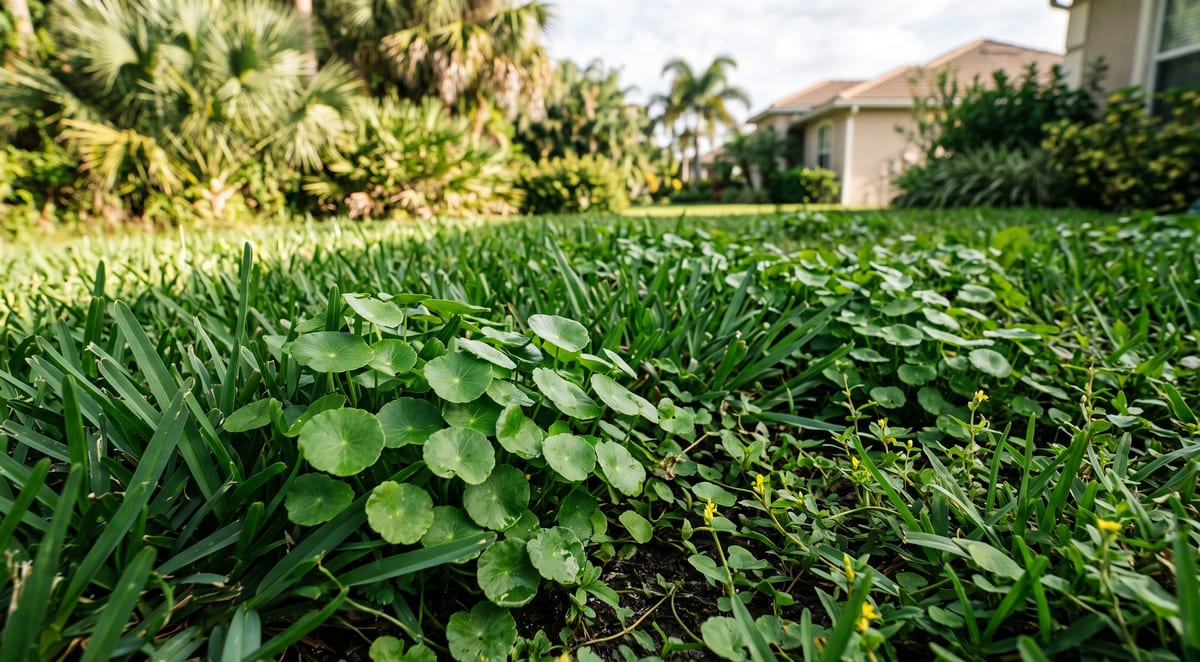
Florida doesn't have a weed season. It has a weed calendar with no blank pages. The growing conditions that make your lawn lush twelve months a year — heat, humidity, sun, irrigation — grow weeds twelve months a year too, in two organized shifts: a summer crew that loves the rain, and a winter wave that moves in the moment soils cool while the rest of the country's lawns are asleep. Beating Florida weeds isn't one heroic weekend; it's knowing which shift you're facing, which weeds your spray can honestly handle, and which rules your grass type sets.
The short answer: Most of Florida's worst lawn weeds — dollarweed, chamberbitter, spurge, oxalis, chickweed, henbit, Carolina geranium, lawn burweed, Virginia buttonweed, Florida betony — are broadleaf weeds, and broadleaf weeds are exactly what Salacia kills at the selective lawn rate of 1 lb (about 3 cups) per gallon: it targets them while being designed to spare your grass, on every turf type, with one rule that never changes — always test a small area first. The grassy invaders — doveweed, torpedograss, crabgrass — are a different, honest story covered below.
Not sure what's eating your lawn?
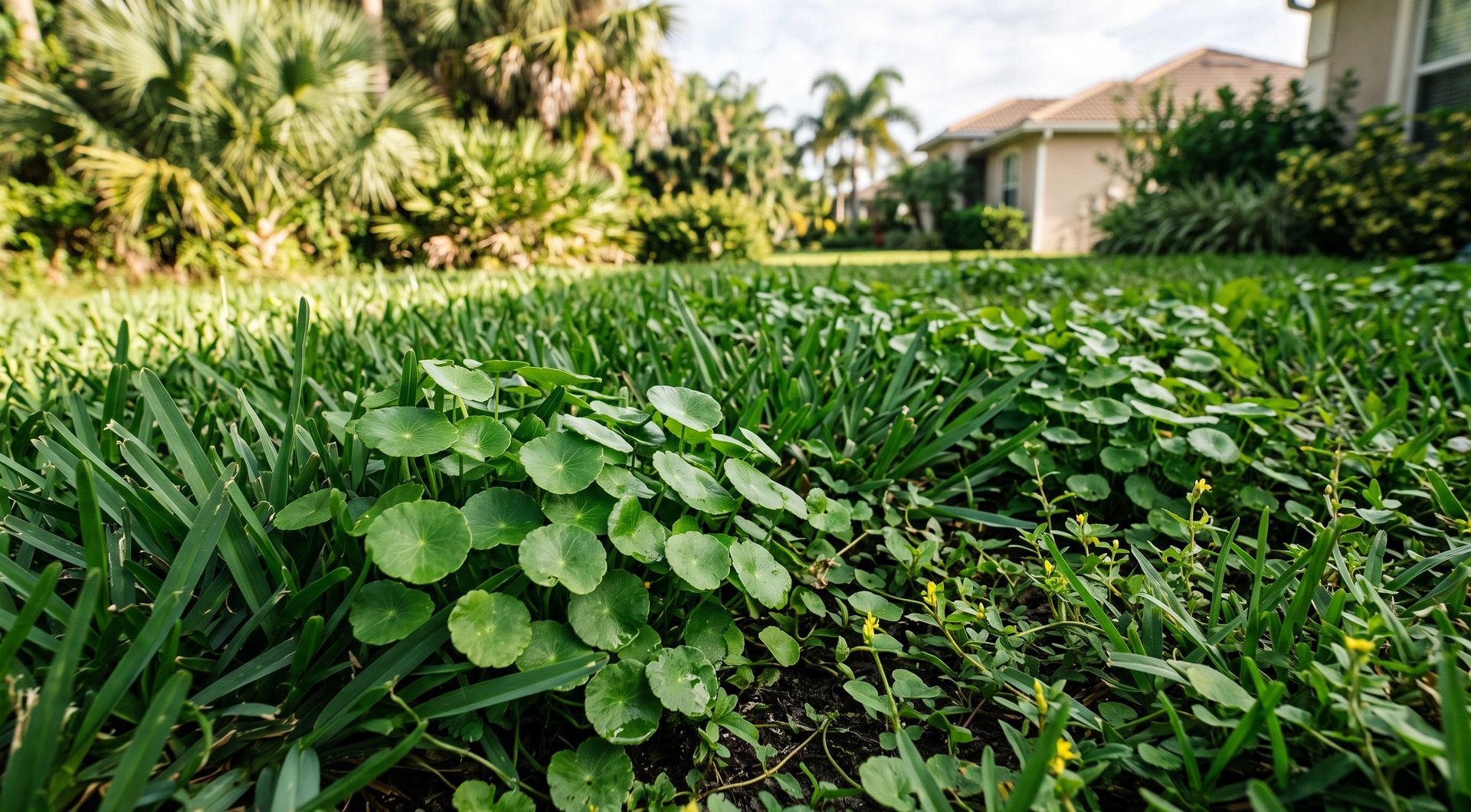
Round coin-shaped leaves on little stalks? Dollarweed. A tiny mimosa seedling with seeds under the leaves? Chamberbitter. A lime-green grass seeding at mowing height? Poa annua. Or skip the guesswork: snap a photo and send it to Sal, our free weed-ID assistant, right on this page. See how Sal works →
The Summer Crew (In Your Lawn Right Now)
Daily rain, warm nights, and irrigated turf: summer Florida is a broadleaf paradise. These are the weeds thriving in it as you read.
Dollarweed (pennywort)
Round, coin-shaped leaves on stalks, marching through the damp parts of the lawn — dollarweed is Florida's moisture meter, and a colony usually means the soil under it stays wet. It's a broadleaf, so the selective treatment handles it; fixing the water is what keeps it gone. The full playbook, including the drainage detective work, is in our dollarweed guide.
Chamberbitter (the "little mimosa")
Feathery seedling that looks like a baby mimosa tree with rows of tiny seed capsules hiding under each leaf — chamberbitter explodes through Gulf-state lawns every summer, and every capsule it ripens is next month's outbreak. Timing and coverage decide the fight: our chamberbitter guide walks the whole battle.
Spurge, oxalis, and the mat-formers
Prostrate spurge spreads flat, dark-mottled mats across hot, thin spots; oxalis (the clover lookalike with heart-shaped leaflets and tiny yellow flowers) never seems to take a month off in Florida. Both are broadleafs, both die to thorough selective coverage — mats need the spray to get under the canopy, not just across the top. Guides: spurge.
Virginia buttonweed
Low, spreading, with opposite lance-shaped leaves and small white four-petal stars at the leaf joints, loving the same wet lawns dollarweed loves. It's a tough, deep-rooted broadleaf perennial: treat with thorough selective coverage, expect a follow-up on established mats, and fix the moisture that invited it — the same wet-lawn detective work as dollarweed.
Also on summer duty: doveweed — but it's a grassy weed wearing a broadleaf costume, so it lives on the honest list below.
The Winter Wave (Germinating in Weeks)
Here's the Florida twist most lawn advice misses: while northern lawns shut down for winter, Florida's weed pressure just changes uniforms. As soils finally cool in late fall, a whole cool-season cast germinates — and because warm-season grasses slow down or go semi-dormant at exactly that moment, the newcomers get the lawn almost to themselves until spring.
The winter roster, in order of appearance
Poa annua (annual bluegrass): lime-green tufts seeding at mowing height all winter — the one winter weed no spray removes selectively, with its own honest plan: our poa annua guide.
Chickweed: soft, sprawling mats with tiny star-white flowers — chickweed guide.
Henbit: square stems, scalloped clasping leaves, purple bloom by February — henbit guide.
Carolina geranium: deeply cut leaves, wiry red stems, pink specks of flower — Carolina geranium guide.
Lawn burweed: the villain of the list. A feathery, parsley-like winter rosette nobody notices — until spring, when it hardens into the spiny stickers that end barefoot season. The entire fight happens in winter, while it's soft and sprayable: kill the rosettes when you see them, because by the time it hurts, the spines are already built.
Florida betony (rattlesnake weed): square stems and a segmented white tuber like a rattlesnake's tail. Topgrowth dies to selective treatment; the tuber makes it a repeat opponent — persistence wins, and never rototill a betony patch (every chopped tuber piece is a new plant).
All of the winter wave except poa annua is broadleaf — which means one selective pass in the young-rosette stage, thorough coverage, handles the lot. The strategic gift Florida hands you: your winter weeds are visible on slowed-down turf and tender from youth. Winter is Florida's easiest killing season, and our timing guide explains why cool-season applications still work — they just take longer to show.
Ready to Take Back Your Lawn?
Salacia™ is the first OMRI-certified selective organic herbicide — kills weeds, not grass. Choose your lawn size:
Your Grass Sets the Rules
St. Augustine (including Floratam) carpets more Florida yards than any other grass, and it's famously picky about herbicides: UF/IFAS documents its sensitivity to common synthetic broadleaf actives, and the popular synthetic answer carries temperature restrictions that rule out much of the Florida year. That's the backdrop for the one rule that actually travels: whatever you spray, know your grass and read the label like it's the whole decision — because on St. Augustine, it is. Salacia's rule is the same on every turf type, cool-season or warm: the selective rate is designed to spare the lawn, and you always test a small area first. No asterisks by grass type, no temperature fine print by variety — one rate, one caveat, every lawn. The full St. Augustine picture — chinch-bug openings, shade thinning, the careful-control mindset — lives in our St. Augustine weed guide.
Bermuda plays a different game: bulletproof in July, wide open in winter when it goes fully dormant and every green weed advertises itself against the tan — the whole inverted strategy is in the bermuda weed guide. Zoysia, centipede, and bahia lawns follow the same Salacia rules as everything else — selective rate, full coverage, test a small area first — with the same winter-wave calendar as their neighbors.
The Broadleaf Plan for Every Florida Lawn
One plan covers the entire broadleaf lineup on this page, summer or winter. Salacia is the first OMRI-certified selective organic herbicide — naturally derived, Pet Friendly, made by Lanaturo — and it kills through rapid osmotic dehydration on contact.
1. Mix the selective lawn rate
1 lb (about 3 cups) of Salacia per gallon of water, dissolved fully and kept agitated in the tank.
2. Drench to runoff — coverage is the whole game
Contact means contact: if the spray doesn't touch it, it doesn't kill it. Coat every leaf, stem, and crown, get under mats and canopies, and wet the soil ring at the base. Your results are directly proportional to your coverage.
3. Pick a Florida-smart window
A calm morning between 60 and 80 degrees Fahrenheit with no rain in the near forecast. In the Florida summer that means going early, before the heat and the afternoon storm cycle; in winter, midday windows qualify more often than anywhere north of you.
4. Respect the caveat — every lawn, every time
The selective rate is designed to spare grass, and temporary paling or yellowing is still possible depending on rate, lawn health, and conditions. Test a small area first. On St. Augustine, treat that as gospel.
For weeds in driveways, beds, gravel, and fence lines — anywhere grass doesn't matter — the non-selective rate of 1.5 lb (about 4 cups) per gallon takes down all vegetation it drenches. Never use it on turf you want to keep.
The Honest List: What No Spray Fixes
Some Florida invaders are grasses and sedges inside your grass, and we'll tell you straight what that means: no product — ours included, organic or otherwise — selectively lifts them out of a living lawn.
Doveweed looks like a fleshy broadleaf but is a grassy summer annual that loves soggy lawns; treat dense patches like a small renovation, and fix the water. Torpedograss is the brutal one — a rhizome machine that laughs at partial measures; dense invasions are a renovate-and-replant decision, not a spray decision. Crabgrass gets the same honesty in our crabgrass guide, sedges in the nutsedge guide, and poa annua in its honest guide. Can't tell which grassy intruder you have? The grass-lookalike ID guide sorts all nine with one tell each.
The consolation prize is real: in Florida's growing climate, dense turf recovers and fills faster than almost anywhere — every renovation you do closes for good if you reseed or replug thick and keep the lawn fed.
The whole Florida playbook in one place
Identify with Sal (photo in, weed ID and plan out). Treat the broadleafs with the selective rate — the ranked comparison lives in our guide to weed killers that won't kill grass. Handle the grassy invaders with honesty, not wishful spraying. And build density all year — the full weed control guide ties it together. Florida gives weeds twelve months; it gives your lawn twelve months right back.

Lanaturo
Intelligence
Not sure which weed you're looking at? Show Sal.
Sal is the lawn-care brain behind Lanaturo Intelligence. He doesn't just name the weed — he builds your exact treatment plan and checks whether today is the right day to spray.
Ready to Take Back Your Lawn?
Salacia™ is the first OMRI-certified selective organic herbicide — kills weeds, not grass. Choose your lawn size:
Twelve Months, One Plan
Florida's weeds work in shifts — so work in shifts back. Sweep the summer broadleafs with thorough selective coverage. Meet the winter wave while it's young, soft, and visible on slow turf. Renovate the grassy patches once, properly. And let Florida's twelve-month growing season do for your turf what it's been doing for the weeds.
OMRI certified organic · Pet Friendly · Always test a small area first
Your lawn lives here year-round too.
This article is for informational purposes. Agronomic references: UF/IFAS Extension — Weed Management in Home Lawns and St. Augustinegrass for Florida Lawns. Always follow product label directions for application rates, timing, and use.